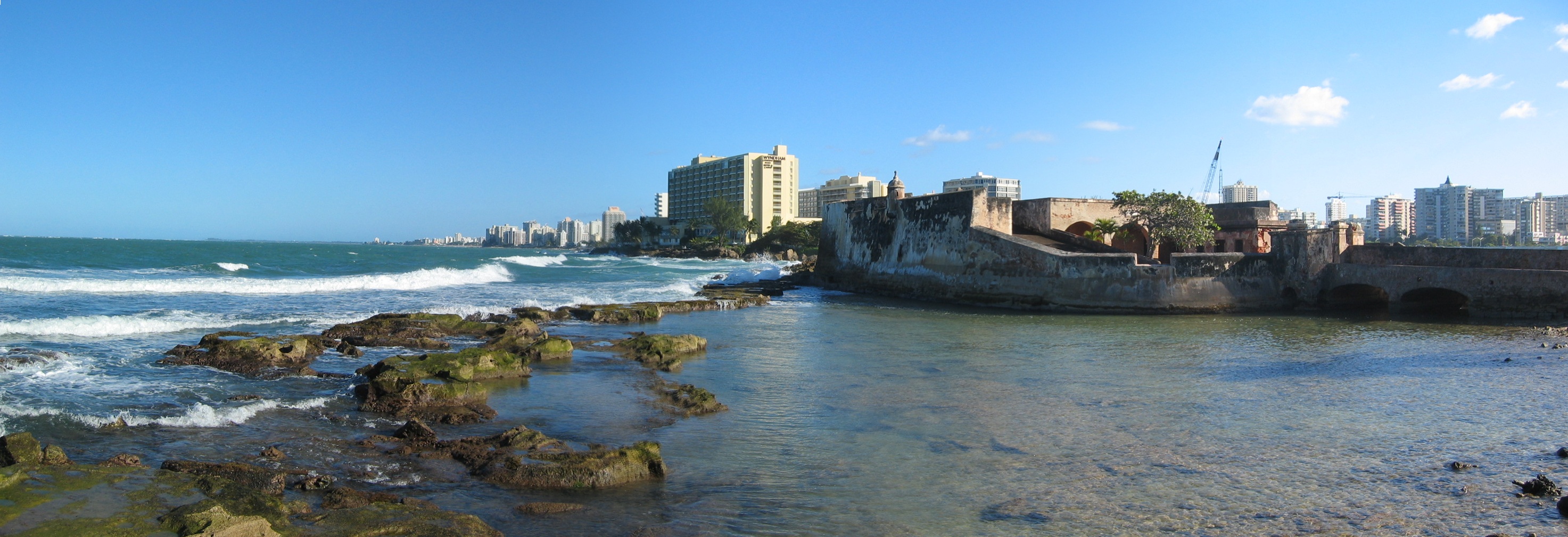
Fortin de San Geronimo
The Condado Lagoon spills into the Atlantic through a narrow throat, and perched on the rocks at that opening sits a fort so small you could mistake it for a guardhouse. Do not be fooled by the scale. Fortin de San Geronimo de Boqueron has punched far above its weight since the 18th century, absorbing broadsides from British warships, weathering two centuries of hurricanes, and outlasting the luxury hotels that now crowd its flanks. Built to replace an even older battery called El Boqueron -- one that Sir Francis Drake attacked in 1595 and the Earl of Cumberland destroyed in 1598 -- San Geronimo anchored the eastern defenses of San Juan at a time when the Caribbean was a chessboard of empires.
The Night the British Came
On April 17, 1797, somewhere between 64 and 68 British ships appeared off San Juan carrying as many as 13,000 men under Admiral Henry Harvey and Sir Ralph Abercromby. The defenders were outnumbered roughly three to one. Abercromby's plan was straightforward: take the Martin Pena Bridge to cut off Spanish reinforcements from the south, then bombard San Geronimo and its neighbor Fortin San Antonio from the heights of Miramar until both crumbled, clearing a path across the San Antonio Bridge and into the San Juan islet. For two weeks the bombardment was relentless. Chronicles describe the fort's defenders firing muskets and cannons from behind sandbags because the stone walls had been blasted apart around them. Governor Ramon de Castro y Gutierrez, a gifted tactician, kept the British from ever crossing. Both forts were eventually rebuilt and expanded, their scars absorbed into thicker walls.
A Fort Between Empires
San Geronimo served as San Juan's first line of defense alongside Fortin San Antonio and Escambron Fort. Behind them loomed the formidable Castillo San Cristobal, the last line guarding the city entrance. This layered system meant that any force approaching San Juan from the east had to fight through a gauntlet before reaching the capital proper. The original El Boqueron battery had already proven the site's strategic value against Drake and Cumberland decades before. When the Spanish rebuilt at the same location in the 18th century, they understood something about this narrow passage between lagoon and ocean: whoever held it controlled access to the entire eastern approach. The fort's gunpowder house, the Polvorin de San Geronimo, was built in 1769 and still stands today as part of Luis Munoz Rivera Park nearby.
Squeezed by Progress
Today San Geronimo sits adjacent to the grounds of the Caribe Hilton Hotel, a juxtaposition that tells its own story about competing claims on Puerto Rico's coast. The fort was listed on the National Register of Historic Places on October 11, 1983, but unlike the celebrated forts of Old San Juan, it was never incorporated into San Juan National Historic Site. Owned by the Instituto de Cultura Puertorriquena but managed by the Hilton, the fort occupied an uneasy position between public heritage and private commerce. In July 2007, that tension erupted when protesters occupied the site to block construction of Paseo Caribe, a tourism development they argued would seal off public access to the fortification. For a week, demonstrators climbed construction cranes while the centuries-old walls watched another kind of siege.
The Long Campaign to Save It
Erosion has been San Geronimo's most persistent enemy. By 2006, the Instituto de Cultura Puertorriquena and the U.S. Army Corps of Engineers were working to build a breakwater to halt deterioration that threatened to damage the fort beyond repair. Senate Vice President Orlando Parga led efforts to keep nearby construction projects from encroaching on the site. After two decades closed to the public, a nonprofit called the Asociacion Amigos del Fortin de San Jeronimo was founded in 2018 to shepherd the fort's preservation and eventual reopening. In 2023, the U.S. House of Representatives passed a bill that would make San Geronimo an affiliated area of the National Park Service, potentially giving it the federal backing its defenders have long sought. The Omnibus Public Land Management Act of 2009 had already directed the Secretary of the Interior to study the fort's suitability for inclusion in the San Juan National Historic Site -- a process that moves at its own geological pace.
From the Air
Located at 18.463N, 66.084W on the San Juan islet at the mouth of Condado Lagoon. Visible from low altitude as a small stone structure between the Caribe Hilton Hotel and the Condado district. Best viewed on approach to San Juan's Luis Munoz Marin International Airport (TJSJ). The fort sits at sea level; nearby landmarks include the Condado Bridge and the distinctive lagoon opening to the Atlantic.