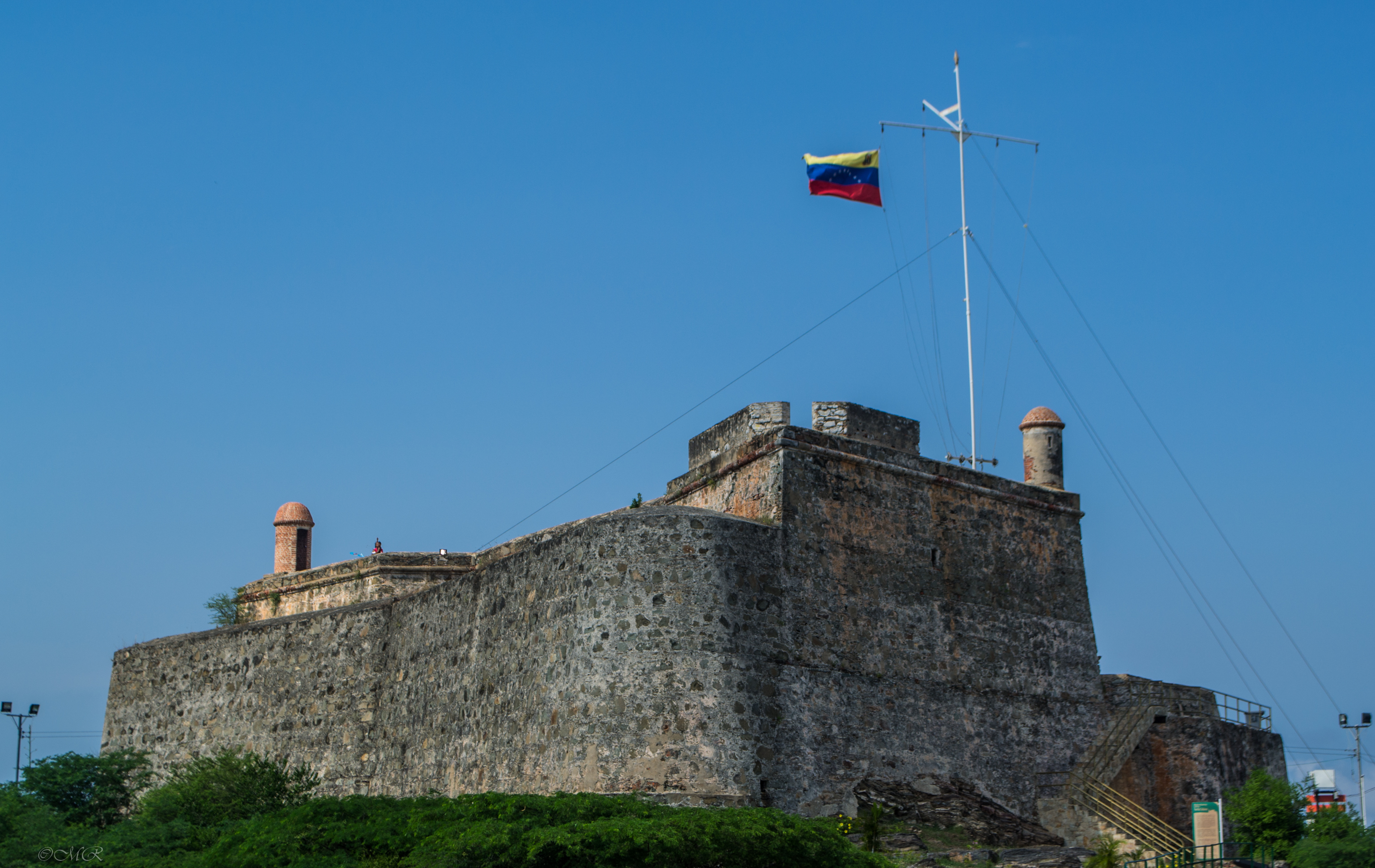
Fortín Solano
They called the ridge Cresta de Vigía - the lookout crest - and anyone standing on it can see why. From this jungle hilltop south of Puerto Cabello, the Caribbean stretches to the horizon, and every ship entering the harbor below is exposed. Spain built Fortín Solano here between 1763 and 1771, the last military fortification it would ever construct in Venezuela. The fort was designed to rain artillery down on attackers from above while its older companion, Castillo San Felipe, guarded the waterline. Together they formed a defensive pair: one watching, one fighting. What Spain did not foresee was that the fort's most dramatic chapters would unfold not against foreign navies but against Spain itself.
A Flagpole Execution
On September 1, 1813, in the middle of the Admirable Campaign, patriot forces aided by Rafael Urdaneta launched a surprise attack on Puerto Cabello and captured Fortín Solano from the royalists. Among the prisoners taken the following day was Antonio Zuazola, a Spanish commander notorious for having mutilated hundreds of captives in eastern Venezuela. Simón Bolívar, leading the patriot cause, offered Domingo de Monteverde a prisoner exchange: Zuazola for Domingo Jalón. The royalists refused. Bolívar ordered Zuazola hanged from a flagpole outside the fort's walls - a grim piece of justice carried out in full view of the harbor below. The fort had changed hands, and the message was unmistakable.
The Assassin in Irons
Fortín Solano's cells held another famous prisoner fifteen years later. Pedro Carujo had been handpicked by Bolívar himself to lead the Military Academy in Bogotá. But when Bolívar declared his dictatorship in 1828, Carujo turned against him, joining conspirators who wanted Francisco de Paula Santander installed as constitutional president. On the night of September 25, 1828, they attempted to kill Bolívar in the presidential palace. He escaped only because Manuela Sáenz helped him jump from a window into the darkness. Carujo was sentenced to death and transferred to Fortín Solano in March 1829. He managed to escape, was recaptured and clapped in irons, then deported to Curaçao in June 1830. He returned to Venezuela months later under the government of José Antonio Páez - a survivor of his own failed revolution.
The Porteñazo
The fort saw one more violent chapter in the twentieth century. On June 2, 1962, military commanders led by Manuel Ponte Rodriguez launched the Porteñazo, an uprising against the government in Puerto Cabello. The national government responded immediately, sending Air Force bombers and Army troops under Colonel Alfredo Monch to surround the city. Most officers of the 55th National Guard squadron refused to join the rebellion. By June 3, the Ministry of Interior declared the revolt crushed, reporting 400 dead and 700 wounded. Fortín Solano had served as the rebels' last stronghold. On June 6, Army forces stormed the fortress and captured the remaining leaders. The old Spanish walls had witnessed one more siege - this time Venezuelan against Venezuelan.
Stone and Canopy
Today the fort stands inside San Esteban National Park, established in 1987, its walls wrapped in tropical vegetation. It was declared a National Monument in 1965, three years after the Porteñazo scarred its stone. The park protects not only the ecological corridor of the coastal range but also other colonial-era infrastructure, including the Camino de los Españoles, the old Spanish road that once connected Puerto Cabello to Valencia del Rey. Walking that road today, beneath a canopy of green, you trace the same route that soldiers, merchants, and prisoners traveled for centuries - all of it leading uphill toward the fort on the lookout crest, still watching the harbor it was built to defend.
From the Air
Located at 10.4625N, 68.017W, on a hilltop south of Puerto Cabello in Carabobo state, Venezuela. The fort sits within San Esteban National Park at moderate elevation on the Cresta de Vigía ridge. Puerto Cabello's harbor is visible to the north. From the air, look for the coastal city of Puerto Cabello and the forested hills immediately to its south. Nearest airport: Arturo Michelena International Airport (SVVA) in Valencia, approximately 30 km to the southeast. The coastal range creates turbulence; expect clear Caribbean visibility on calm days.