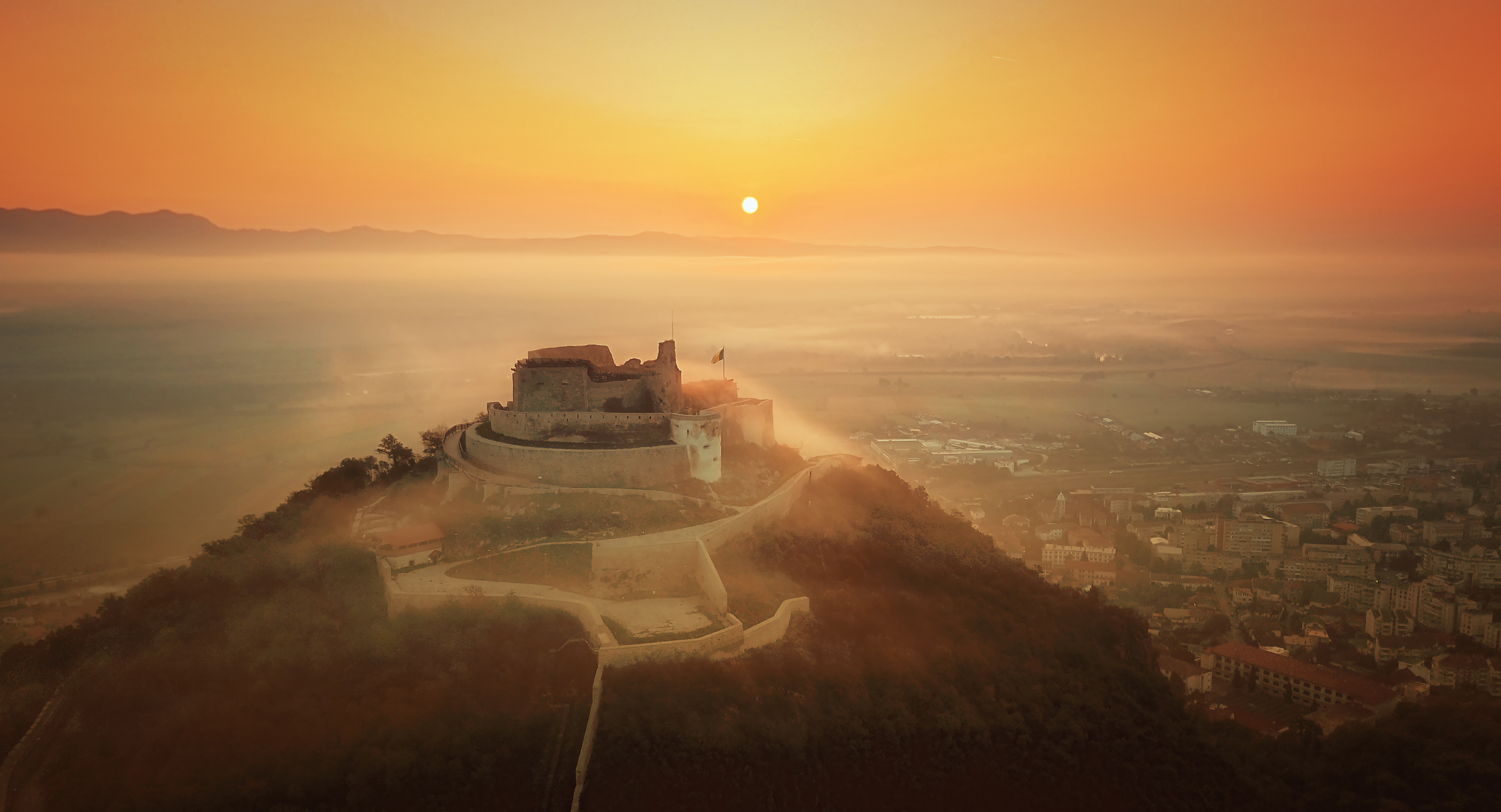
Fortress of Deva
In 1273, a Hungarian palatine named Peter Csak defeated the Cumans beneath the walls of Deva Fortress and earned a royal letter praising his courage: sub castro Dewa contra Cumanorum exercitur viriliter dimicavit -- "fought bravely against the Cumans under the Castle of Deva." The Latin phrasing tells you something about the fortress's importance: it was worth writing about in the language of official record. Perched on a volcanic hill in the Poiana Rusca range of the Western Carpathians, the Fortress of Deva has overlooked the Mures River valley for more than seven hundred years. The city of Deva spreads from its base, growing outward from the Magna Curia palace and public park toward the administrative buildings -- courthouse, prefecture, city hall -- that cluster nearby like courtiers around a throne.
The Salt Road Below
The fortress's location was strategic from the start. Romans strengthened the walls and defended the hilltop because the trade road connecting their imperial provinces -- commonly called the salt road -- passed directly at the foot of the hill. The Mures basin experienced its peak economic prosperity during the Roman era, and control of the heights above the river meant control of commerce flowing through the valley. When medieval powers inherited the landscape, the calculus was the same. A garrison on a volcanic hill with clear sightlines in every direction commanded not just territory but the movement of goods, armies, and information through one of Transylvania's most important corridors.
Kings, Counts, and Gold Mines
The earliest documentary evidence of the medieval fortress dates to 1269, when Stephen V, King of Hungary and Duke of Transylvania, mentioned "the royal castle of Deva" in a privilege-grant for Count Chyl of Kelling. Four years later came the battle against the Cumans that earned Peter Csak his royal commendation from King Ladislaus IV. By the late 13th century, the fortress belonged to Ladislaus Kan, Voivode of Transylvania, who maintained both a court and a military garrison -- turning Deva into a seat of regional governance as well as defense. Then came the Hunyadis. In 1444, John Hunyadi took possession of the fortress and all its riches: 56 villages and gold mines. During his tenure, the settlement at the base of the hill received its first written mention as a fair town. The Corvin family, Hunyadi's descendants, held the fortress and domain until 1504.
Volcanic Rock, Living City
The hill itself is volcanic, part of the Poiana Rusca range within the Western Carpathians, and it gives the fortress a dramatic natural pedestal visible for kilometers. At its base, Deva grew into a proper city with institutions that reflect centuries of administrative importance: the Decebal National College and the Pedagogic Lyceum, two of the city's oldest schools, stand near the cluster of government buildings that ring the park. The fortress above them is no longer a seat of power but a tourist destination, connected to the city below by an inclined lift that carries visitors up the slope. From the top, the view encompasses the same Mures Valley that Romans, Cumans, Hungarian kings, and Transylvanian voivodes fought over. The landscape has been worth controlling for two millennia.
Ruins That Refuse to Be Forgotten
Unlike its neighbor Corvin Castle in Hunedoara, 15 kilometers to the south, the Fortress of Deva was never romantically restored. What stands on the hilltop today is ruin -- broken walls and foundations that trace the outline of a once-formidable stronghold. In some ways, the honest decay tells a more accurate story than reconstruction would. The fortress cycled through owners and empires, each leaving marks on the stonework before the next arrived. Historical sketches from the 19th century, including lithographs by the German artist Ludwig Rohbock, capture the citadel in an already-picturesque state of decline. The ruins are classified as a historic monument in Hunedoara County, a designation that protects what remains while acknowledging that the fortress's most dramatic chapters ended centuries ago.
From the Air
Located at 45.89N, 22.90E atop a volcanic hill in Deva, Romania. The fortress ruins are clearly visible from the air, sitting on a prominent hilltop above the city and the Mures River valley. Look for the inclined lift track running up the hillside. Corvin Castle in Hunedoara is approximately 15 km to the south. Nearest major airport is Sibiu International (LRSB), about 100 km east. The Mures Valley runs east-west through the region, providing a natural navigation corridor.