Fortress of Mimoyecques
Deep inside a chalk hill in the Pas-de-Calais, twenty-five long steel barrels were meant to point at London. Each was to be 127 metres long. Each would be wedged at exactly 299 degrees, a direct line on Westminster Bridge, and angled at fifty degrees down into the rock. The plan was to fire ten shots a minute from the lot of them: 600 shells an hour, in perpetuity, falling on the British capital from 165 kilometres away. The plan was carried out by more than 5,000 workers, including Soviet prisoners of war used as forced labour. Not a single shell was ever launched at London. The bombers got there first.
The Hill That Was Pointed at a Bridge
Major Bock, a German fortifications officer with the LVII Corps near Dieppe, found the site in 1943. He needed a chalk hill, not too deep in topsoil, with a rock core thick enough to tunnel into without timber supports. The Mimoyecques ridge, 158 metres high and exactly 165 kilometres from London, fit the specification. It also sat a few kilometres west of the main Calais-Boulogne railway, behind the cliffs of Cap Gris-Nez where the V-1 and V-2 sites were already going in. Hitler signed off. Speer signed off. In September 1943, Organisation Todt began laying railway lines toward the hill. In October they began excavating the inclined shafts, five of them on the eastern complex, each angled fifty degrees into the chalk, each meant to hold a stacked cluster of five gun tubes. Five times five gives twenty-five barrels. Every one of them aimed at the same point on a London bridge.
The Workers in the Chalk
More than five thousand people built the eastern complex. The German engineering was led by Mannesmann, Krupp, Gute Hoffnungshütte, and the Vereinigte Stahlwerke. Four hundred and thirty miners came from the Ruhr. The rest were Soviet prisoners of war, who were not workers in any meaningful sense of the word. They were captives, dragged west across a continent, made to dig the floor of someone else's revenge. They were the most expendable workforce the Reich had. Mimoyecques is not on the scale of the camps at Wizernes or Watten, where tens of thousands suffered, but the men who broke chalk in these galleries broke chalk under guard, in cold and damp, for a weapon meant to kill civilians in another country. Their names are mostly lost. Their work, oddly, lasted. The galleries are still there. The dignity Germany denied them in 1943 belongs to them anyway.
The Gun That Could Not Quite Work
What the workers did not know, and the Allies did not know either, was that the gun itself was failing. The Hochdruckpumpe (High Pressure Pump), or V-3, was supposed to use a chain of secondary propellant charges along the barrel's length to push a 150-millimetre fin-stabilised shell at 1,500 metres per second. In practice, at speeds above 1,000 metres per second the shells began tumbling in flight, falling far short of the target. The Germans only realised this after manufacturing over 20,000 projectiles. By April 1944, after a failure at the Misdroy test gun on the Baltic, the plan at Mimoyecques was cut from five drifts to three. They were still trying to fix the projectile when the bombs arrived.
Operation Crossbow
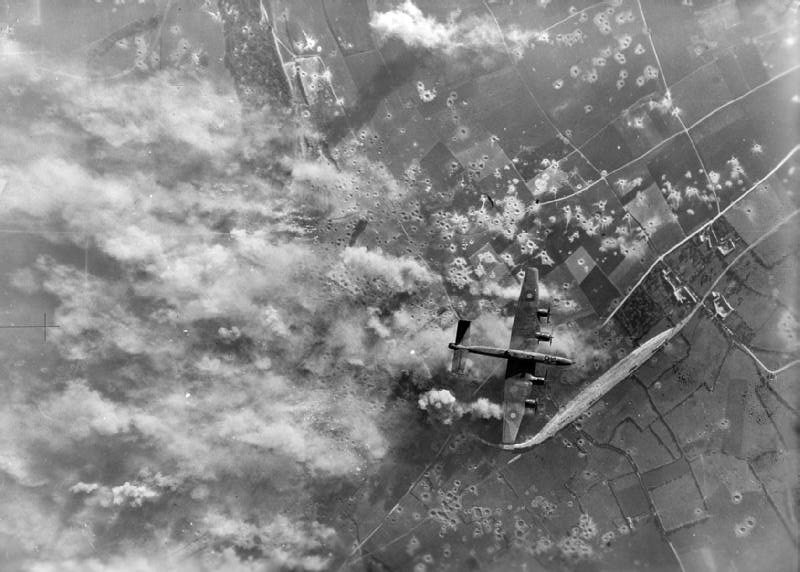
Allied intelligence had been watching the hill since September 1943, when a photo analyst named André Kenny noticed that a haystack covering one of the shafts had blown apart in a gale, exposing a windlass and pulley. The Allies thought it was a V-2 site, then a railgun, then they were not sure at all. They bombed it anyway. On 8 November 1943 the RAF struck with 72 Boston and Mitchell medium bombers. On 19 March 1944 the US Ninth Air Force hit it with 173 B-17 Flying Fortresses. On 6 July 1944, 617 Squadron RAF, the Dambusters, attacked using 5,400-kilogram Tallboy earthquake bombs. Wing Commander Leonard Cheshire marked the target from his Mustang fighter, on his hundredth and final operation as squadron commander. One Tallboy bored into the chalk and detonated underground, leaving a crater large enough to swallow a house. The site was effectively finished. In an offshoot called Operation Aphrodite, the US Army Air Forces flew radio-controlled B-17s packed with explosives at targets including Mimoyecques; the US Navy ran a parallel effort, Operation Anvil, using converted B-24 Liberators. In one such Navy mission on 12 August 1944, Lieutenant Joseph P. Kennedy Jr., elder brother of the future President John F. Kennedy, was killed when his drone bomber exploded prematurely over the Suffolk coast of England.
Bats in the Galleries
After the war, Royal Engineers stacked thirty-five tons of bombs and captured German plastic explosive in the tunnels and blew the entrances inward. The site was abandoned. For decades, locals could still climb down one of the inclined drifts. In time the Conservatoire d'espaces naturels du Nord et Pas-de-Calais bought the property for 330,000 euros, partly because a colony of rare bats, including the Greater Horseshoe and Geoffroy's Bat, had moved into the cold, dark galleries. A new museum opened under the management of La Coupole, the V-2 bunker museum near Saint-Omer. Today, visitors descend into shafts that were dug to fire 600 shells an hour at London, and find that the chalk is full of small, sleeping mammals. The guns are gone. The aim, 299 degrees toward Westminster Bridge, is still there in the rock. So is the silent record of the people who were made to dig it.
From the Air
The Fortress of Mimoyecques sits at 50.853°N, 1.759°E in the rolling chalk country south of Cap Gris-Nez, about 18 km southwest of Calais and 25 km north of Boulogne-sur-Mer. The wartime cliff battery at Cap Gris-Nez is 8 km north-northwest. Calais-Dunkerque (LFAC) is the nearest airport at 20 km north-northeast; Le Touquet (LFAT) sits 35 km south. Best viewed from 2,500-4,000 feet, ideally with low oblique light, when the surviving Tallboy crater on the hillside and the modern museum entrance show clearly against the surrounding fields. The site is a few kilometres west of the modern A16 motorway.