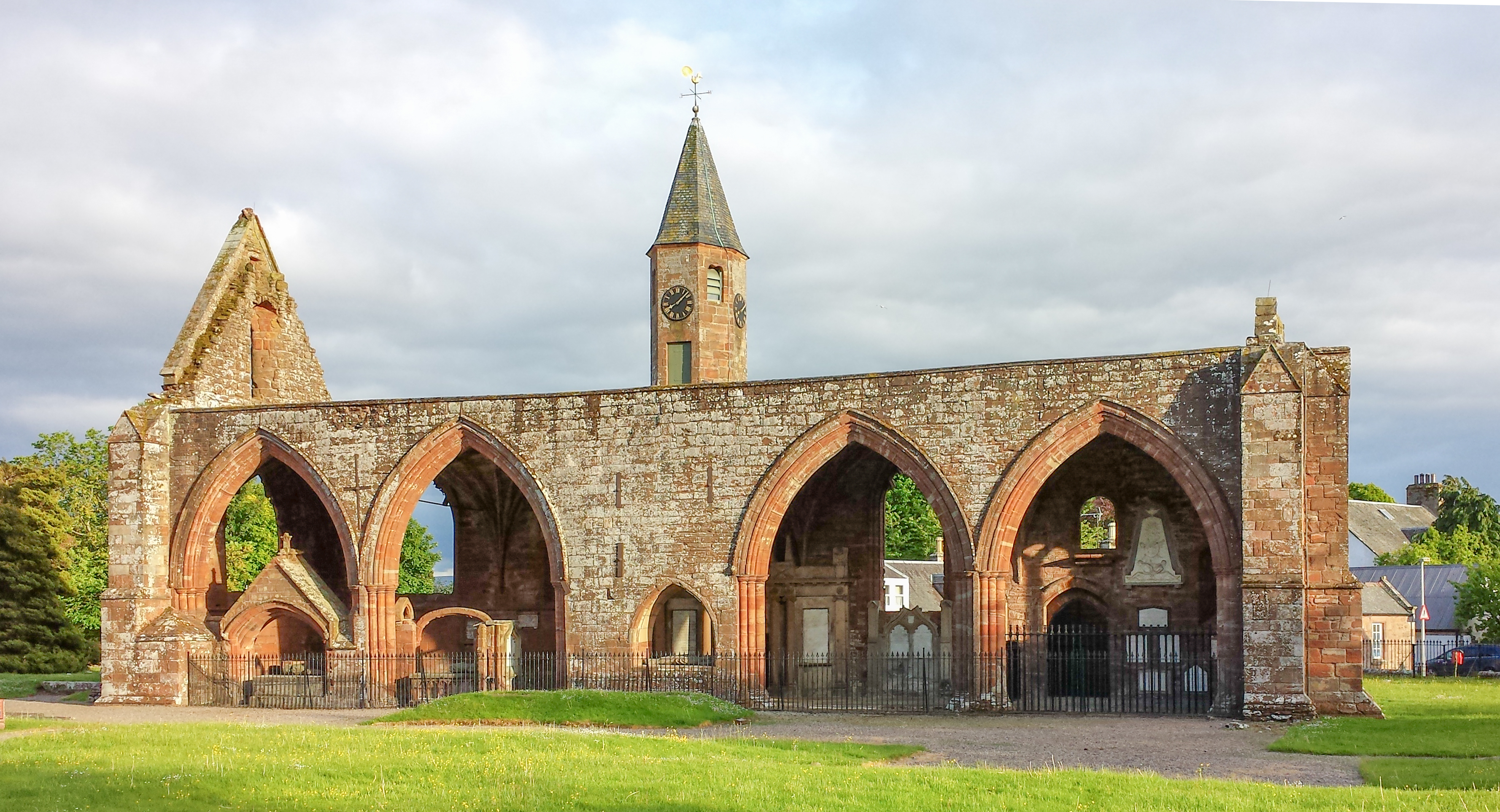
Fortrose Cathedral
Two fragments of red sandstone stand on a green lawn in Fortrose, on the Black Isle peninsula jutting into the Moray Firth. They are all that remain of the cathedral that once served as the episcopal seat of the Diocese of Ross -- a complex that in its prime administered thirty-one parishes stretching from the gentle farmlands of Easter Ross to the wild Atlantic coast of Applecross and Lochbroom. The chapter house and a south aisle survive, quiet enough that you might walk past without realising you were standing at the centre of medieval Highland Christianity.
A Diocese Across the Mountains
The diocese probably originated at nearby Rosemarkie, but by the 13th century the canons had relocated southwest to the site known as Fortrose or Chanonry. According to Gervase of Canterbury, the early cathedral was manned by Celi De -- culdees, the distinctly Celtic form of religious community that predated the Roman monastic orders in Scotland. The cathedral chapter eventually controlled twenty-one prebends drawing income from thirty-one churches, an empire of parishes that stretched from the prosperous eastern lowlands to remote western congregations at Gairloch, Kintail, and Lochcarron. These western churches were held by the chapter in common, a practical arrangement given the difficulty of administering parishes separated by some of the roughest mountain terrain in Britain.
Stone and Patronage
The cathedral was constructed primarily of red sandstone, with building beginning probably in the early-to-mid-13th century as an extended rectangle with a tower in the northwest. The south-eastern chapel, aisle, and porch were commissioned by Euphemia I, Countess of Ross in the late 14th century, replacing an earlier structure. These later portions resemble contemporary work at Elgin Cathedral, a connection explained by the fact that the Bishop of Ross, Alexander de Kylwos, had previously served as Dean of Moray. Excavations in 1873 revealed the outline of the full cathedral complex, but by then most of the stone had long since found new uses elsewhere.
Clan Burial Ground
The surviving south aisle contains two distinct chapels with several burials. The eastern chapel is thought to hold Countess Euphemia herself and Bishop Robert Cairncross. The western chapel reputedly contains Bishop John Fraser, and heraldic bosses on its ceiling represent Earl Alexander of Ross and Bishop John Bulloch. According to the 19th-century historian Alexander Mackenzie, the cathedral served as the burial place of the chiefs of Clan Munro for over 400 years, from the 12th-century Robert Munro, 2nd Baron of Foulis through to the 16th-century Hector Munro, 13th Baron of Foulis. Alexander of Islay, Earl of Ross and Lord of the Isles, was also buried here, though his grave has never been located.
Slow Dissolution
After the Scottish Reformation, Fortrose Cathedral continued as a parish church, but the building began falling apart in the later 16th and early 17th centuries. The sacristy and chapter house remained in use for official gatherings into the 18th century, but the main structure was gradually quarried for building stone. What survives today is managed by Historic Environment Scotland. Standing among the fragments, you can trace the moulding profiles and window tracery that mark the transition from Romanesque to Gothic in the Scottish Highlands -- a transition that happened later here than in England or France, and that carries its own distinctive character in the local red sandstone.
From the Air
Located at 57.58N, 4.13W on the Black Isle peninsula in the Moray Firth. The cathedral ruins are in the town of Fortrose on the south coast of the peninsula. Inverness Airport (EGPE) is approximately 10 miles west. Best viewed at 1,500-2,500 ft AGL. Chanonry Point, a notable dolphin-watching spot, extends into the firth just east of the town.