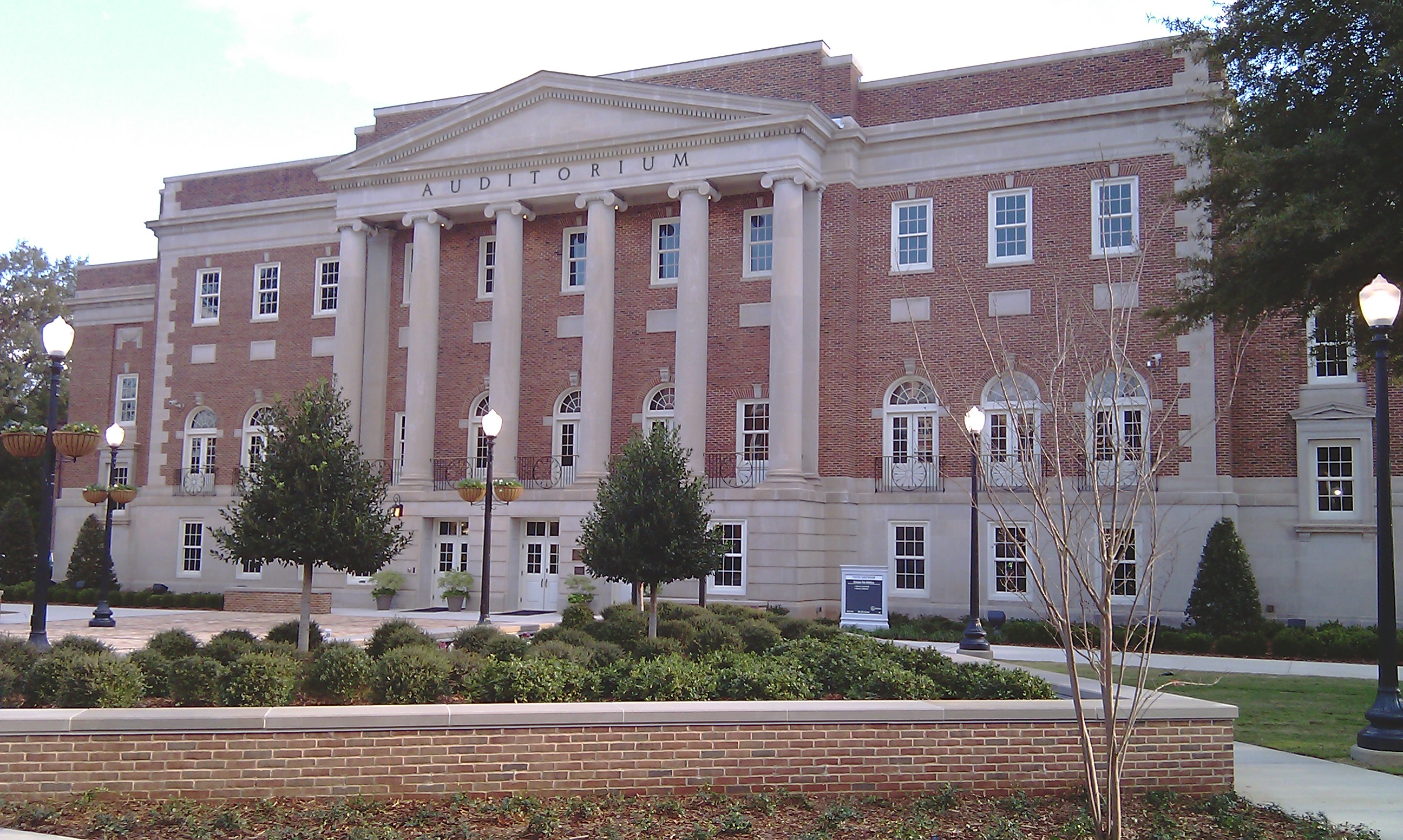
Foster Auditorium
On the morning of June 11, 1963, a governor planted himself in a doorway and tried to stop the future from walking in. George Wallace, fulfilling a campaign promise of "segregation now, segregation tomorrow, segregation forever," stood at the entrance of Foster Auditorium on the University of Alabama campus in Tuscaloosa, blocking two Black students from registering for classes. By that afternoon, Vivian Malone and James Hood had walked past him, and American history had turned another page. The building where it happened still stands, a brick-and-mortar witness to one of the civil rights movement's most photographed confrontations.
A New Deal Gymnasium
Foster Auditorium arrived on campus in 1939, a product of the Works Progress Administration during the tail end of the Great Depression. Named for Richard Clarke Foster, who served as president of the University of Alabama from 1937 to 1941, the building was practical rather than grand -- a multi-purpose facility designed for basketball games, graduation ceremonies, lectures, and large gatherings. For nearly three decades it served as the largest indoor building on campus, a role it held until the Memorial Coliseum opened in 1968. Through the 1970s and 1980s it hosted women's sports, and later housed the Department of Kinesiology until 2006. But no basketball game or commencement speech is what people remember about Foster Auditorium.
The Schoolhouse Door
The confrontation that defined this building lasted only hours but echoed for decades. Wallace positioned himself at the auditorium's entrance flanked by state troopers, refusing to let Vivian Malone of Mobile and James Hood of Gadsden register for summer classes. President John F. Kennedy responded by federalizing the Alabama National Guard. Deputy Attorney General Nicholas Katzenbach arrived with federal marshals and asked Wallace to step aside. Guard General Henry Graham delivered the order directly: "Sir, it is my sad duty to ask you to step aside under the orders of the President of the United States." Wallace read a prepared statement denouncing what he called an "unwelcomed, unwanted, unwarranted and force-induced intrusion upon the campus," then retreated to Montgomery. Malone and Hood walked in and registered.
What Came After
The story did not end at the doorway. Malone persisted in her studies and in 1965 became the first African American to graduate from the University of Alabama, earning a bachelor's degree in business management. Hood withdrew after two months but returned decades later and received his doctorate in 1997. The university had already turned away Autherine Lucy in 1956 after violent protests erupted just three days into her enrollment as the school's first Black student. Her expulsion was rescinded in 1980, and she re-enrolled and earned a master's degree in 1992. Later in life, Wallace himself apologized for his opposition to integration. In 2010, the university rechristened the courtyard at the auditorium's rear entrance -- the actual doorway where Wallace stood, not the front facade -- as Malone-Hood Plaza, anchored by the Autherine Lucy Clock Tower.
Landmark and Living Space
On April 5, 2005, Foster Auditorium was designated a National Historic Landmark, formally recognizing the building's role in the desegregation struggle. A brass marker set into the gymnasium floor marks the spot where the confrontation took place. After a major renovation announced in 2009, the Crimson Tide women's basketball and volleyball programs returned to Foster Auditorium, their original home court. The building now operates as both an active athletics venue and a civil rights memorial, carrying the weight of history in its walls while hosting the next generation of students. The scene at the schoolhouse door was dramatized, with some artistic liberties, in the 1994 film Forrest Gump, bringing the story to a new audience worldwide.
From the Air
Foster Auditorium sits on the University of Alabama campus at 33.208N, 87.544W in Tuscaloosa. The campus is visible east of the Black Warrior River. Nearest airport is Tuscaloosa National Airport (KTCL), approximately 3.5 miles northwest. At 2,000-3,000 feet AGL, the University Quad and surrounding buildings are identifiable. Bryant-Denny Stadium, just south of Foster Auditorium, serves as a prominent visual reference point.