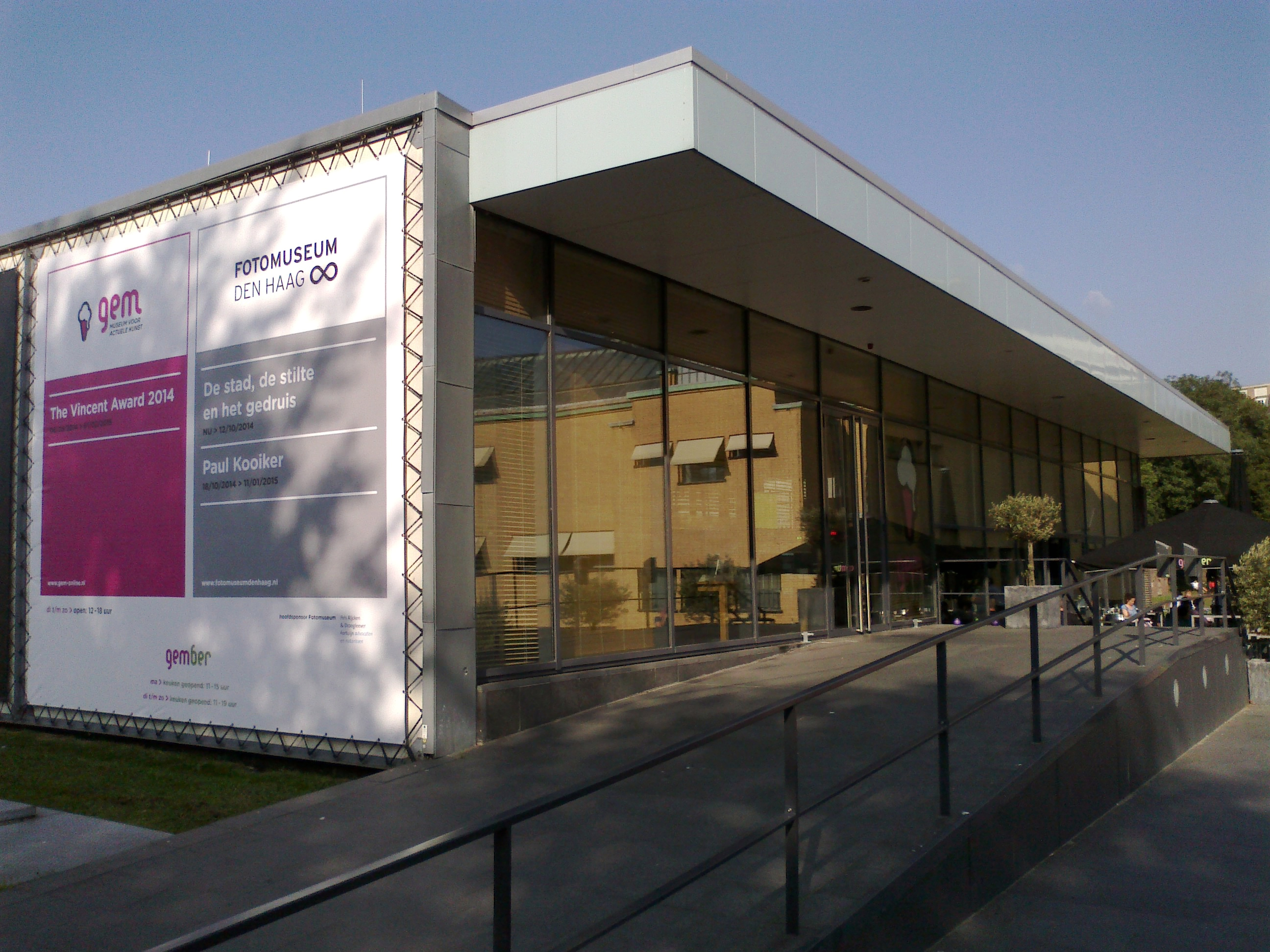
Fotomuseum Den Haag
Around the turn of the millennium, the director of the Kunstmuseum Den Haag had a quiet problem on his hands. Wim van Krimpen looked at his photography holdings and concluded they had outgrown the role of a sub-collection inside someone else's museum. The pictures - Andriesse's modernist faces, Curtis's grave portraits of Native American elders, Blumenfeld's prewar fashion experiments shot in his Amsterdam years - needed their own walls. So in 2002, the Kunstmuseum did the unusual thing of giving birth to a sibling. The Fotomuseum Den Haag opened next door, in the same brick complex, sharing an entrance with the contemporary art museum then called GEM. It was a museum that began not from a founding gift but from a quiet bureaucratic insistence: photography had earned its own address.
The Schamhart Wing
The new museum did not build a new building. It moved into the Schamhart Wing, designed by Sjoerd Schamhart and J.F. Heijligers and finished in 1961 and 1962 as an exhibition extension to what was then called the Haags Gemeentemuseum. Schamhart's wing has the calm, restrained modernism that Dutch postwar architecture did so well - rectangular volumes, careful daylight, no flash. The architectural firm Benthem Crouwel updated it for the 2002 launch, then again in 2016, when the Fotomuseum expanded from 400 to 1,000 square meters by absorbing space from the contemporary art museum next door. The extra room let curators slip smaller historical surveys and emerging-talent shows in alongside the headline exhibitions. A photography museum is partly an argument about how big a print should be allowed to be, and how many of them you can stand to see in one afternoon. The expansion was an answer.
Six Shows a Year
The rhythm is roughly six exhibitions annually, swinging between contemporary photographers and historical surveys. Desiree Dolron and her painterly stillness. Loretta Lux and her unsettling, doll-like children. Gregory Crewdson, who builds suburban tableaux with film-set budgets and shoots a single frame. Then back through time: Emmy Andriesse, who photographed the Hunger Winter of 1944-45 in Amsterdam as a young Jewish woman in hiding; Edward S. Curtis and his vast, ethically complicated project of photographing Native American peoples; Leonard Freed and his civil rights documentation. The mix means the museum keeps changing register. One season is glossy and constructed, the next is grainy and historical, the next is a quiet retrospective of someone the public has never heard of - exactly the museum's other specialty.
The Underexposed
A museum can do many things, and one of the kinder ones is to bring back the careers that almost vanished. The Fotomuseum has made a habit of this. Gerard Fieret, the Hague photographer whose work was nearly lost when birds and dust took over his apartment. Willem van de Poll, the press photographer who shot Dutch royalty and the Indonesian independence struggle. The Dutch years of Erwin Blumenfeld, before he reinvented himself in New York as the most expensive fashion photographer of his era. The museum gives space, too, to socially engaged photo essays: Friso Keuris on the International Criminal Tribunal for the former Yugoslavia, Marrie Bot on sexuality among older adults, Anja de Jong on primeval landscapes under threat. None of these are easy crowd-pleasers. The point is that they exist.
A Prize and a Roof
From 2006 to 2015, the museum hosted the Silver Camera - the most prestigious press-photography award in the Netherlands. For five of those years (2009–2013) it also ran the Photo Academy Award for student work. Press photography is having a strange decade everywhere, and the prize moved on, but the museum kept the habit of taking journalistic and student photographers seriously. Administratively, the Fotomuseum is still part of the Kunstmuseum, sharing a roof with KM21 - the renamed contemporary art museum. In 2024, Margriet Schavemaker took over as director, replacing Benno Tempel. In 2023, the joint Fotomuseum and KM21 operation drew 61,052 visitors, up from 50,010 the year before.
What the City Sees
Photography museums in small countries do a particular kind of work. The Kunstmuseum, the museum that birthed the Fotomuseum, sits next door with its 1935 Berlage building and its Mondrians and its Monets - the institution that gets the tour buses. The Fotomuseum draws a quieter crowd, sometimes specifically for one photographer the visitor has flown in to see. The Hague keeps a lot of culture for a city its size: the Mauritshuis, the Mesdag Panorama, the Escher in the Palace, and on the Stadhouderslaan, this calmer building of brick and daylight where the country's photographs come to be looked at, one by one.
From the Air
Located at 52.0906 degrees N, 4.2797 degrees E on the Stadhouderslaan in the western part of The Hague, attached to the Kunstmuseum Den Haag complex. Best viewed at 1500-2500 ft AGL during approach to Rotterdam The Hague Airport (EHRD, about 7 nm south-southeast). Look for the long, low brick volume of the Kunstmuseum and its tower; the Fotomuseum sits in the wing immediately adjacent. The Hague lies under the Schiphol TMA - operate VFR at low altitude and check NOTAMs for royal-family movements in the city center.