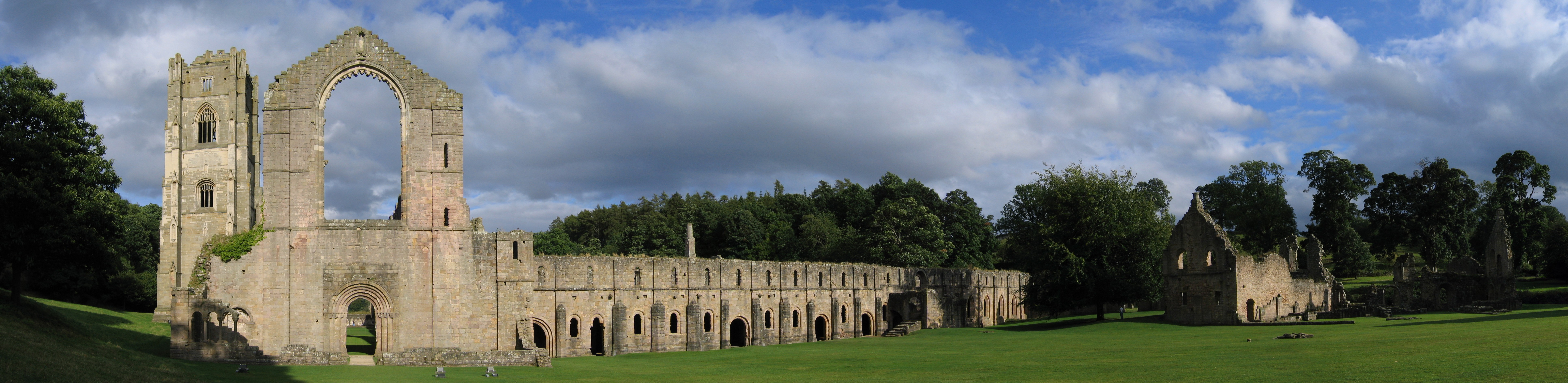
Fountains Abbey
Thirteen monks were expelled from St Mary's Abbey in York in 1132 for wanting to live a stricter religious life. Archbishop Thurstan of York gave them a patch of land in the narrow valley of the River Skell, near Ripon -- a place so inhospitable that the monks initially sheltered under the branches of an elm tree. From that desperate beginning grew Fountains Abbey, which over the next four centuries became one of the wealthiest monasteries in England, accumulating vast landholdings in sheep farming, lead mining, and iron smelting. Today its ruins are the largest Cistercian remains in the country and the centerpiece of a UNESCO World Heritage Site.
Austerity and Ambition
The expelled monks appealed to the Cistercian order, joining the austere movement that was reshaping European monasticism. The Cistercians rejected the elaborate liturgical practices of the Benedictines in favor of manual labor, simple worship, and remote locations. The Skell valley fit perfectly: isolated, undeveloped, and far from the distractions of urban life. The community grew quickly. Within a generation, Fountains was founding daughter houses of its own, including Kirkstall Abbey near Leeds. The monks built in local stone, raising a church, cloister, dormitories, and the great cellarium -- a vaulted undercroft stretching over 300 feet that stored provisions for the community. The cellarium survives as one of the most impressive medieval structures in England, its ribbed vaults drawing the eye down a seemingly endless corridor of stone.
Wool, Lead, and Power
Fountains grew wealthy through the industries that the Yorkshire landscape offered. The monks ran enormous sheep farms on the moorlands above the Skell valley, producing wool that was traded across Europe. They mined lead in the Pennines and smelted iron. Their lands extended across Yorkshire and into the Lake District. By the late medieval period, the abbey employed hundreds of lay brothers and hired laborers. Abbot Marmaduke Huby, who served from 1494 to 1526, built the great tower that still dominates the ruins -- a 160-foot perpendicular addition that announced the abbey's status across the valley. Huby's tower was one of the last major building projects before the Dissolution, a final assertion of monastic confidence just as the institution was about to be destroyed.
Studley Royal
After Henry VIII dissolved the abbey in 1539, the estate passed through several hands. In the 18th century, John Aislabie -- a former Chancellor of the Exchequer who had been disgraced in the South Sea Bubble scandal -- retired to his estate at Studley Royal and spent the rest of his life creating one of the finest water gardens in England. His son William extended the gardens to incorporate the abbey ruins as a dramatic focal point, framing the medieval stonework at the end of carefully designed vistas. The combination of Georgian landscape design and medieval monastic ruins created a site of extraordinary aesthetic power. In 1986, UNESCO inscribed Studley Royal Park including the Ruins of Fountains Abbey as a World Heritage Site, recognizing both the outstanding medieval architecture and the exceptional 18th-century landscape.
Walking the Ruins
The abbey is now managed by the National Trust. Walking through the ruins, the scale of medieval monastic life becomes tangible. The nave of the church stretches over 300 feet, its walls open to the sky but rising to their original height. The chapter house, where monks gathered daily to hear a chapter of the Rule of St Benedict, retains its ribbed vault. The infirmary, the refectory, the warming house -- each space served a specific purpose in the ordered Cistercian day, and the ruins preserve enough of the original plan to make that daily rhythm comprehensible. Huby's tower rises above everything, visible from miles across the North Yorkshire countryside. Below it, the River Skell still flows through the precinct, following the course the monks channeled eight centuries ago to power their mills and supply their fishponds. More than 300,000 visitors come each year to walk among stones that thirteen expelled monks could never have imagined when they huddled under an elm tree in 1132.
From the Air
Located at 54.11°N, 1.58°W in the Skell valley near Ripon, North Yorkshire. Huby's tower is a prominent landmark visible from altitude, rising above the extensive abbey ruins. The Studley Royal water gardens extend southeast from the abbey along the river. Nearest airport: Leeds Bradford (EGNM) approximately 20 nm south. The ruins are surrounded by parkland and woodland within the World Heritage Site boundary.