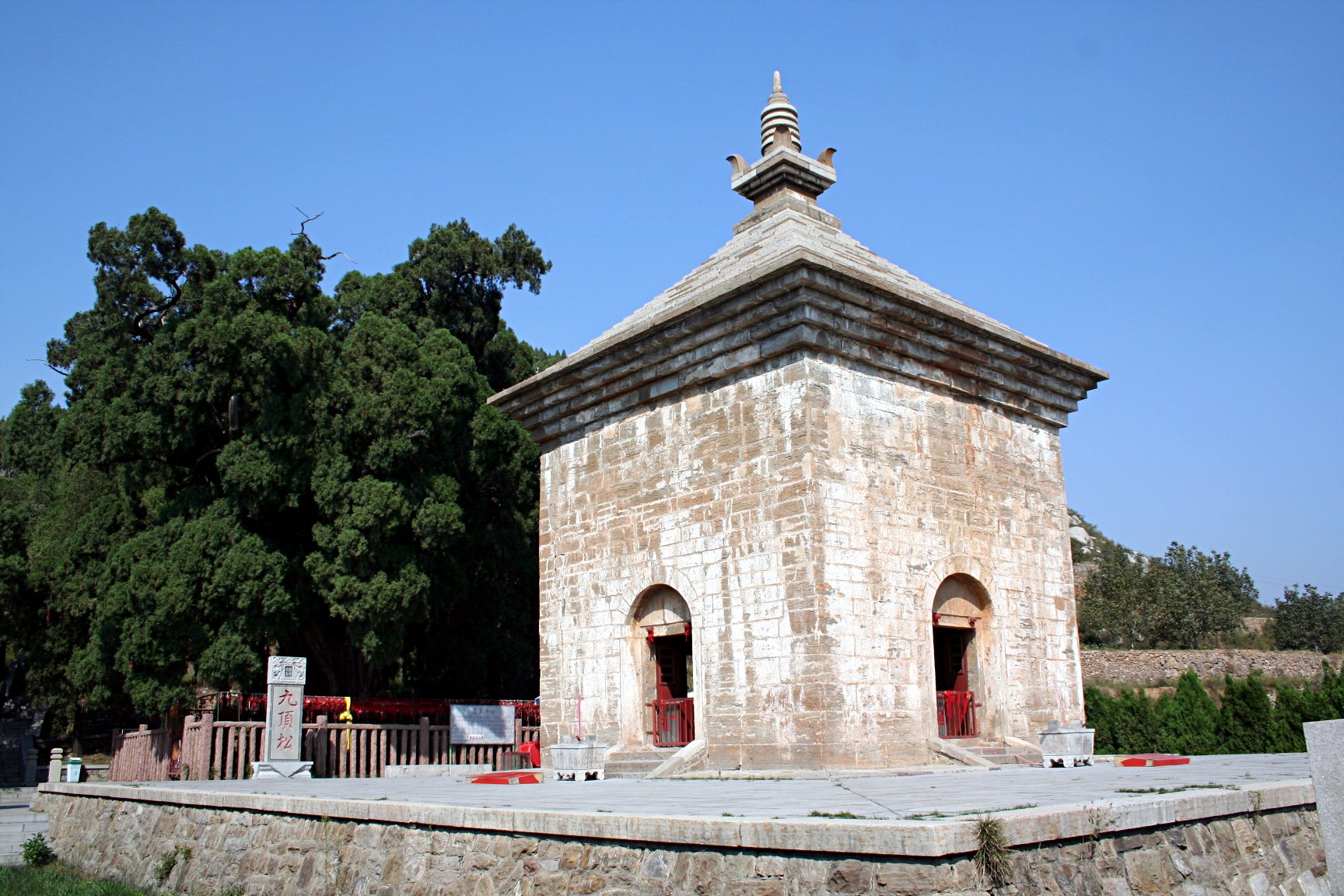
Four Gates Pagoda
The Buddhas were waiting for their house. Four seated figures -- carved in 544 AD during the Eastern Wei dynasty, commissioned by a military official named Yang Xianzhou to honor his deceased father -- sat for 67 years before someone built a structure worthy of holding them. That structure, completed in 611 AD near the end of the Sui dynasty, is the Four Gates Pagoda: a stone building of almost geometric purity, four identical walls facing the four cardinal directions, a round-arched doorway centered in each one. It is thought to be the oldest surviving pavilion-style stone pagoda in China, and it stands at the foot of Qinglong Mountain in Shandong Province, 33 kilometers southeast of Jinan.
Perfect Symmetry in Stone
Everything about the Four Gates Pagoda is fourfold. Four walls, four doors, four Buddhas, four directions. The square cross-section measures 7.4 meters on each side, and each wall is identical to the others -- plane surfaces of quarried local stone, with a round-arched doorway at center. The pyramid-shaped roof consists of 23 tiers of overlapping stone slabs supported by five tiers of stone eaves. At the apex, a stone steeple shaped like a miniature pagoda sits on its own Sumeru pedestal, decorated with banana-leaf corners and capped by a spire of five stone discs. The total height is 10.4 meters. The design is simple enough to describe in a paragraph, yet the proportions are so precisely calibrated that the pagoda achieves a visual gravity far beyond its modest dimensions.
The Four Who Wait Within
Inside, a large central pillar with a square cross-section dominates the space. A corridor runs between the pillar and the outer walls, allowing visitors to circumambulate -- a practice central to Buddhist worship. Sixteen triangular beams link the pillar to the walls, supporting the roof. On each face of the central pillar, behind each gate, a seated Buddha looks outward: the "Subtle-voiced" Buddha on the north wall, Ratnasambhava on the south, Akshobhya on the east, and Amitabha on the west. The dedication inscription on the statues' bases dates them to 544 AD, which means the pagoda was likely built specifically to house these pre-existing sculptures. In 1997, the head of the Akshobhya Buddha was sawed off and stolen. It eventually surfaced in Taiwan, where the Dharma Drum Mountain Foundation displayed it in their Museum of Buddhist History and Culture. After its origin was identified, the head was returned and reattached in 2002.
A Thousand-Year Pine
Next to the pagoda stands a pine tree known as the "Nine-tip Pine" or the "Thousand Year Pine," believed to be over a millennium old. Its gnarled branches frame the pagoda in photographs, and its longevity mirrors the endurance of the structure beside it. The wider landscape reinforces this sense of accumulated time. Two Tang dynasty pagodas stand nearby: the Dragon-and-Tiger Pagoda and its smaller companion. Together with the Thousand Buddha Cliff, these monuments transform a rural valley into one of the richest concentrations of early Chinese Buddhist architecture anywhere in the country. The pagoda was recognized as a Major Historical and Cultural Site Protected at the National Level in 1961, among the very first group of sites to receive that designation.
Stone in the Age of Wood
The Four Gates Pagoda matters to architectural historians because it marks a moment of transition. During the Sui dynasty, stone and brick began to replace wood as the primary material for pagoda construction. Older stone pagodas exist in China, but they are sculptured columns or decorative objects -- not functional buildings with interiors you can enter. The Four Gates Pagoda is the earliest known pavilion-style pagoda built from stone blocks, quarried from the hard local rock and assembled with the precision that stone demands. A stone tablet discovered inside the pagoda's ceiling in 1972 confirmed the construction date: "built in the seventh year of the Daye period of the Sui dynasty" -- 611 AD, just seven years before the dynasty's collapse. The dynasty did not survive, but its pagoda did.
From the Air
The Four Gates Pagoda is located at 36.45°N, 117.13°E at the foot of Qinglong Mountain, near Liubu Village, Licheng District, about 33 km southeast of Jinan, Shandong Province. The pagoda at 10.4 meters is not individually visible from cruising altitude, but the cluster of historical Buddhist sites in this valley is notable. Nearest major airport: Jinan Yaoqiang International (ZSJN), approximately 45 km northwest. The terrain is hilly and forested. The site of the former Shentong Temple, now in ruins, is immediately to the west.