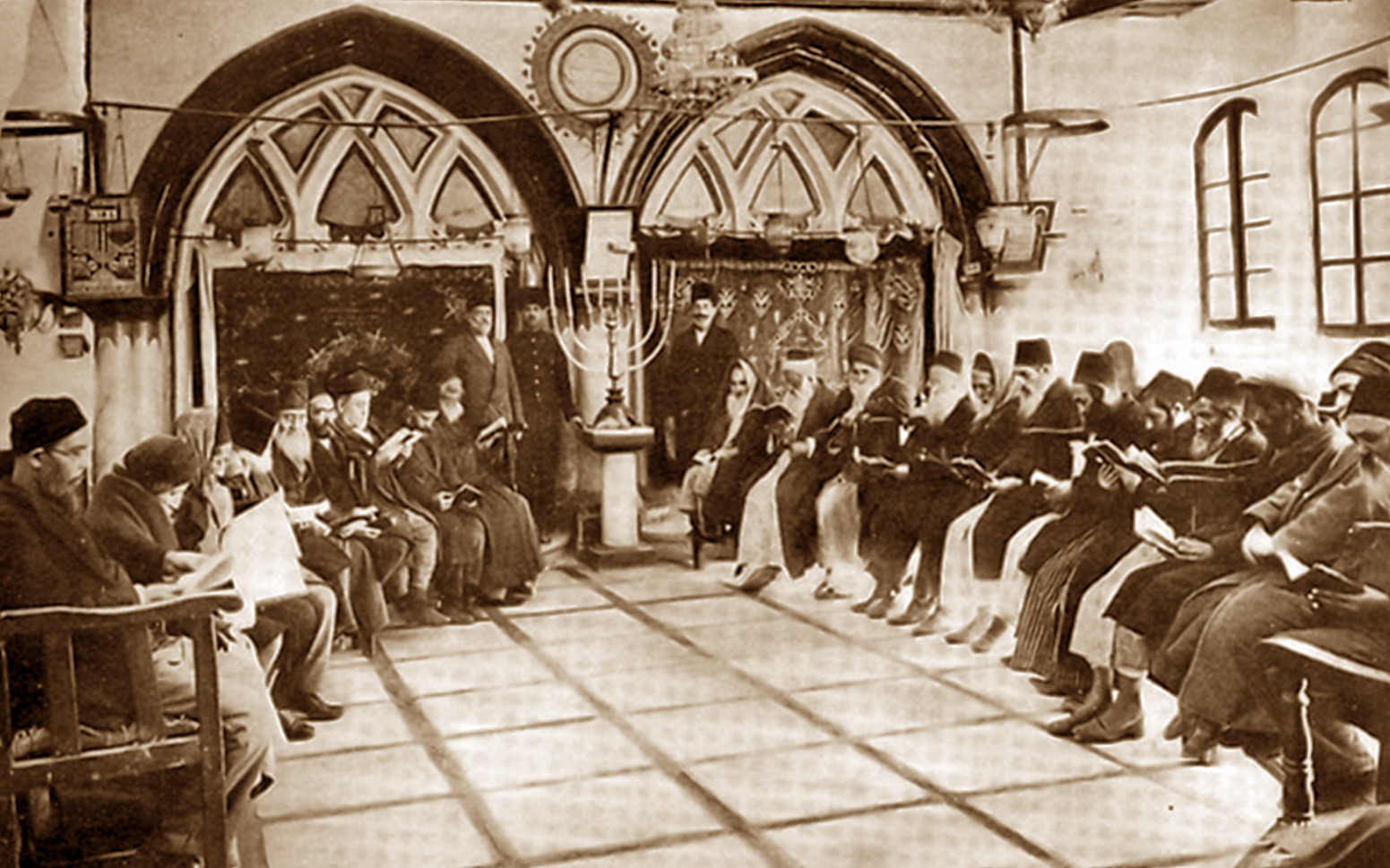
Four Sephardic Synagogues
A stranger appeared during Yom Kippur services -- or so the legend goes. The congregation at the Eliahu Ha'navi Synagogue needed one more man to complete the minyan, the quorum of ten required for prayer. A figure no one recognized walked in, the service proceeded, and after the final Neilah prayer he vanished. The worshippers concluded it could only have been Elijah the Prophet. Whether or not one believes the story, it captures something essential about the Four Sephardic Synagogues of Jerusalem's Jewish Quarter: these are places where the sacred and the practical have always been entangled, where community need drove architectural invention, and where survival itself became a form of devotion.
Refugees and Worshippers
The story begins with a closing. In 1586, Ottoman authorities shut down the Ramban Synagogue -- established around 1400 -- because it shared a wall with a mosque. The only other synagogue in Jerusalem belonged to the Karaite minority, leaving followers of mainstream Rabbinic Judaism, many of them descendants of Jews expelled from Spain in 1492, with nowhere to worship. For several years they held services in private homes, until the Yochanan ben Zakai Synagogue was completed nearby. It was built below street level, either to conceal it from the authorities or because the surrounding city simply grew upward around it over the centuries. Either way, the sunken entrance became a defining feature -- worshippers descended into prayer as if entering a different world. By 1947, it was the largest Sephardic synagogue in Jerusalem.
Four Rooms, One Living Organism
The complex grew organically over two centuries. The Istanbuli Synagogue was established in 1764 to serve immigrants arriving from Istanbul, Kurdistan, and North Africa. Its Torah ark dates from the seventeenth century and was salvaged from a destroyed synagogue in Ancona, Italy; the reading platform came from yet another synagogue in Pesaro. These rescued furnishings gave the space a layered provenance -- Italian craftsmanship serving Ottoman congregants in a Levantine city. The Emtsai Synagogue, the smallest of the four, began as an open courtyard between the other buildings. During Sukkot it became a temporary sukkah; the rest of the year it served as the women's section. By the mid-eighteenth century, the growing community roofed it over and claimed it as a fourth synagogue. The four buildings formed, as one nineteenth-century visitor noted, "properly speaking, but a very large single building, since they stand near one another, so that one can walk from one into the other."
Ruin and Return
In 1835, Muhammad Ali of Egypt, then ruling Jerusalem, granted permission to rebuild the synagogues -- the first such authorization since their construction. They were knocked down and rebuilt from the foundations, emerging as "four fine buildings." A century later, that renewal was undone. During the 1948 Arab-Israeli War, the Jewish Quarter fell after fierce fighting. Shell fire damaged the synagogues, and during the nineteen years of Jordanian rule that followed, the buildings were used as donkey stables. The Torah scrolls, the oil jar and shofar traditionally said to be Temple relics awaiting the Messiah -- all disappeared. It was a comprehensive desecration of spaces that had served continuous worship for centuries.
Threads of a Scattered World
After Israel captured the Old City during the 1967 Six-Day War, architect Dan Tanai oversaw the restoration. The synagogues reopened, though some things could not be recovered. The ancient oil jar and shofar were replaced with modern substitutes, kept on a glass shelf as symbolic placeholders for what was lost. Today, the Istanbuli Synagogue houses a Spanish and Portuguese congregation following the London rite, established in 1980 -- a community whose liturgical traditions trace back through England, the Netherlands, and ultimately to the Iberian Peninsula. On Sabbath afternoons, a scholar still expounds on the Torah in the tradition of the community, though the Ladino language of those earlier sermons has largely given way to Hebrew. The four synagogues remain active houses of worship, their interconnected rooms embodying the history of a diaspora community that kept reassembling itself across continents and centuries.
From the Air
Located at 31.775N, 35.232E in the Jewish Quarter of Jerusalem's Old City, at approximately 750m elevation. The complex sits below street level and is not individually distinguishable from the air; look for the Jewish Quarter in the southeastern portion of the walled Old City. Nearest major airport is Ben Gurion International (LLBG), about 50 km northwest. The Western Wall plaza is visible just to the east, and the golden Dome of the Rock on the Temple Mount provides orientation.