Fourth Ward: Freedmen's Town and the Battle for Houston's Soul
The bricks tell the story. In the early 20th century, when the City of Houston refused to pave Andrew Street in the Fourth Ward, members of Reverend Jeremiah Smith's congregation did it themselves, laying bricks by hand on a road the city had abandoned. That act of stubborn self-reliance defined Freedmen's Town from its founding. Established after the Civil War by recently freed people, the neighborhood became the center of Houston's African-American community -- home to ministers, entrepreneurs, attorneys, and brick makers who built an entire world just west of downtown. By 1984, the community had 563 surveyed historic structures. Today, shotgun houses sit beside parking lots and gleaming townhomes, and the Harris County Appraisal District once declared the old houses worth less than $750 while the land beneath them was valued at over $500,000. The Fourth Ward is where Houston's past and future collide, and neither side has won.
Built by Their Own Hands
The Fourth Ward was established as one of Houston's original four wards in 1839, but its identity was forged after the Civil War. Freedmen's Town grew as formerly enslaved people settled on land west of downtown, building shotgun houses on narrow streets in a dense, self-sustaining community. By the late 19th century, the Fourth Ward was the beating heart of Black Houston. In 1870, 36 percent of the city's African Americans lived here; by 1910, the proportion was still 27 percent. Three ministers -- Jack Yates, Jeremiah Smith, and Ned P. Pullum -- anchored the community. Pullum founded a brickyard that produced 20,000 bricks a day, along with three pharmacies, a shoe business, and the first hospital for Black Houstonians, Union Hospital. J. Vance Lewis, born around 1860, became an attorney and built a home he named "Van Court" at Andrews and Wilson in 1907. The Freedmen's Bureau opened schools in the area, and by 1872, students attended the Gregory Institute, named after Edgar M. Gregory, a Union Army officer. The community did not wait for Houston to build it -- it built itself.
The Slow Unraveling
The forces that eroded Freedmen's Town came from multiple directions. The construction of a freeway severed the community's connection to downtown. After the civil rights reforms of the 1960s, Black homeowners who could finally live elsewhere began leaving the Fourth Ward. By the 1970s, crime and crack cocaine ravaged what remained. In 1980, approximately half the ward's residents lived below the poverty line, and 95 percent did not own their homes. The Handbook of Texas recorded that "in the 1980s and 1990s the continued future of the Fourth Ward as a black community came under serious attack" as plans emerged to demolish Allen Parkway Village and replace it with high-income housing. Citizen opposition and the mid-1980s economic downturn delayed those plans. Then came the fires: in the summer of 1991, nine run-down houses burned in the Fourth Ward. Gladys House, head of the Freedmen's Town Association, believed the fires were arson designed to clear land for redevelopment. The Houston Fire Department's arson bureau agreed the timing was suspicious.
The Register and the Wrecking Ball
On January 17, 1985, Freedmen's Town was added to the National Register of Historic Places -- a designation that meant federal redevelopment funds could no longer be used to demolish its structures. It was a legal shield, but it could not stop the market. In the late 1990s and 2000s, gentrification arrived in earnest. Mid-rise apartment complexes and upscale townhomes replaced the old neighborhood fabric. The remaining 500 units of Allen Parkway Village were renamed The Historic Oaks of Allen Parkway and partially rebuilt with $30 million in federal funding. The Houston Chronicle observed that the Fourth Ward was becoming "a western extension of Midtown's condo and loft district." By 2011, journalist Lisa Gray wrote plainly: "Hardly anyone calls it Freedman's Town or the Fourth Ward anymore. Now it's just Midtown." The population shifted dramatically. In 1990, there were 1,421 Black residents in the Fourth Ward census tract; by 2000, only 635 remained. By 2015, the super neighborhood's demographics had inverted: 46 percent non-Hispanic white, 27 percent Black.
What Remains, What Returns
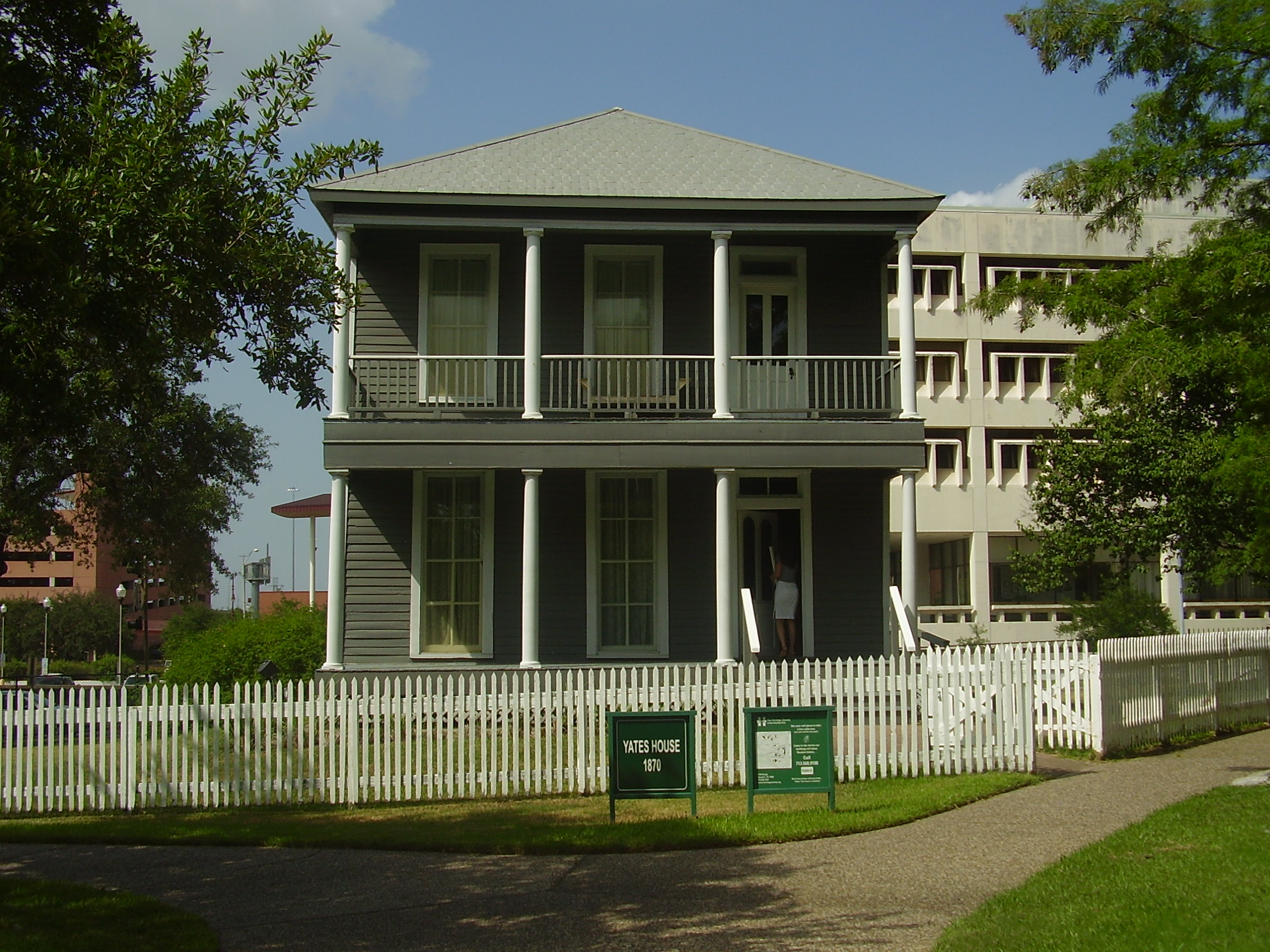
The fight to preserve Freedmen's Town has not ended. The Rutherford B.H. Yates Museum owns six houses on ten lots, all listed on the National Register, as part of an Educational and Cultural Corridor Park. Most of these houses were designed by Black architects and built by Black contractors who were themselves freedmen or their descendants. The Houston Public Library operates the African American Library at the Gregory School -- the city's first library dedicated to African-American history and culture, housed in the former school building that opened in 1926. In 2009, the City of Houston purchased the fire-damaged remains of the Bethel Missionary Baptist Church, founded by Jack Yates, for $350,000 to convert into a park. The Fourth Ward Redevelopment Corporation, founded in the late 1990s, works to preserve what gentrification has not yet consumed. The bricks that Reverend Smith's congregation laid on Andrew Street are still there -- artifacts of a community that built its own infrastructure when no one else would, and that continues to insist on its right to exist in a city that keeps trying to build over it.
From the Air
Located at 29.76°N, 95.38°W, the Fourth Ward sits immediately west of downtown Houston, inside the I-610 loop. From altitude, the area is identifiable by its position between the downtown skyline and the tree-lined corridor of Buffalo Bayou and Allen Parkway. The contrast between older low-rise structures and new mid-rise development is visible from lower altitudes. Nearest airports: William P. Hobby Airport (KHOU) approximately 9 nm south-southeast, and George Bush Intercontinental (KIAH) 20 nm north. The downtown Houston cluster of skyscrapers serves as the primary visual landmark.