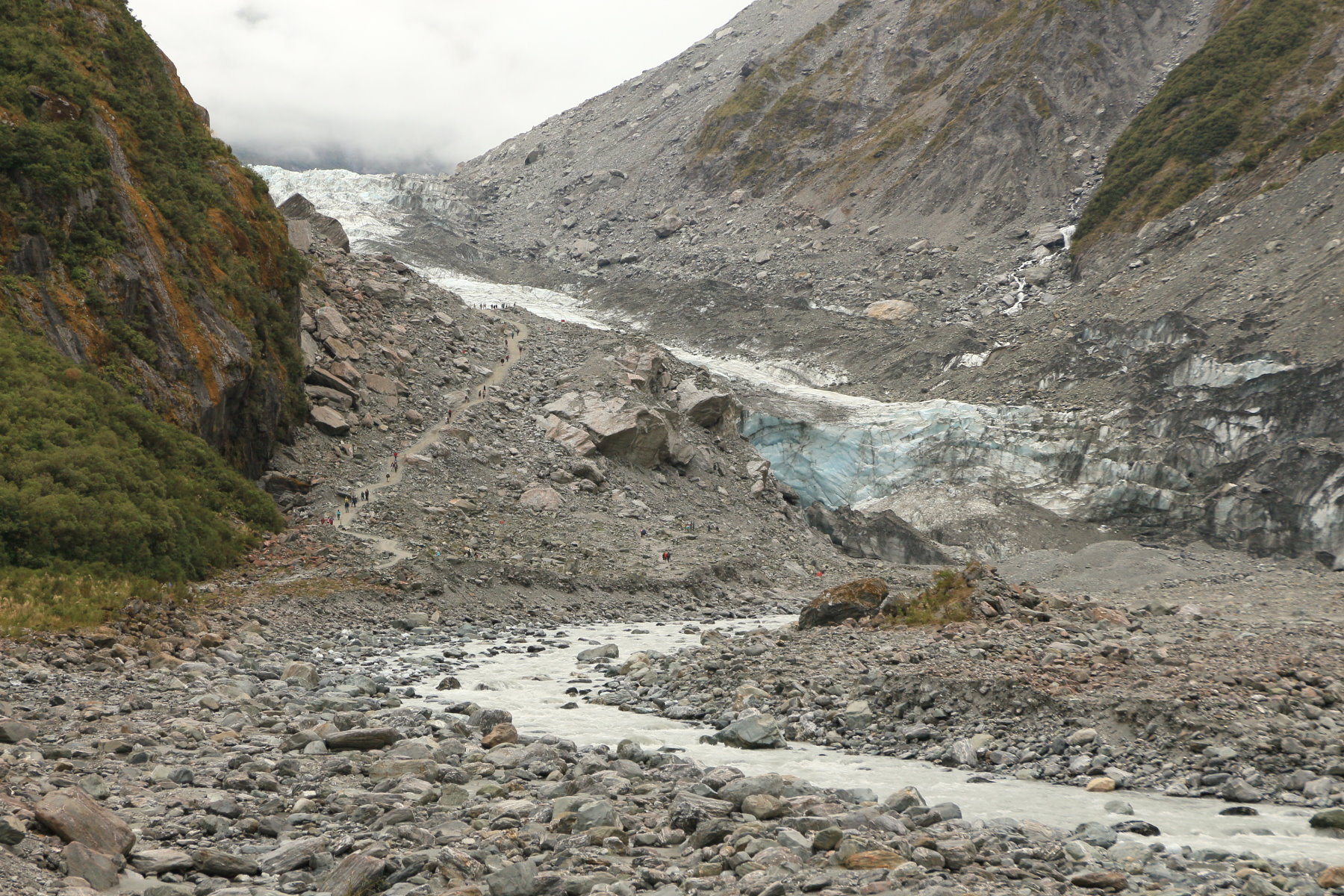
Fox Glacier
Most glaciers end in barren rock and gravel. Fox Glacier ends in rainforest. Te Moeka o Tuawe, as Maori name it, descends 2,600 meters from just below Aoraki/Mt Cook and Mt Tasman to terminate in lush temperate bush only 250 meters above sea level. It is one of the few glaciers on Earth where ice meets ferns, and the village that shares its name -- a quiet collection of lodges and cafes tucked into the foothills -- exists almost entirely because of this improbable neighbor.
A Glacier That Moves Like No Other
At 13 kilometers long, Fox Glacier is remarkable not just for where it ends but for how quickly it gets there. A funnel-like valley shape and an enormous neve -- the snow accumulation zone at the glacier's head, covering roughly 32 square kilometers -- combine to push the glacier forward at roughly ten times the speed of other valley glaciers worldwide. This velocity means the terminal face and ice features look noticeably different from one year to the next. Crevasses open and close, seracs topple, and the ice front advances or retreats in ways that make each visit distinct. The rapid descent through such a steep gradient also means the glacier is unusually accessible, reaching rainforest elevations that would seem impossible for a body of ice this size.
Gold Rush Origins, Glacier Town Present
The township began with a gold strike -- a brief flare of prospecting fever that petered out as quickly as it ignited. What remained was a settlement in one of the most spectacular settings in the South Island, and the glacier eventually became the draw that gold could not sustain. Today, Fox Glacier village operates as a quieter, more intimate alternative to its neighbor Franz Josef, about 30 minutes north along State Highway 6. The drive between the two crosses an entire mountain range on one of the windiest roads in the country. From the south, Queenstown is four and a half hours away; from the north, Christchurch is five and a half. The isolation is part of the appeal. Everything in the village sits within walking distance, and the pace here runs closer to the glacier's rhythm than the outside world's.
Ice, Lake, and Light
The ideal day in Fox Glacier follows a specific sequence that locals know by heart: sunrise at Lake Matheson, glacier viewing in the middle hours, sunset at Gillespies Beach. Walking to the glacier itself is an experience that unfolds through a valley sculpted by millennia of moving ice. Signposts along the track mark where the terminal face stood in previous decades -- a timeline of retreat measured in footsteps. For those who want the aerial perspective, helicopter services fly over the glacier and the Southern Alps, weather permitting, with options to land on the neve. An early morning flight can put you on top of the glacier just as dawn catches Aoraki/Mt Cook. But the weather here is famously fickle: mornings tend to be clear, while afternoon clouds gather and can cancel tours, slicken trails, and turn photography into an exercise in patience.
Beyond the Ice
Fox Glacier's backcountry extends well past the main attraction. Tramping tracks lead through native bush to pebble-covered beaches and lesser-known lakes. Gillespies Beach, with its quartz pebbles and black sand, offers a coastal counterpoint to the alpine drama inland. The Department of Conservation office on State Highway 6 has maps for trails that most visitors never find. For those staying on, the village offers a modest but sufficient range of accommodation, from backpacker hostels to the Glacier Country Hotel. The general store and a handful of restaurants line the highway. Winter brings drier weather and fresh snow on the glacier, though the roads grow icier. In every season, the essential experience remains the same: standing where ice meets forest, watching a landscape that refuses to hold still.
From the Air
Located at 43.50S, 170.08E on the West Coast of New Zealand's South Island. Fox Glacier is visible as a white tongue descending through green rainforest from the Southern Alps. The village sits at the glacier's foot along State Highway 6. Best viewed from 4,000-6,000 ft AGL approaching from the west, where the contrast between ice and forest is most dramatic. Lake Matheson is visible 5 km to the southwest. Nearest airports: Hokitika (NZHK) to the north, Franz Josef helipad nearby. Expect variable weather; mornings generally offer the best visibility.