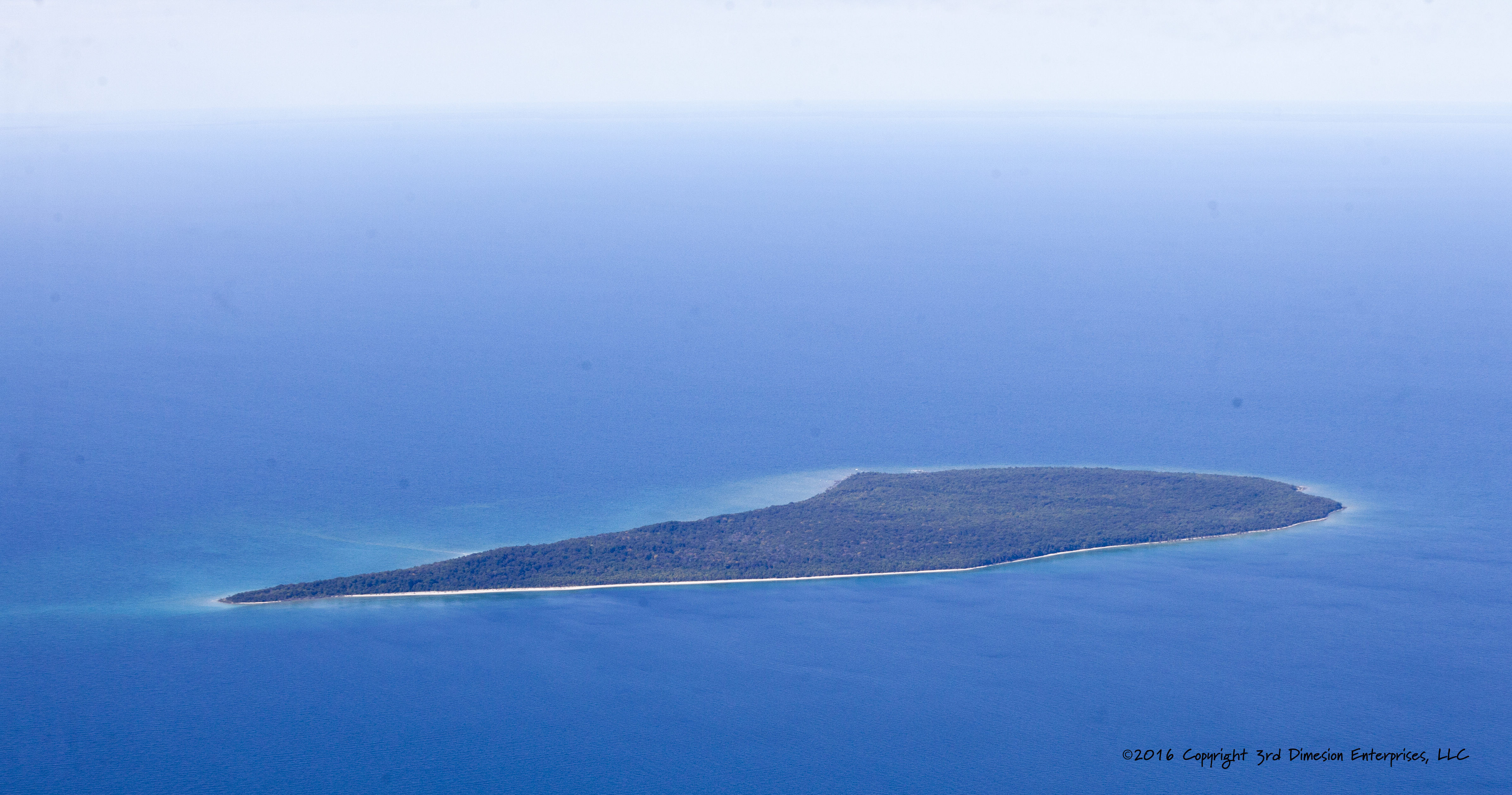
Fox Islands (Lake Michigan)
The Anishinaabe name for these islands is animookaadjiinon, and the story behind it is ancient. A young Anishinaabe woman, sent to seek her sacred vision, ran away with her dog to an abandoned island. When warriors from her village discovered her and her family there, her brother killed them all. The Anishinaabe outlawed animal-human marriage and named two islands after the woman and her dog husband. European mapmakers translated the name into something simpler: Fox Islands. But the original Odawa story, recorded by Jane Willetts Ettawageshik and translated by Howard Webkamigad, carries a gravity that the English name does not -- a reminder that these two specks of land northwest of Michigan's Leelanau Peninsula have been meaningful to the people of this region for far longer than any lighthouse or airstrip has stood on them.
Reef and Ruin
The Fox Islands sit in open Lake Michigan about fifteen miles northwest of Cathead Point, near the tip of the Leelanau Peninsula, and roughly the same distance southwest of Beaver Island. They form part of an archipelago that steps across the northern lake like a broken bridge. The waters around both islands are treacherous -- shallow, rocky, and studded with reefs that have been shredding hulls since commercial shipping began on the Great Lakes. In 1851, the Illinois was reported a total wreck on the Fox Island reef. In 1860, the bark Fontanelle ran aground here. In 1861, the schooner Nightingale followed. In 1873, the Frank Perew and the Magnet both met trouble at the Fox Islands. These are only the documented losses; the reefs have claimed more vessels than anyone recorded.
Two Lights on South Fox
South Fox Island is the larger of the two, with a private paved runway long enough to accommodate jet aircraft and a pair of lighthouses standing at its southern tip. The first South Fox Island Light was built in 1867 -- a brick house with an attached tower that guided ships through the dangerous passage for nearly seven decades. In 1934, a second light arrived by an unusual route: the skeletal tower that had served as the Sapelo Island Light off the Georgia coast was disassembled, shipped north, and reassembled on South Fox. The old brick lighthouse and the transplanted steel tower stand together, two generations of navigational technology side by side. The South Fox Island Light operated until 1959. The Fox Island Lighthouse Association, a nonprofit formed in 2004, works to preserve both structures. The island also holds a cemetery where members of the Grand Traverse Band of Native Americans are buried, a reminder that these islands are historically important to the Odawa people.
The Grass Strip on North Fox
North Fox Island is smaller than its southern neighbor but holds something rare: a public grass airstrip, designation 6Y3, maintained by volunteers from the Recreational Aviation Foundation. The runway stretches 3,001 feet long and 100 feet wide, sitting at an elevation of 639 feet with trees ranging from 35 to 65 feet tall at both ends. There are no instrument procedures, no fuel, no maintenance facilities, no cell service, and no weather coverage -- just an outhouse and the runway itself, closed from November through April and treacherously soft after rain. Pilots are advised to overfly the strip before entering the traffic pattern. The nearest airport with services is Beaver Island Airport (KSJX), fifteen nautical miles to the northeast. The Michigan-based flying club North Woolsey is based here. For aviators willing to accept the risk, landing on North Fox is one of the most remote and rewarding grass-strip experiences in the Great Lakes.
Bought, Sold, and Returned
Both Fox Islands have passed through private hands. Real estate magnate David V. Johnson purchased North Fox Island in 1994 for $1.3 million and sold it back to the state of Michigan for $2.2 million at the end of 2000. Johnson also owned about two-thirds of South Fox. He had proposed swapping North Fox for the state-owned third of South Fox that he lacked, but in 2003 the parties settled on a consolidation deal instead, trading state land on the south end of South Fox for Johnson's holdings on the north and central parts. Deer were introduced to South Fox in 1915, and hunting is still permitted on state land. North Fox is now part of the Beaver Islands State Wildlife Research Area, managed by the Michigan Department of Natural Resources. The island's waters draw swimmers, free divers, and scuba divers to at least four known wrecks offshore, though there are no lifeguards and the currents can be strong.
Anishinaabe Country
The Fox Islands hold deep significance for three federally recognized tribes of Odawa peoples in Michigan: the Grand Traverse Band, the Little River Band of Ottawa Indians, and the Little Traverse Bay Bands of Odawa Indians. These Anishinaabe communities have occupied northern Michigan for centuries, and their cultural relationship with the islands is preserved in stories recorded by Jane Willetts Ettawageshik and published in Howard Webkamigad's translation, Ottawa Stories from the Springs. The Odawa name animookaadjiinon carries a moral teaching embedded in landscape -- every time someone says 'Fox Islands,' they are using an English approximation of a story about boundaries, consequences, and the sacred order of the living world. The islands themselves, uninhabited and wind-scoured, feel like the kind of place where such stories would take root.
From the Air
The Fox Islands are located at approximately 45.442N, 85.810W in northern Lake Michigan, about 15nm northwest of Cathead Point on the Leelanau Peninsula. North Fox Island has a public grass airstrip (6Y3) -- 3,001 feet long, 100 feet wide, elevation 639 feet. Runway 7/25 with displaced thresholds (804 ft on Rwy 7, 999 ft on Rwy 25). Trees 35-65 ft at both ends. No instrument procedures. VFR only. Closed November through April. Communications on 122.900. Nearest airports with services: Beaver Island Airport (KSJX) 15nm NE, Charlevoix Municipal (KCVX) 24nm SE. South Fox Island has a private paved runway approximately 1,600 meters long. Both islands are uninhabited with no fuel, no services. Shallow rocky waters surround both islands. Best viewed at 2,000-4,000 feet AGL for island overview. The archipelago stepping from the Leelanau Peninsula toward Beaver Island is a prominent visual feature.