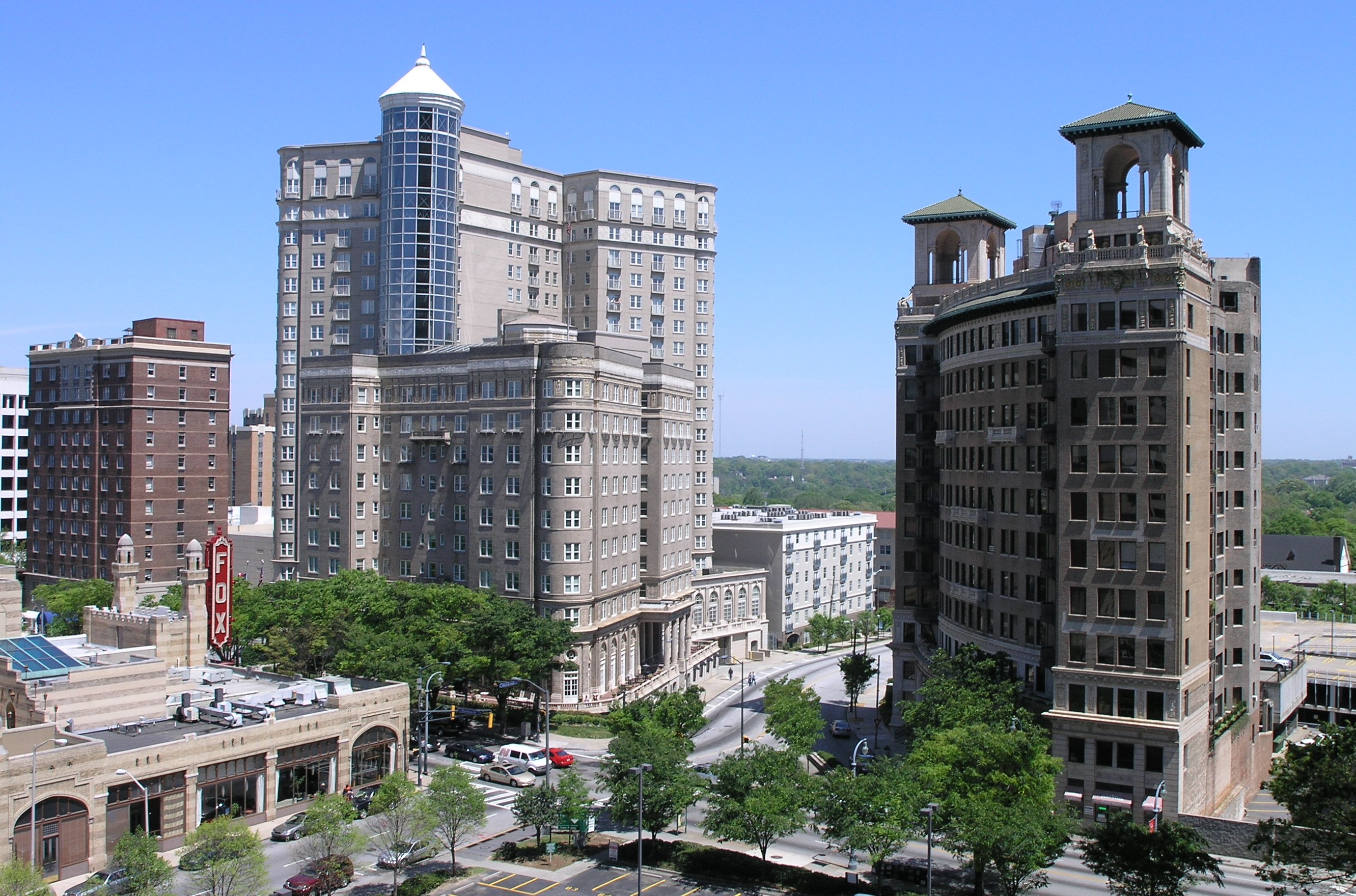
Fox Theatre (Atlanta)
Look up inside the Fox Theatre and you will see stars. Ninety-six crystal points embedded in the auditorium ceiling, a third of them flickering, with projected clouds drifting slowly across a manufactured night sky. One of those stars, it was confirmed in 2010, is made from a piece of a Coca-Cola bottle. That detail -- equal parts glamour and Georgia improvisation -- captures everything about this improbable building on Peachtree Street, where Islamic minarets meet Egyptian pharaohs and a pipe organ named Mighty Mo can imitate thunder, birdsong, and a full orchestra.
The Shriners' Mosque That Became a Movie Palace
The Fox was never supposed to be a theater. In the 1920s, the 5,000-member Yaarab Shrine Temple in Atlanta commissioned a grand headquarters in Moorish style -- minarets, arched doorways, ablution fountains. The $2.75 million project exceeded their budget, so they leased the auditorium to William Fox, a movie mogul building theaters across the country. The Fox Theatre opened on Christmas Day, 1929, just two months after the stock market crash. The local newspaper described it as having "a picturesque and almost disturbing grandeur beyond imagination." The Shriners inaugurated their adjacent mosque on New Year's Day 1930. Within 125 weeks, the theater had closed. William Fox went bankrupt. The Shriners could not meet their mortgage payments. By 1932, Paramount Pictures and a Georgia theater chain bought the foreclosed complex for a fraction of its cost.
Arabian Nights and Egyptian Temples
Architect Olivier Vinour designed the 4,665-seat auditorium to replicate an Arabian courtyard open to the heavens. The effect is extraordinary: you sit beneath what appears to be an enormous Bedouin canopy stretched across the desert sky, but it is actually plaster and steel rods engineered to funnel sound to the farthest balcony. Throughout the building, trompe-l'oeil illusions abound -- wooden beams that are plaster, gold leaf that is paint, fireplaces with no chimneys, and walls painted to simulate sunlight streaming through windows that do not exist. The Egyptian Ballroom replicates a temple for Ramses II at Karnak, complete with hieroglyphic columns. The mezzanine Ladies Lounge features a replica of King Tut's throne chair and makeup tables adorned with tiny sphinxes. The Islamic sections retain their ablution fountains, now kept dry.
Saved by Lynyrd Skynyrd and a Phone Company's Blunder
By the 1970s, the Fox was dying. White flight, suburban multiplexes, and changes in film distribution gutted its audience. In 1974, Southern Bell -- AT&T's regional arm -- offered to buy the building, tear it down, and build a parking deck for its new headquarters. The demolition threat galvanized Atlanta. A "Save the Fox" campaign erupted, backed by celebrities including Liberace and Lynyrd Skynyrd, who recorded their first live album at the theater and debuted guitarist Steve Gaines to the world on its stage. The city refused to issue a demolition permit. A complicated deal was brokered: Southern Bell built its tower on adjacent land, and the Fox was placed on the National Register of Historic Places in May 1974. Two years later, the U.S. Department of the Interior designated it a National Historic Landmark, citing its architectural uniqueness. The Fox is now the only surviving movie palace in Atlanta.
Mighty Mo and the Phantom of the Fox
The Fox's pipe organ, nicknamed the Mighty Mo, was custom-built by M. P. Moller, Inc. in Hagerstown, Maryland, in 1929. With 3,622 pipes -- the largest ranging 32 feet tall, the smallest the size of a ballpoint pen -- it was the second-largest theater organ in the country, behind only the Wurlitzer at Radio City Music Hall. Beyond pipes, it contains a marimba, xylophone, glockenspiel, drums, sleigh bells, a gong, and a six-foot grand piano salvaged from a Chicago theater organ. It can also produce silent-movie sound effects: car horns, thunder, rain, and bird whistles. For three decades, the Fox's technical director Joe Patten lived in a hidden apartment inside the building -- walls two feet thick, with a secret passageway leading from his bedroom to a spotlight platform above the auditorium. In April 1996, Patten's presence saved the Fox when he detected a pre-dawn fire in the attic wiring and called the fire department, limiting damage to two million dollars.
A Stage for Georgia and the World
Every year since the nonprofit Atlanta Landmarks assumed management in 1975, the Fox has generated an operating surplus. An estimated 750,000 people visit annually. The venue was the site of Prince's final performance, held one week before his death on April 21, 2016. Elvis Presley played here in 1956. The Rolling Stones performed in 1978 under the alias "The Cockroaches." Bob Marley played in 1979, Ray Charles in 1983, James Brown in 1985. Georgia's own Allman Brothers, R.E.M., B-52's, Outkast, and Black Crowes have all taken the Fox's shallow stage. In September 2024, the theater hosted a concert celebrating former President Jimmy Carter's 100th birthday. From Shriners' folly to bankrupt ruin to National Historic Landmark, the Fabulous Fox endures -- a place where the ceiling pretends to be the sky and one of the stars is a Coke bottle.
From the Air
The Fox Theatre is located at 33.7725N, 84.3856W on Peachtree Street in Midtown Atlanta, Georgia. From altitude, look for the distinctive Moorish architecture with minarets along the Peachtree Street corridor, between the Georgian Terrace Hotel and the Southern Bell Building (now Tower Square). The Fox Theatre Historic District is a few blocks north of the Downtown Atlanta core. Hartsfield-Jackson Atlanta International Airport (KATL) lies approximately 10nm to the south. Dekalb-Peachtree Airport (KPDK) is approximately 8nm to the northeast. The building sits adjacent to the North Avenue MARTA station. Best appreciated from a descending approach into KATL when the Midtown skyline is visible. The Fox's roofline and minarets are distinctive among the surrounding modern high-rises.