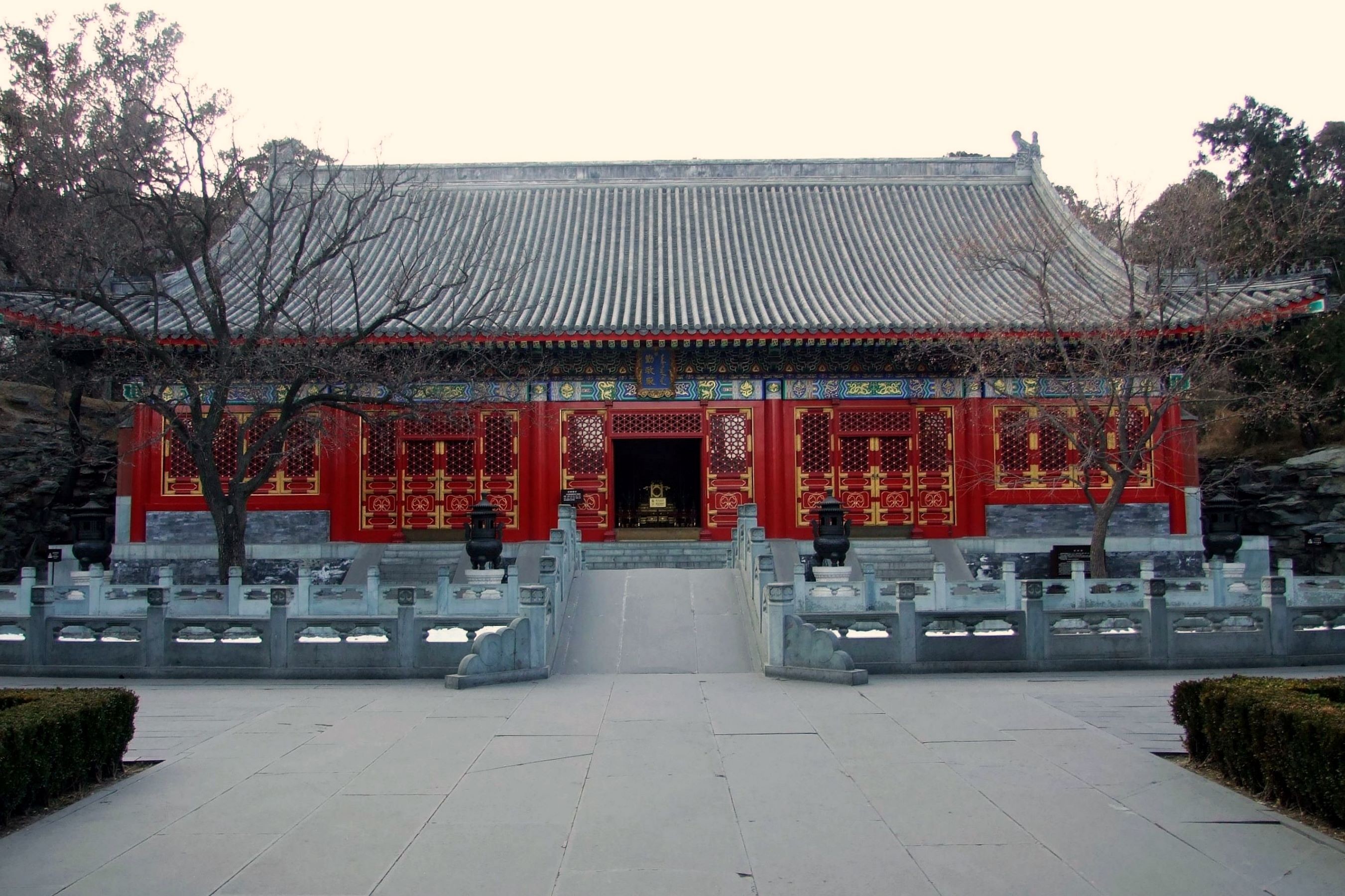
Fragrant Hills
The name is misleading. Xiangshan -- Fragrant Hills -- has nothing to do with fragrance. The xiang refers to incense, a metonym for the temples that once dotted these slopes. The park's highest peak, Xianglu Feng, takes its name from two large rocks at its 575-meter summit that resemble incense burners. But every autumn, when the smoke tree leaves turn from green to crimson and the entire mountainside blazes red, visitors who ride the cable cars through the canopy might be forgiven for thinking the name was always about the beauty.
A Park Built by Dynasties
Fragrant Hills Park was first laid out in 1186 during the Jin Dynasty, when Beijing served as the Jurchen capital. Subsequent dynasties expanded and embellished the grounds. The Yuan Dynasty added to the original structures, and the Ming Dynasty contributed buildings that remain in some form today, including the Study of Reading Heart, a landscaped garden-within-a-garden. In 1745, the Qianlong Emperor of the Qing Dynasty ordered a major renovation, adding new halls, pavilions, and gardens and renaming the park Jingyi Garden -- the Garden of Tranquility and Pleasure. Covering 395 acres, the park comprises a natural pine-cypress forest, hills planted with maple and persimmon trees, and carefully landscaped areas with traditional architecture and cultural relics.
Burning and Rebuilding
The park's beauty made it a target. In 1860, during the Second Opium War, British and French forces torched the nearby Old Summer Palace, and the destruction spread to Fragrant Hills. The park suffered extensive damage. Forty years later, during the Boxer Rebellion, troops of the Eight-Nation Alliance inflicted further harm on the grounds and buildings. Since 1949, the Chinese government has pursued continuous restoration, but some structures remain partially ruined -- a deliberate choice that allows visitors to see the scars alongside the rebuilding. The Bright Temple, a large Tibetan-style lamasery complex built in 1780 as a residence for the sixth Panchen Lama during visits to the Qianlong Emperor, stands partially burned. Its surviving glazed-tile archway, terrace, and pagoda -- with bells that chime in the breeze -- are all the more striking for what was lost around them.
Mao's Mountain Retreat
Not all of Fragrant Hills' history is ancient. Shuangqing Villa, nestled in the southern part of the park, served as the residence of Mao Zedong and an early headquarters for the Central Committee of the Chinese Communist Party. In the spring of 1949, as the People's Liberation Army prepared to enter Beijing, Mao directed operations from this hillside retreat. The villa has been preserved as a memorial, and visitors can see the rooms where decisions were made that shaped the founding of the People's Republic. Outside the park's north gate stands the Temple of Azure Clouds, an additional attraction that predates the park itself.
Red Leaves and I.M. Pei
The annual Red Leaf Festival transforms the park into Beijing's most popular autumn destination. Thousands of visitors ascend the hills on foot or by cable car to walk through groves of smoke trees whose leaves shift from gold to deep crimson across October and November. The two main routes through the park offer different experiences: the northern route passes Spectacles Lake, the Study of Reading Heart, and the Bright Temple; the southern route climbs through Tranquility Green Lake and Fragrant Temple before reaching Incense Burner Peak, the park's summit. At the park's edge sits the Fragrant Hills Hotel, designed by I.M. Pei -- an unusually traditional work by the architect better known for the Louvre Pyramid and the Bank of China Tower. It is, like the park itself, an exercise in making the modern defer to the ancient.
From the Air
Located at 39.99N, 116.18E in Beijing's Western Hills, Haidian District. The park's forested 395-acre expanse is clearly visible from the air as a large green area at the eastern edge of the Western Hills range, northwest of central Beijing. Incense Burner Peak rises to 575 meters. Nearest major airport is Beijing Capital International Airport (ZBAA/PEK), approximately 42 km east. The China National Botanical Garden lies adjacent to the southeast. Best viewed at 3,000-5,000 ft, especially in autumn when the red foliage is visible.