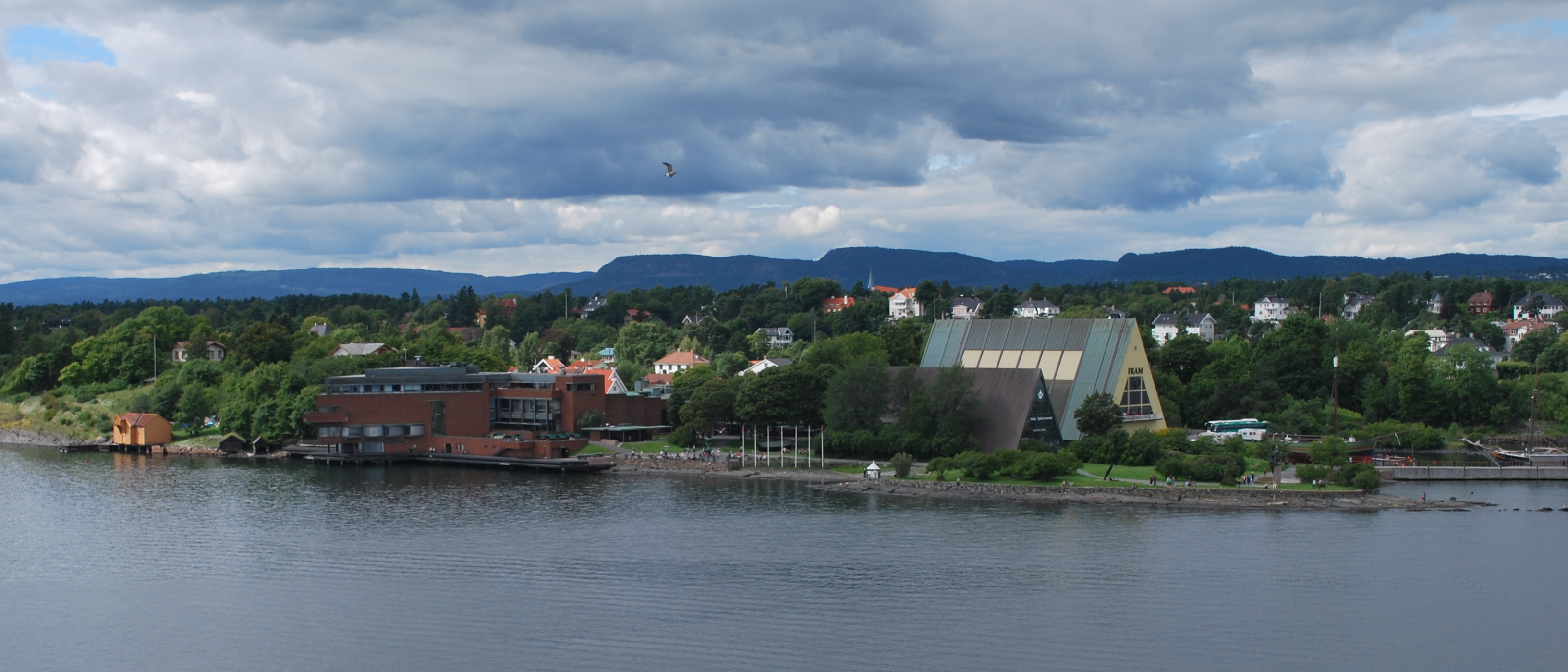
Fram Museum
Step inside the Fram Museum on Oslo's Bygdoy peninsula and the first thing you encounter is a ship. Not a model or a replica, but the actual vessel that sailed farther north and farther south than any wooden ship in history. The Fram sits in an A-frame building inaugurated in 1936, her hull intact, her interior open for visitors to walk through. She was built for one purpose: to survive being frozen into polar ice. That she accomplished this on three separate expeditions, under three different commanders, across both ends of the Earth, makes her arguably the most important exploration vessel ever constructed.
Built to Be Crushed
Fridtjof Nansen had a theory. He believed that an Arctic current could carry a ship frozen in pack ice from Siberia across the North Pole to Greenland. To test it, he needed a vessel that would not be crushed when the ice closed in. He commissioned Scots-Norwegian shipbuilder Colin Archer to design a ship with a rounded hull that would rise under pressure rather than splinter. The result was the Fram, launched in 1892 and financed through a combination of Norwegian government grants and private funding. Nansen's expedition of 1893 to 1896 proved his current theory roughly correct: the Fram drifted with the ice, surviving pressures that would have destroyed a conventional ship. The hull's egg-shaped cross-section forced the vessel upward as ice squeezed inward, riding on top of the frozen sea rather than being consumed by it.
Three Expeditions, Two Poles
After Nansen, the Fram served Otto Sverdrup from 1898 to 1902, exploring and mapping the Canadian Arctic archipelago. Sverdrup charted more than 250,000 square kilometers of previously uncharted territory, adding entire island groups to the map. Then came Roald Amundsen. In 1910, Amundsen sailed the Fram south toward Antarctica on what the world believed was a scientific expedition. Only at sea did he reveal his true objective: to beat Robert Falcon Scott to the South Pole. Amundsen reached it on December 14, 1911. The Fram had carried explorers to the farthest reaches of both hemispheres, her wooden hull enduring conditions that tested the limits of maritime engineering.
The Ship Next Door
In 2009, the Fram Museum acquired the Gjoa, the first vessel to navigate the Northwest Passage. Amundsen and a crew of six had accomplished that feat between 1903 and 1906, threading through the Arctic waterways connecting the Atlantic to the Pacific that had defeated expeditions for centuries. The Gjoa, far smaller than the Fram, now sits in her own dedicated building at the museum, fully accessible to visitors since 2017. Together, the two ships represent the golden age of Norwegian polar exploration: the passage that mapmakers had dreamed of since the 16th century and the polar journeys that pushed humanity to the planet's extremes.
A Peninsula of Discovery
The Fram Museum sits on Bygdoy, a peninsula dense with institutions devoted to Norwegian exploration and culture. The Kon-Tiki Museum, housing Thor Heyerdahl's balsa raft, stands nearby. The Norwegian Museum of Cultural History, the Viking Ship Museum, and the Norwegian Maritime Museum are all within walking distance. Bygdoy Royal Estate, the official summer residence of the King of Norway, and the historic Oscarshall palace complete the cluster. The concentration of exploration artifacts in this single neighborhood speaks to how central polar achievement remains to Norwegian identity. In a nation that produces North Sea oil and manages a trillion-dollar sovereign wealth fund, the ships on Bygdoy recall an earlier era when Norway's greatest resource was the willingness of its people to sail toward places no one had reached.
From the Air
The Fram Museum (59.90N, 10.70E) is located on the Bygdoy peninsula in western Oslo, within a cluster of maritime and cultural museums. The distinctive A-frame building housing the Fram is visible from the air near the tip of the peninsula. Oslo Gardermoen Airport (ENGM) lies 47km north. From above, Bygdoy is the large wooded peninsula extending southwest into the Oslofjord from the city center. The museum cluster near the peninsula's southern shore includes several large buildings visible at 2,000-3,000 feet. Ferry routes connecting Bygdoy to the city center are often visible on the water.