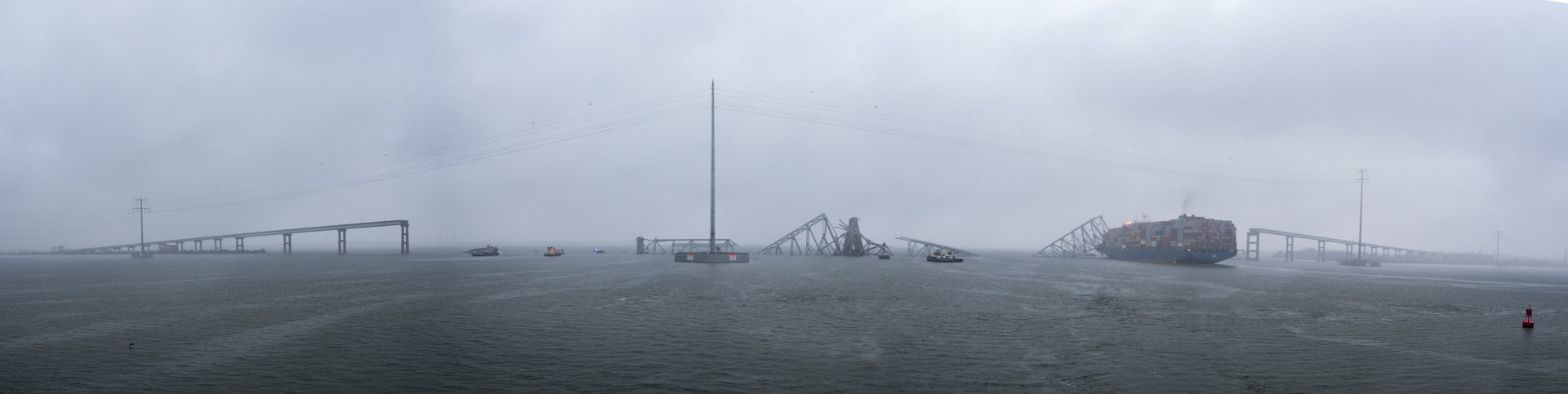
Francis Scott Key Bridge Collapse
The probable cause turned out to be a single wire. Signal wire 1, in terminal block 381, inside the electrical control center of the container ship Dali -- improperly seated because a plastic label prevented its ferrule from clicking fully into the socket spring clamp. That wire had been silently unreliable for months. On March 26, 2024, at 1:24 a.m., it failed for good. The ship's lights went dark, its propulsion died, and a 95,000-tonne vessel loaded with 4,700 containers drifted powerless toward the Francis Scott Key Bridge. Four minutes later, the bridge was in the Patapsco River.
The Four Minutes
The Dali departed Baltimore's Seagirt Marine Terminal at 12:39 a.m., bound for Colombo, Sri Lanka, with two harbor pilots aboard. At 1:24:59, total power failure struck. The lights cut out, alarms screamed, and the voyage data recorder stopped logging ship systems. Thirty-two seconds later the lights flickered back on, but propulsion was gone. The pilots radioed a mayday at 1:27 a.m., and one requested that traffic be stopped from crossing the bridge immediately. That call saved lives -- Maryland Transportation Authority officers managed to halt vehicles on both approaches. The ship's crew dropped anchor. Then the lights died again. Smoke rose from the funnel. At roughly 1:28 a.m., the Dali struck the southwest pier of the Key Bridge's central truss span. The bridge was fracture critical, meaning its structure had no redundancy. Each failure cascaded into the next; within thirty seconds, the main truss spans and three approach spans had collapsed into the river.
Six Men on the Night Shift
A maintenance crew had been working on the bridge that night, filling potholes on the road surface. When the spans fell, eight workers went into the water. Two were rescued. Six were not. Their bodies were recovered over the following weeks: from submerged vehicles, from the wreckage, from the riverbed. They were immigrants from Mexico, Guatemala, El Salvador, and Honduras -- men doing dangerous work at 1:28 in the morning. Miguel Angel Luna Gonzalez, 49, of Glen Burnie, was found on May 1. Jose Mynor Lopez, 37, of Baltimore, was the last recovered on May 7. Governor Wes Moore addressed the families in Spanish: "Estamos con ustedes, ahora y siempre" -- we are with you, now and always. Members of the Baltimore County Latino community built a memorial at the south end of the bridge. The Maryland General Assembly later established a state scholarship for the workers' children.
A Port City Severed
The Key Bridge had carried 34,000 vehicles a day across the outer harbor, including 3,000 trucks hauling hazardous materials that were barred from Baltimore's two harbor tunnels. Its collapse closed the Fort McHenry Channel, blocking most shipping to and from a port that employed 15,000 people and indirectly supported 140,000 more, generating $3.3 billion in annual wages. Governor Moore called it a "global crisis" affecting over 8,000 jobs, with the waterway's closure costing an estimated $15 million per day. Supply chain disruptions rippled across the East Coast. Shipping lines diverted vessels to New York and Virginia. Railroads CSX and Norfolk Southern scrambled to set up dedicated routes hauling cargo overland. For eleven weeks, the port's main channel stayed shut while salvage crews -- eventually numbering over 800 workers, 22 floating cranes, 36 barges, and 27 tugboats -- pulled some 50,000 tons of wreckage from the river. The channel fully reopened on June 10, 2024.
What a Label Can Do
The NTSB's final report, released November 18, 2025, traced the catastrophe to that single improperly attached label on signal wire 1. The plastic tag had prevented the wire's ferrule from seating properly in the terminal block's spring clamp. The connection was intermittent -- stable enough to pass routine checks but prone to failure under vibration or load changes. The wire's deterioration could have been detected with thermographic imaging equipment already available aboard the ship. The NTSB recommended that Synergy Marine Group implement routine thermal imaging inspections and that WAGO Corporation and Hyundai Heavy Industries update their documentation to warn against improper label placement. The bridge itself, opened in 1977, was fully code-compliant at the time of its collapse but lacked the fender systems and island barriers required of bridges built after 1991 regulations -- protections that engineering experts debated would have mattered against a vessel of the Dali's size.
Building Forward
In February 2025, the Maryland Transportation Authority unveiled a preliminary design for the replacement: Maryland's first cable-stayed bridge, with a 1,600-foot main span, 600-foot towers, and at least 230 feet of channel clearance -- 45 feet higher than the old bridge's 185-foot clearance. Congress approved $2 billion in funding through a December 2024 continuing resolution. Demolition of the remaining old bridge structure began in July 2025. Cost estimates have since risen from an initial $1.7-1.9 billion to between $4.3 and $5.2 billion. The U.S. Justice Department sued the Dali's owner and operator, settling for $101.9 million, while the state of Maryland, the city of Baltimore, and the families of the six workers all filed separate suits. The legal proceedings may last a decade. Where the bridge once stood, the Patapsco now flows open to the sky, a gap visible from any altitude -- the absence itself a landmark.
From the Air
The Francis Scott Key Bridge collapse site (39.2156°N, 76.5297°W) is starkly visible from the air as a gap in the I-695 beltway where it once crossed the Patapsco River's outer harbor. The construction zone for the replacement cable-stayed bridge is visible on both banks. Best viewed at 2,000-4,000 feet AGL on approach to Baltimore. Nearby airports: Baltimore/Washington International (KBWI, 7 nm southwest), Martin State Airport (KMTN, 8 nm north). The Dali struck the bridge approximately where the main channel passes between Hawkins Point and Sollers Point.