Francis X. Prefontaine
Three weeks after his ordination, Francis Xavier Prefontaine boarded a ship and left Quebec forever. It was late November 1863, and the young priest's destination was Washington Territory, reached by a sea voyage around the Isthmus of Panama that deposited him in Vancouver, Washington, in February 1864. He spoke no English. He knew nothing of the muddy settlement on Elliott Bay that would become Seattle. But within a few years, Prefontaine would rent a two-room house at Third Avenue and Yesler Way, convert one room into a chapel, and begin the work that made him Seattle's first resident Catholic priest, a role he held for four decades until the Pope himself took notice.
From Longueuil to the Edge of the Continent
Prefontaine was born in 1838 in Longueuil, Quebec, near Montreal, the eldest of five children in a devout French-speaking Catholic family. He studied at parochial schools and Nicolet College before entering the Grand Seminary of Montreal in 1859. His ordination came on November 20, 1863, and his departure followed almost immediately. The Pacific Northwest was mission territory, sparsely settled and desperately short of Catholic clergy. The journey via Panama was long and uncertain, but Prefontaine made it to Vancouver, where he studied English and Chinook Jargon, the pidgin trade language that served as a lingua franca among the region's diverse populations. Learning Chinook was practical: the territory's inhabitants included Indigenous peoples, fur traders, and settlers from a dozen countries, and a priest who could speak only French would reach very few of them.
A Chapel in a Rented Room
Prefontaine arrived in Seattle and rented a small two-room house at Third Avenue and Yesler Way for six dollars a month. One room became his living quarters; the other became a chapel where he conducted services while raising funds to build a proper church. The location placed him at the heart of early Seattle, near the sawmill that Henry Yesler had built on the waterfront and the skid road that gave the surrounding neighborhood its character. From this modest beginning, Prefontaine built the city's first Catholic church and spent the next four decades serving Seattle's growing Catholic community. He witnessed the city burn in the Great Seattle Fire of 1889 and watched it rebuild. He saw the population swell during the Klondike Gold Rush. Through all of it, the French Canadian priest who had arrived speaking no English became a fixture of the city's civic and spiritual life.
The Pope Takes Notice
In July 1908, Pope Pius X conferred on Prefontaine the honorary degree of protonotary apostolic, a recognition of his distinguished service in Seattle since 1869. Bishop Edward John O'Dea invested Prefontaine with the robes and title of Monsignor, making him a Member of the Papal Household. The honor acknowledged nearly forty years of continuous ministry in a city that had grown from a frontier settlement into a major Pacific port. Prefontaine was seventy years old, and the recognition from Rome came less than a year before his death in 1909. He had never returned to Quebec.
The Fountain at Third and Yesler
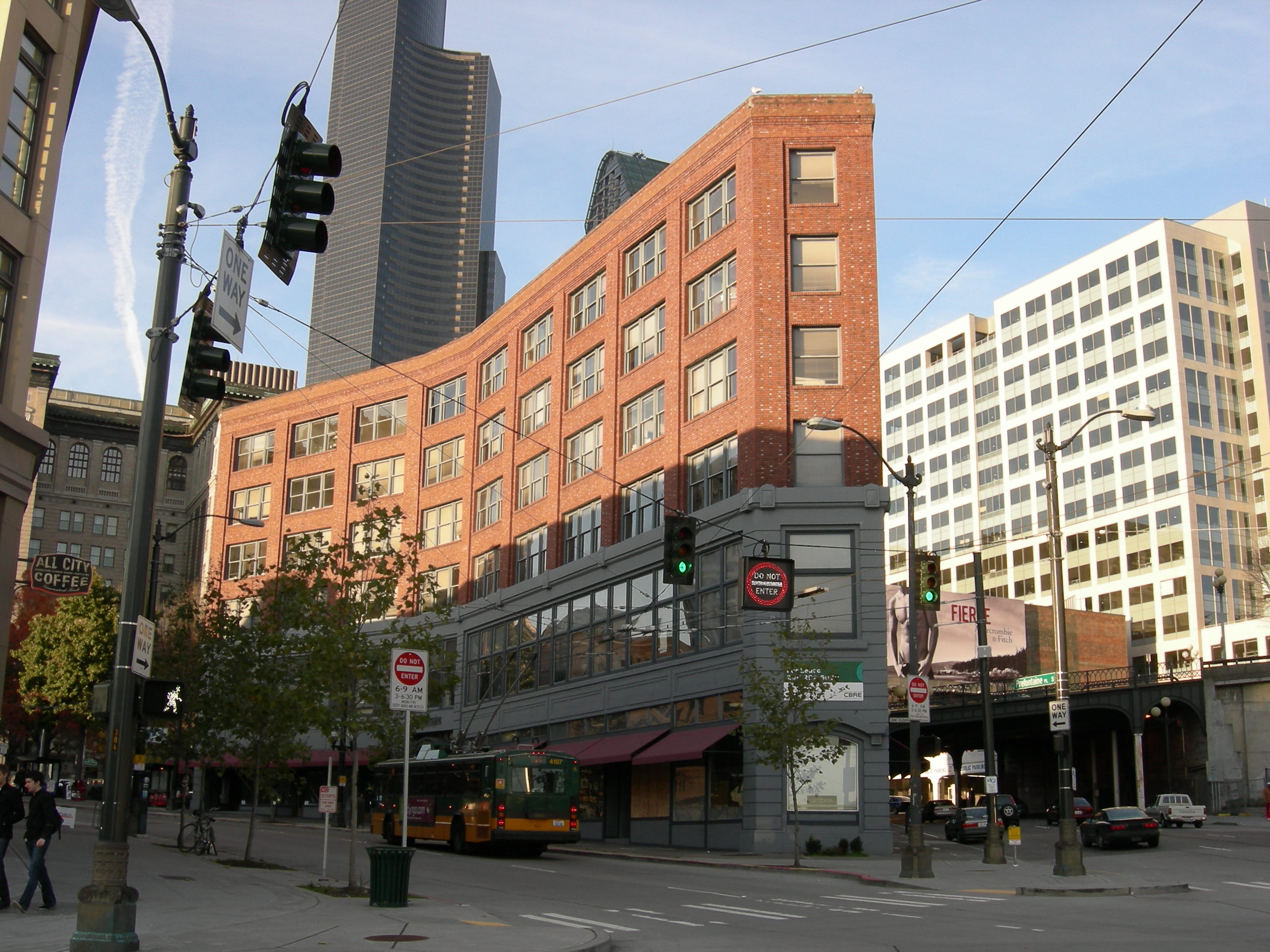
Prefontaine's will contained a bequest of five thousand dollars to the city of Seattle "for a fountain in a public square." The fountain was not completed until 1925, sixteen years after his death, but it stands today at the intersection of Third Avenue and Yesler Way, approximately where his first rented house and improvised chapel once stood. A short street nearby, Prefontaine Place South, marks the site of his first church. On that street stands the Prefontaine Building, a nearly triangular six-sided structure in the Beaux-Arts style completed in 1909, the year of his death. These modest namesakes cluster within a few blocks of Pioneer Square, small traces of a man who crossed a continent and an ocean to minister to a town that barely existed when he arrived. The fountain, the street, and the building form an accidental memorial to the quiet persistence that built Seattle's spiritual foundations one rented room at a time.
From the Air
The Prefontaine legacy sites cluster in Seattle's Pioneer Square neighborhood at approximately 47.601N, 122.332W, near the intersection of Third Avenue and Yesler Way. The Prefontaine Fountain and Prefontaine Place South are at street level and not individually visible from altitude, but the Pioneer Square neighborhood is identifiable by its distinctive red-brick architecture and the triangular Prefontaine Building. Nearest airports: Boeing Field (KBFI) 3nm south, Seattle-Tacoma International (KSEA) 10nm south. Best context at 2,000-3,000 feet over downtown Seattle, looking south toward the older brick-building district between the waterfront and Interstate 5.