Francisco's Fight
The soldier who refused to hand over his silver shoe buckles stood six feet six inches tall. In July 1781, at Captain Benjamin Ward's plantation along West Creek in what is now Nottoway County, Virginia, Peter Francisco -- unarmed, alone, and surrounded by nine mounted British dragoons -- supposedly pulled off one of the most audacious feats of individual combat in the entire American Revolution. He claimed he disarmed a cavalryman, killed him with his own sword, wounded several others, and rode away with eight of their nine horses. The story has been retold, embellished, and commemorated for over two centuries. But the only person who ever wrote it down was Francisco himself, and he did so while asking for money.
The Giant from the Azores
Peter Francisco was already something of a legend before the alleged skirmish. Reportedly abandoned at the docks of City Point, Virginia as a young boy -- possibly from the Azores -- he grew into a physically imposing man, standing about six feet six inches and known throughout the Continental Army for extraordinary strength. He fought at Brandywine, Monmouth Court House, and the Battle of Stony Point, where he was supposedly the second man over the fortifications. Wounded at Stony Point, he had returned to his home in Buckingham, Virginia to recuperate when Cornwallis's forces began sweeping through the state. Banastre Tarleton -- the feared cavalry commander known for swift, brutal raids -- dispatched elements of his British Legion deep into central Virginia, leaving Suffolk on July 9 and riding hard into the Blue Ridge foothills on a mission to destroy military stores.
A Sword Drawn from Its Scabbard
The only documented primary sources for what happened next come from Francisco himself: an 1820 letter to the Virginia State Assembly seeking compensation, and an 1829 application to the United States Congress for financial support. Congress rejected the claim, noting he was already receiving a military pension. The two accounts differ in details but share the same core narrative. Francisco described encountering a detachment of British Legion dragoons at Ward's plantation. One demanded his watch and silver shoe buckles. Francisco refused. When the dragoon bent down to take the buckles by force, Francisco reached across, drew the man's sword from its scabbard, and killed him with it. He then claimed to have wounded and driven off the remaining soldiers, seizing eight of their nine horses. No other contemporary source corroborates the events. Tarleton's own memoir mentions casualties on the expedition only in general terms.
The Legend Grows Taller
Later retellings inflated the story far beyond Francisco's own words. Henry Howe's 1852 account introduced dramatic details absent from the original letters: the tavernkeeper treacherously handing a musket to a British soldier, a misfire at point-blank range, and Francisco bellowing invented commands -- 'Come on, my brave boys! We will soon dispatch these few, and then attack the main body!' -- to bluff Tarleton's nearby troop of four hundred men into thinking reinforcements were arriving. The embellished version added a colorful coda: the treacherous tavernkeeper, given Francisco's captured horses to hide, demanded two as payment for his trouble. Francisco took six and left, planning to return for revenge. Providence, as the tale would have it, intervened first -- the man broke his neck falling from one of the very horses he had extorted. An 1814 engraving depicting the scene cemented the dramatic version in popular memory, though its details come from storytelling rather than documentary evidence.
What Remains at Jennings Ordinary
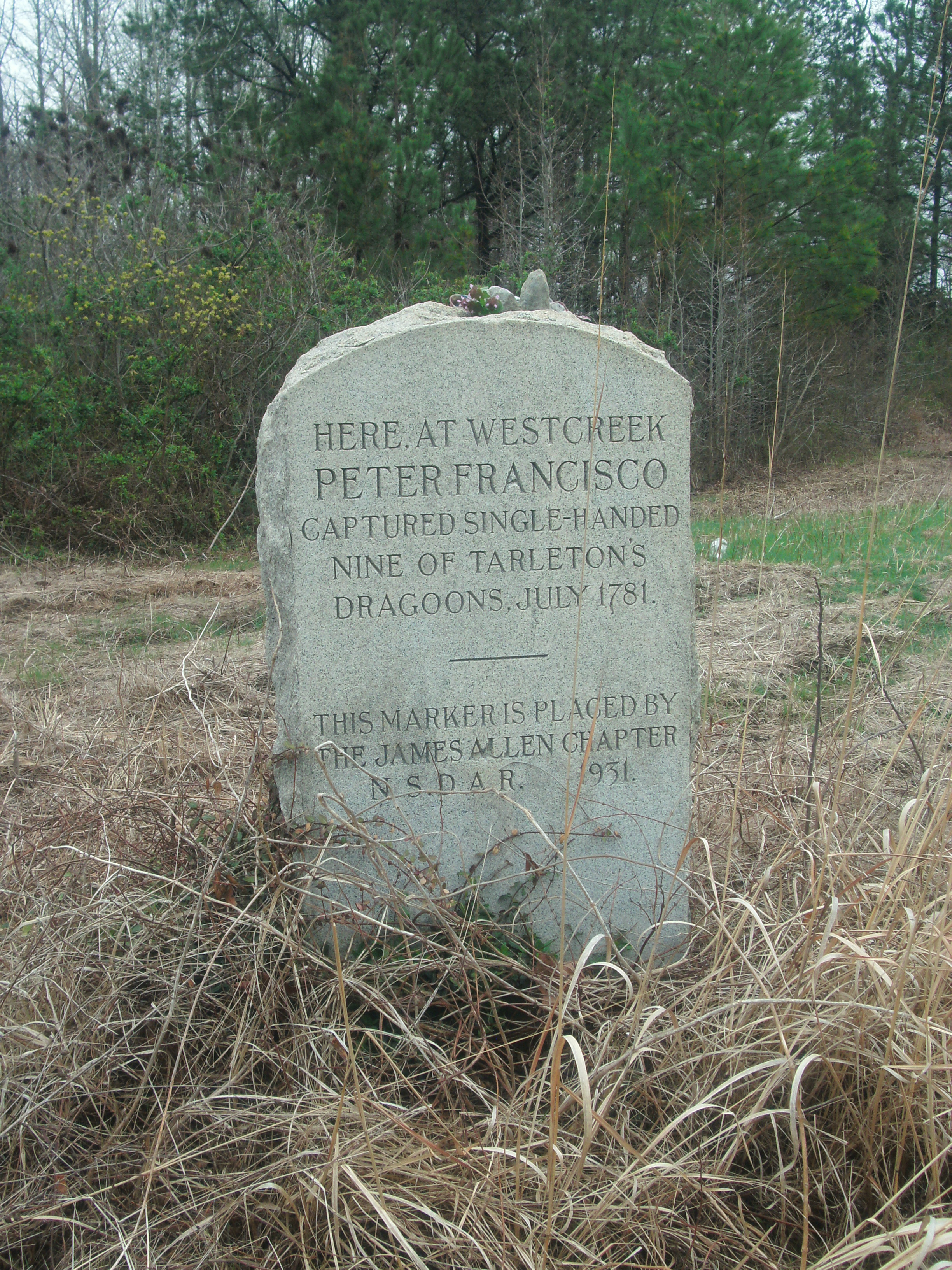
Whether the fight happened precisely as Francisco described -- or at all -- it earned a place in the landscape of Nottoway County. In 1931, the local chapter of the Daughters of the American Revolution erected a marker at the approximate site, near the community of Jennings Ordinary. A Virginia state historical marker stands along U.S. Route 360, six miles south of Burkeville and about five miles due west of where Ward's tavern once stood. The markers commemorate not just a skirmish, but the broader Revolutionary War experience in rural Virginia -- a place where the war was fought not in grand set-piece battles but in roadside confrontations, raids on isolated plantations, and individual acts of defiance whose truth is tangled with the telling.
From the Air
Located at 37.14N, 78.05W in Nottoway County, Virginia. The site lies along U.S. Route 360, six miles south of Burkeville. From cruising altitude, look for the rolling farmland of central Virginia between the Blue Ridge foothills to the west and the flat Tidewater plain to the east. Nearest airports include Crewe Municipal Airport (W81) approximately 15 nm north and Lunenburg County Airport (W17) roughly 20 nm southwest.