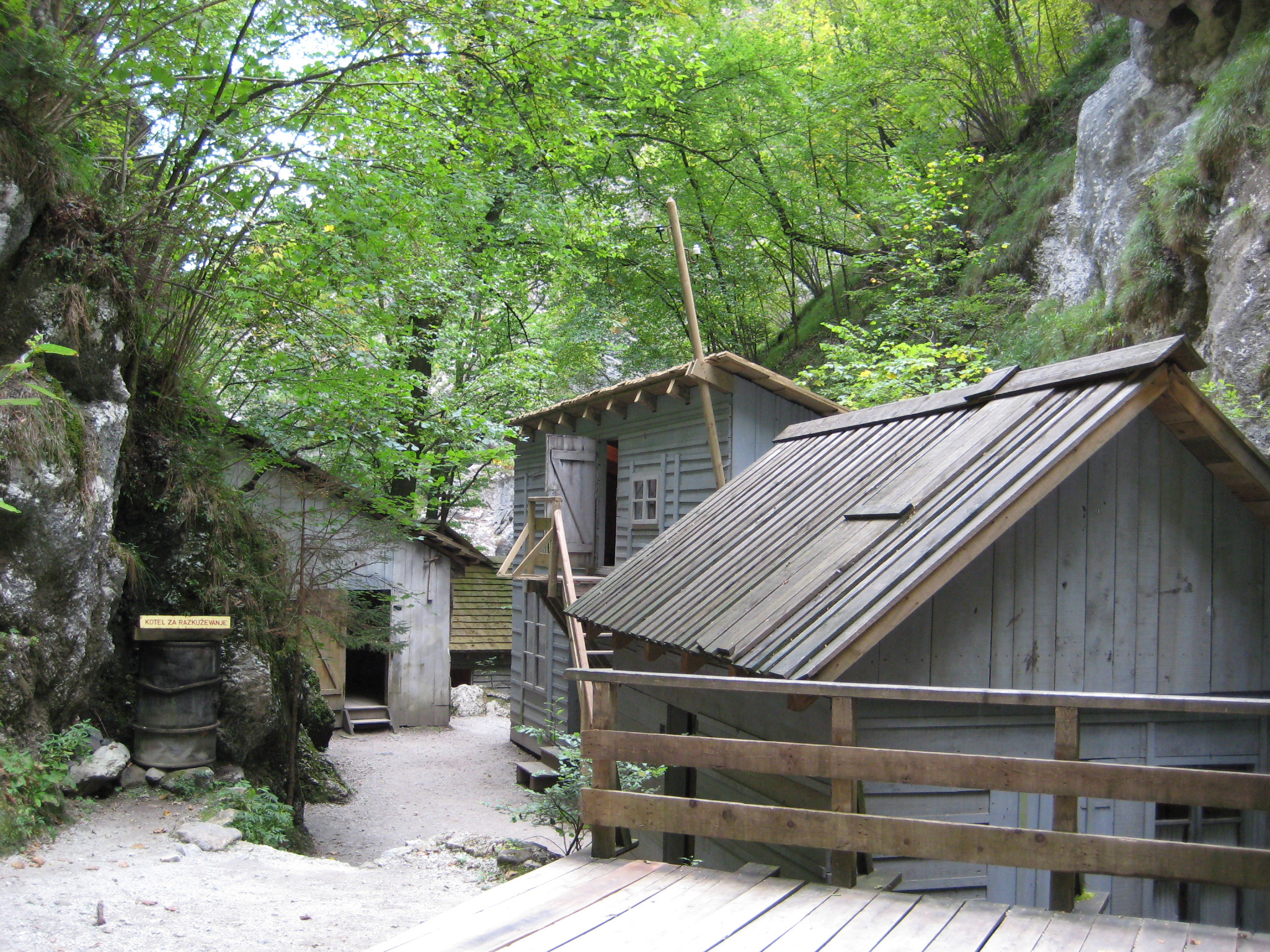
Franja Partisan Hospital
Patients arrived blindfolded. They were carried on stretchers through dense forest, across bridges that could be retracted at a moment's notice, past minefields and concealed machine gun nests, into a narrow gorge where the canopy was so thick that no aircraft could spot what lay beneath. This was Franja Partisan Hospital, a fully operational medical facility hidden in the Pasica Gorge near Cerkno in western Slovenia. From December 1943 until May 1945, it operated deep inside German-occupied Europe, just hours from the Austrian border, and the Wehrmacht never found it.
A Hospital Built in Defiance
The Slovene Partisans built Franja in some of the most rugged terrain in the Julian Alps. Viktor Volcjak founded and constructed the first buildings, hauling materials into the remote gorge where the steep walls and dense tree cover offered natural camouflage. The hospital was designed to hold up to 120 patients at a time, but over its eighteen months of operation, it treated nearly 900 wounded fighters across the hospital and its dislocated units. The facility was remarkably complete for a clandestine operation: it included an operating room, an X-ray unit, an isolation ward, a kitchen, a laundry, a carpentry workshop, even a small electric plant. The hospital's entrance was hidden in the forest, accessible only by those narrow bridges that the staff could pull away when enemy patrols drew close.
The Doctor Who Gave It a Name
The hospital bears the name of Franja Bojc Bidovec, the physician who became its manager in February 1944 and ran it until the war's end. Under her direction, the hospital treated wounded resistance fighters of many nationalities -- people who could not go to regular hospitals without being arrested. Among the doctors was an Italian, Antonio Ciccarelli, who worked alongside Slovenian colleagues in conditions that demanded both medical skill and the nerve to operate under constant threat of discovery. Perhaps the most remarkable patient was a wounded German soldier, an enemy combatant who, after receiving treatment, chose to stay on as a member of the hospital staff rather than return to the war that had nearly killed him.
Invisible from Above
The hospital's survival depended on layers of security that bordered on the ingenious. The gorge itself was the first defense -- narrow, deep, and heavily wooded, it rendered the buildings invisible to aerial reconnaissance. The camouflaged structures blended into the rock walls. Patients were blindfolded during transport so they could not reveal the location if captured. Minefields ringed the approaches, and machine gun positions covered the few access points. German military activity was frequent in the surrounding region throughout the hospital's operation, and the Wehrmacht launched several deliberate search missions. All failed. For eighteen months, in the heart of occupied Europe, Franja remained a secret.
Recognition and Ruin
After the war, Franja Partisan Hospital became part of the Cerkno Museum in 1963. In 1997, the American Association of Air Force Veterans honored it for saving and treating the downed American pilot Harold Adams. The site has been a candidate for UNESCO World Heritage status since 2000, and in 2003, Slovenia issued a commemorative stamp for its 60th anniversary -- a stamp that became the country's stamp of the year. But the gorge that once protected the hospital has also threatened it. On 18 September 2007, torrential rains sent floodwaters crashing through the site, badly damaging the buildings. It took three years to reconstruct and reopen. Then, on 13 July 2023, heavy rainfall struck again, completely destroying three buildings and damaging three more.
What Endures
The repeated destruction and reconstruction of Franja Partisan Hospital mirrors something about its original purpose. It was built by people who refused to accept that healing was impossible under impossible conditions. The gorge that hides it is still remote, still narrow, still thick with forest. The rebuilt museum stands where the operating room and barracks once stood, a cultural monument of national significance in a country that remembers this place as proof of what stubborn courage and medical dedication can accomplish. Franja is not a battlefield memorial. It is the opposite -- a monument to the idea that even in the middle of a war, some people insisted on saving lives.
From the Air
Located at 46.15N, 14.03E in the Pasica Gorge near Cerkno, western Slovenia. The site is nestled in a narrow, heavily forested gorge in the Julian Alps foothills and is essentially invisible from the air -- which was the entire point. Nearest airport: LJLJ (Ljubljana Joze Pucnik Airport), approximately 50 km east. The surrounding terrain is mountainous with elevations around 500-800 meters. Best appreciated by understanding the topography from 5,000-8,000 feet AGL.