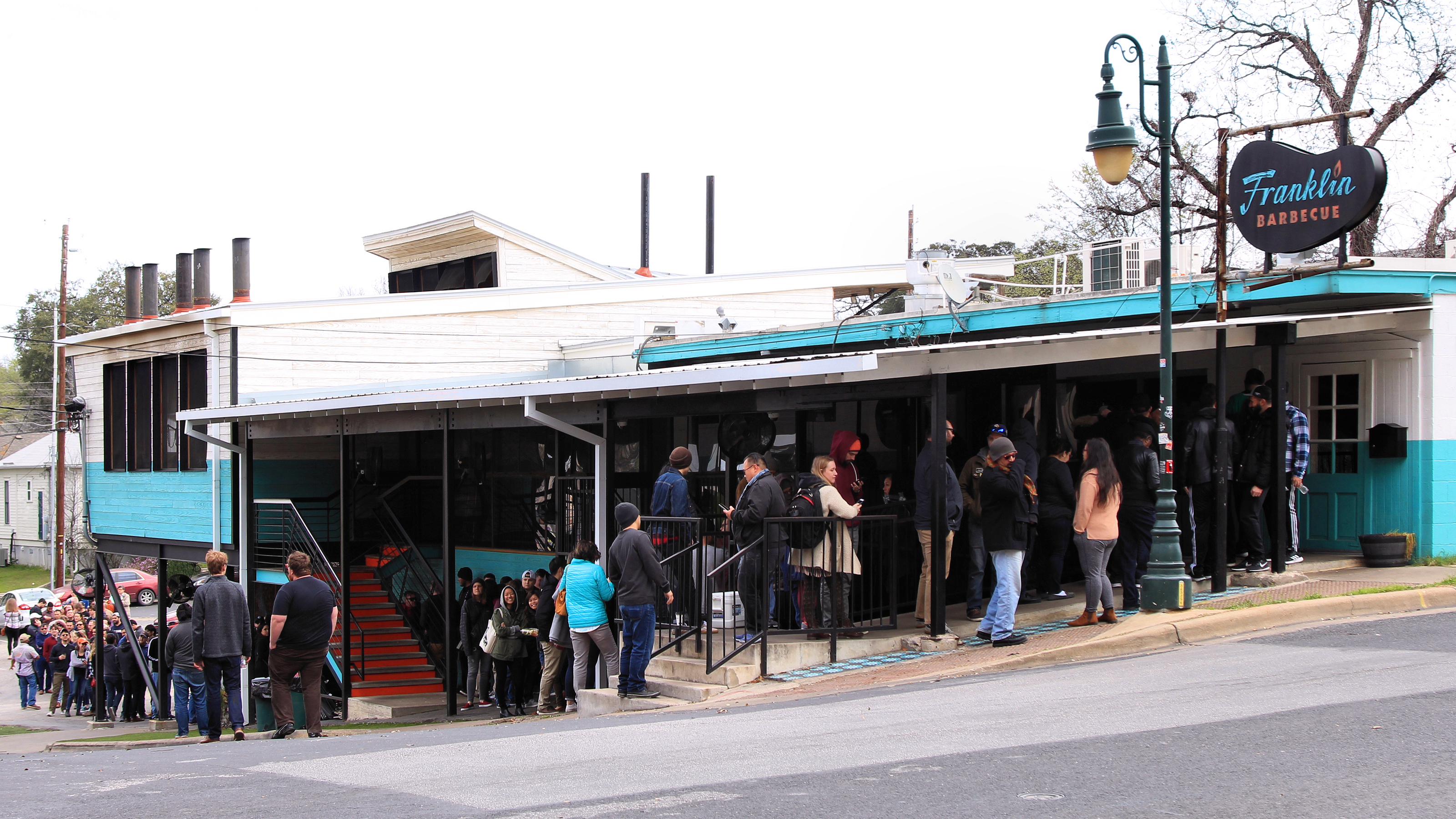
Franklin Barbecue
The line forms before sunrise. By the time Franklin Barbecue opens at 11 a.m. on East 11th Street in Austin, Texas, hundreds of people are already waiting -- folding chairs deployed, coolers stocked, conversations struck up between strangers who will spend the next several hours becoming friends over the shared conviction that this brisket is worth the wait. Every day since Aaron Franklin started serving smoked meat out of a trailer in 2009, the restaurant has sold out. Every single day.
From Trailer to Temple
Aaron Franklin launched his barbecue operation from a modest trailer in 2009 with little more than a smoker, post oak wood, and an obsessive attention to the way heat moves through beef. By 2011, the lines had grown long enough that he moved into a brick-and-mortar building on East 11th Street, painting it to match the color scheme of the original trailer. The restaurant's reputation exploded. Anthony Bourdain featured it on No Reservations in 2012. In July 2014, President Barack Obama visited, skipping the line but paying for everyone behind him. Jon Favreau filmed a scene from his 2014 movie Chef there, with Franklin and general manager Benji Jacob making speaking cameos. The restaurant has drawn Gordon Ramsay, David Chang, Jimmy Kimmel, and a steady stream of food pilgrims from around the world.
The Art of Post Oak and Patience
Franklin Barbecue is credited with leading what has been called the new-traditionalist barbecue movement -- a return to the simplest possible methods executed with fanatical precision. The menu is short: pulled pork, pork ribs, sausages, turkey, and the legendary brisket. For his Texas-style brisket, Franklin uses post oak wood and Meyer Angus beef seasoned with nothing more than salt and pepper. The magic is in the process, not the ingredients. Franklin tends his fires through the night, managing temperature and smoke with a pitmaster's intuition honed over thousands of cooks. In a 2017 New York Times review, the paper called him 'a MacGyver of slow-cooked meats.' David Chang has said Franklin is the best in the world at more than just barbecue -- at the craft of cooking with fire itself.
Rising from the Ashes
In the early hours of August 26, 2017, fire broke out in the smokehouse. Flames tore through the section where Franklin's pits lived, doing significant damage to portions of the outer building. The main dining area suffered only smoke damage, but the heart of the operation was gutted. Franklin Barbecue closed for three months. When it returned in November 2017, it was a smaller operation -- limited menu, limited capacity. By March 2018, the smokehouse had been completely redesigned and rebuilt. The setback became an opportunity: Franklin rethought his pit design and workflow. The restaurant emerged from the ashes with the same obsessive standards and the same daily reality -- sold out before the afternoon.
A Beard for Barbecue
In Bon Appetit's July 2011 issue, editor Andrew Knowlton called Franklin Barbecue 'the best BBQ in the country.' Texas Monthly ranked it first on its 2013 list of the 50 Best BBQ Joints in Texas and featured it again in 2017. But the award that changed the conversation came in May 2015, when Aaron Franklin won the James Beard Foundation Award for Best Chef: Southwest. He was the first chef who specialized in barbecue to be nominated for -- let alone win -- a Beard Award. The honor signaled that barbecue, long dismissed by fine-dining culture as regional folk cooking, had earned its place among the nation's most respected culinary arts. In 2020, Franklin was inducted into the American Royal Barbecue Hall of Fame, cementing his status as one of the most influential pitmasters in the history of American barbecue.
From the Air
Located at 30.270°N, 97.731°W on East 11th Street in Austin, Texas, just east of Interstate 35 and north of Lady Bird Lake. The restaurant is in a single-story commercial building not individually distinguishable from the air, but the surrounding East Austin neighborhood and I-35 corridor are clear landmarks. Best observed as part of the broader Austin cityscape from 3,000-5,000 ft AGL. Nearest airports: KAUS (Austin-Bergstrom International, 6 nm SE), KEDC (Austin Executive, 14 nm NW). The Texas State Capitol dome is visible approximately 1 nm to the northwest.