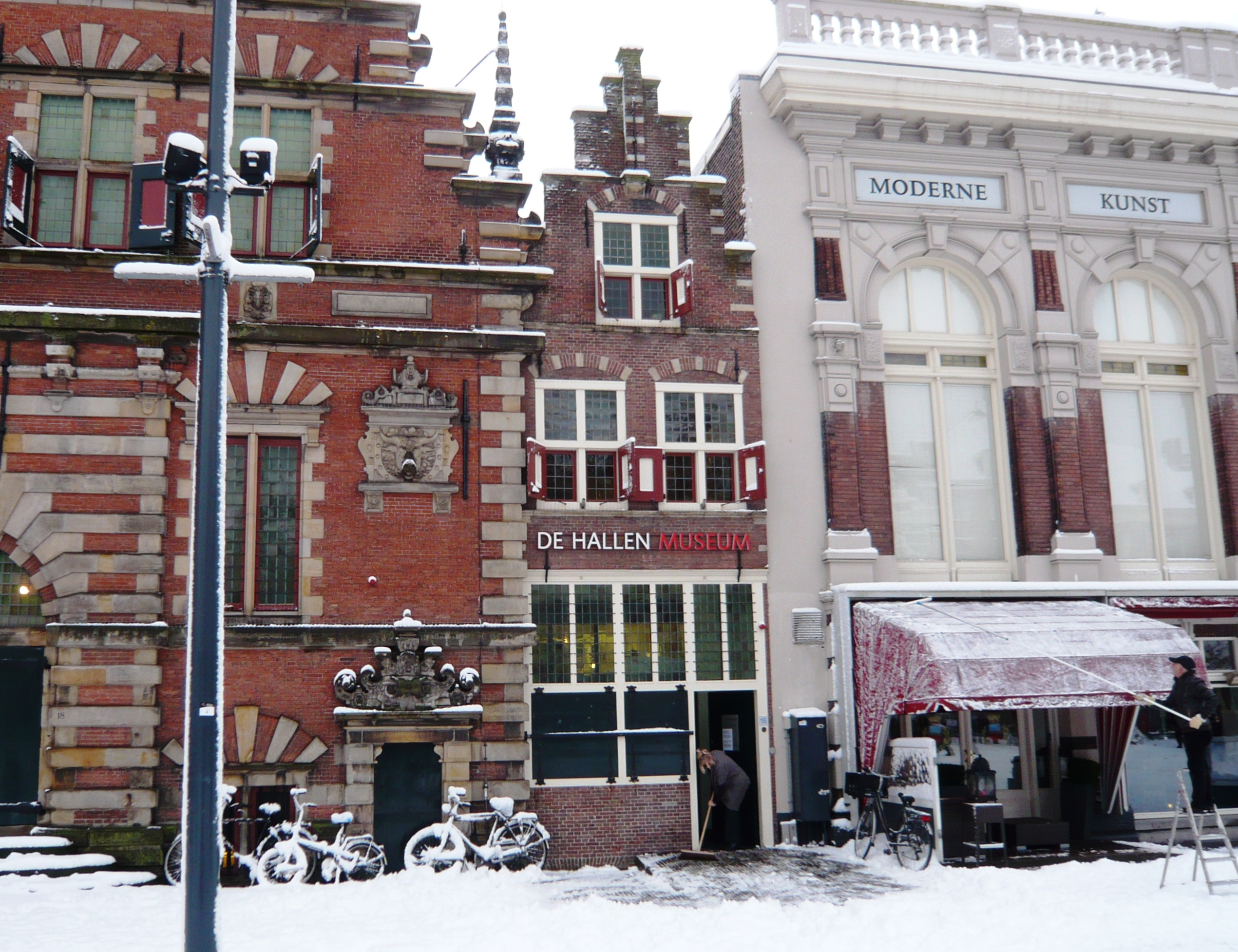
Frans Hals Museum - Hal
Look up at the Vleeshal on Haarlem's Grote Markt and you will meet the eyes of stone bulls and rams. The heads were carved into the facade four hundred years ago, when the building did what its name says: hal means hall, vlees means meat, and this was the place butchers brought their carcasses to be sold under the watchful eye of the city government. The Vleeshal is now one of three buildings that make up the Frans Hals Museum - Hal, the contemporary art wing of the museum better known for its golden-age portraits across town. The juxtaposition is the building's quiet joke: a Dutch Renaissance meat hall, complete with sculpted livestock, hosting video installations about Man and society.
Lieven de Key's Showpiece
The Vleeshal went up between 1602 and 1605, designed by Lieven de Key, the Haarlem city architect at the height of his career. De Key was building on a Gothic floor plan — the meat market's footprint was already fixed — and he layered Renaissance ornamentation over it: pilasters, rustication, Tuscan interior pillars, scrollwork above the cellar entrances, obelisks crowning the roofline. Sample prints by the Antwerp architect Hans Vredeman de Vries gave him his vocabulary of forms. The city government paid for everything, and the finished building suggests that Haarlem's treasury was in robust shape in the years just after the city's independence had been confirmed. The Vleeshal is one of the great surviving works of northern Dutch Renaissance architecture, and the meat market it housed kept running into the nineteenth century.
From Carcasses to Garrison to Galleries
After the meat trade left, the building led a strange institutional life. From 1840 to 1885 it stored supplies for a garrison quartered in Haarlem. Then it became a public records office. Then a depot for the municipal library. During the Second World War the German occupation used it to house the Distribution Service, which managed wartime rationing. After 1945 the city's Mayor and Aldermen, looking for a way to put the building back into civic use, decided it should be an exhibition hall. The first art exhibitions opened in 1950. The cellar — vaulted, low-ceilinged, exactly the right kind of space to make ceramic shards feel ancient — now holds the Archeologisch Museum Haarlem. Three centuries of meat. Forty-five years of military and bureaucratic storage. Then seventy years of art and counting.
The Fish House and the Verweyhal
The middle building between the Vleeshal and the Verweyhal is the smallest piece of the complex and the easiest to overlook. It is sometimes called the fish house, because it once held the residence of the servant who tended the fish market across the square. Until August 2025 it served as the entrance to the museum. On the other side stands the Verweyhal, a nineteenth-century eclectic building with art deco features in the interior. It began life as the meeting hall of a Haarlem gentlemen's society called Trou moet Blycken — "loyalty must be shown" — before the local painter Kees Verwey financed its renovation in 1992. Verwey gave his entire oeuvre to the Frans Hals Museum on condition that it had a permanent home; the Verweyhal became that home. The names along the top of the facade — Israels, Kruyder, Sluyters, Van Looy, Andriessen, De Kat, Gestel — list Haarlem's modern-art lineage.
What Hung Here
The Hal site focused on contemporary photography and video, with an emphasis on what curators described as Man and society — work that looks at how people live now and how their living shapes the world. The HAL location closed permanently in August 2025; the Frans Hals Museum now operates solely from its main site on Groot Heiligland. While it was open, the pairing was part of the curatorial logic: visit one site for the seventeenth-century militia portraits and regents' group pieces that defined Dutch group portraiture, then walk to the Hal for contemporary artists working through similar questions in different media. The two buildings made different arguments about the same subject. The militia paintings asked who deserves to be remembered. The video installations in the Vleeshal often asked the same question and arrived at different answers.
The Bulls Still Watch
What stays with most visitors is the building itself. The high-ceilinged main hall of the Vleeshal preserves the proportions of the meat market: a long, lofty volume designed to keep meat cool and to give buyers space to move. Daylight comes through tall windows. The wooden beams overhead still carry the marks of four centuries of use. Outside, the bulls and rams on the facade have weathered through Spanish wars, Napoleonic occupation, two world wars, and a half-century of contemporary art. They have watched butchers, soldiers, archivists, distribution officers, curators, and tourists pass beneath them. They are still watching, and they show no sign of getting tired of it.
From the Air
Located at 52.3808 N, 4.6361 E on the Grote Markt in central Haarlem, about 20 km west of Amsterdam. Nearest airport: Amsterdam Schiphol (EHAM/AMS), 10 km southeast. The Vleeshal sits directly opposite Haarlem's Grote Kerk (Sint-Bavokerk) on the central square; the church's tower is by far the most prominent visual landmark when approaching Haarlem from the air, with the museum complex just to its west.