Frans Hals Museum
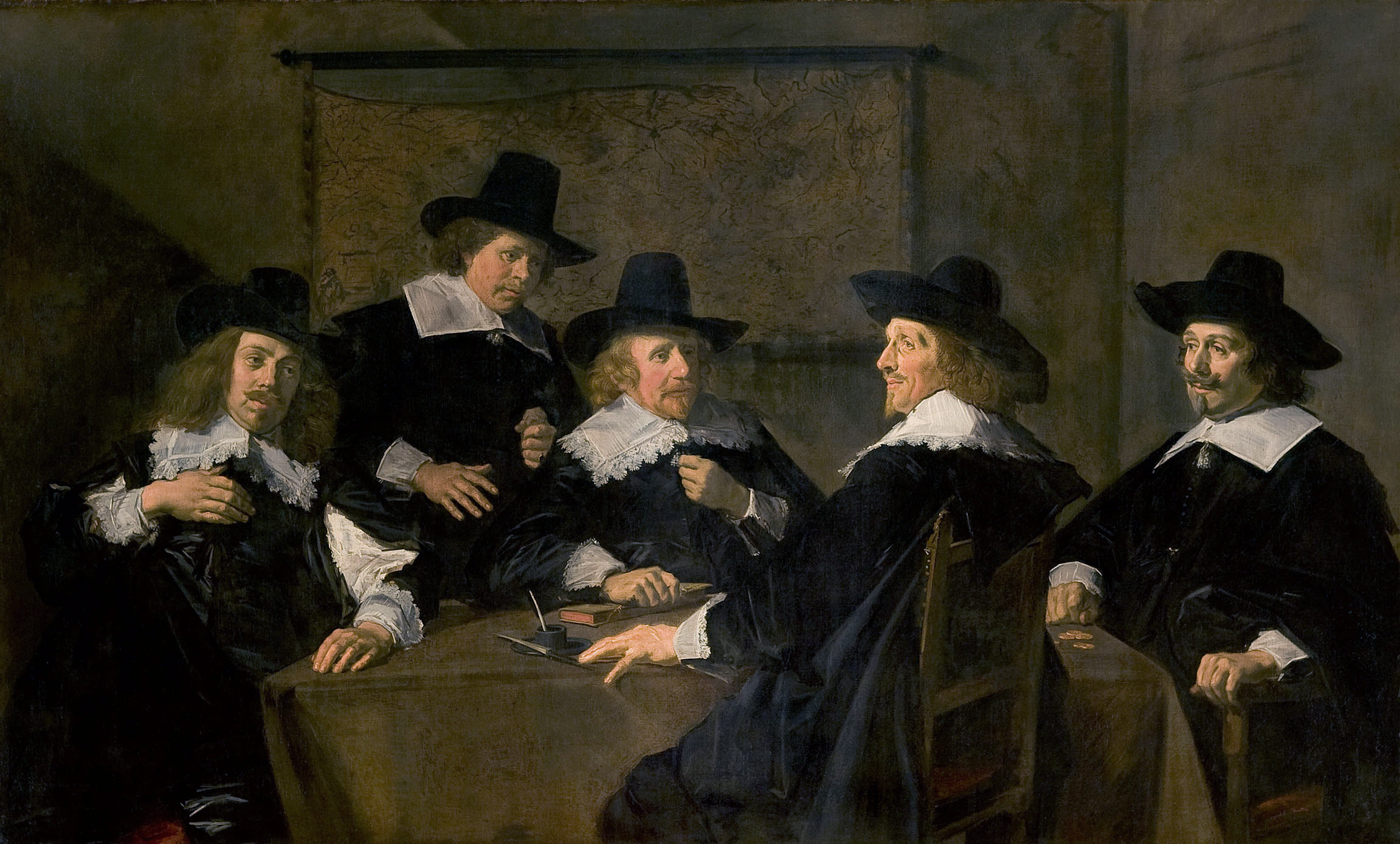
In 1664 Frans Hals was eighty-two years old, nearly destitute, and supported by a small municipal pension from the city of Haarlem. He had outlived most of his subjects and almost all of his audience. The city, embarrassed by the poverty of its greatest living painter, commissioned him to paint two final group portraits: the regents and the regentesses of the Haarlem Old Men's Almshouse. The almshouse was a hofje, a small courtyard of subsidized housing for elderly single men, and the regents were the merchants who governed it. Hals painted them with brushwork that had grown looser and stranger with his age, faces that looked unflinchingly out of the canvas, hands suspended in mid-gesture. Two years later he was dead. The two paintings stayed in the building. The building, three centuries later, became the museum that bears his name, and the regents and regentesses still hang on the walls of the rooms where they once met.
The Old Men's Almshouse
The Oudemannenhuis was founded in 1609. It was a hofje in the Haarlem tradition: thirty small dwellings arranged around a central courtyard, each occupied by two men. Residents had to be at least sixty years old, single, honest, and longtime Haarlem citizens. They brought their own household goods to a strict inventory: a bed, a chair with a cushion, a tin chamberpot, three blankets, six good shirts, six nightcaps. The gates locked at eight in summer evenings and at seven in winter. Five regents governed the institution and sat for the portraits Hals delivered in 1664. The building survived the centuries, though most of it was renovated beyond recognition. The Haarlem municipal orphanage occupied the premises from 1810 until 1908, swapping in dormitories where the small houses had been. When the orphanage left, the old men's home rooms were restored, and in 1913 the building reopened as the Frans Hals Museum. The two group portraits hung again, in the same building they had always been in, only this time facing a paying public.
Hals Himself
Frans Hals was born in Antwerp around 1582 and grew up in Haarlem after his family fled the Spanish reconquest of the southern Netherlands. He spent his entire working life in the city. His specialty was portraiture, particularly group portraits of Haarlem's militia companies - the civic guards who drilled on weekends and dined together annually in vast feasts that demanded commemoration. The Banquet of the Officers of the St George Civic Guard, painted around 1616, established his career. His brushstroke was loose by the standards of the era, his sitters caught in mid-conversation rather than posed in formal stillness. Rembrandt admired him. The young Vincent van Gogh, visiting Haarlem in 1885, wrote home that Hals had no fewer than twenty-seven different shades of black in his palette. His most famous painting in popular memory, the Laughing Cavalier of 1624, hangs not here but in the Wallace Collection in London - a private bequest that left the Netherlands long before the Frans Hals Museum existed. What Haarlem kept were the group portraits, the militia banquets, and the late masterpieces of the almshouse regents.
The Reformation Inheritance
The museum's older holdings exist because of religious upheaval. When Haarlem followed the rest of the Northern Netherlands in becoming Protestant in 1578, the city council formally seized all Roman Catholic art in the city. Paintings that had hung in chapels and altarpieces and convents were inventoried, removed, and absorbed into civic ownership. Frans Hals, then in his sixties, was hired as the first official city-paid restorer to clean and repair them. The city hall became a kind of unofficial museum, with the most important pieces decorating its grand rooms. When Napoleon disbanded the Dutch guilds in 1794, the guild buildings reverted to the state, and their militia portraits and trade-society pieces - many by Hals - joined the city collection. The Frans Hals Museum's holdings today are the cumulative result of three and a half centuries of these seizures, donations, and bequests, layered onto the spine of the old men's home.
Beyond Hals
The museum is not only Hals. Cornelis Cornelisz van Haarlem, who painted his eerie A Monk and a Nun in 1590, hangs nearby. Gerrit Berckheyde's 1696 view of the Grote Markt, with the towering St Bavokerk dominating the horizon, looks almost identical to the same square today. The collection includes works by the Haarlem Mannerists, by Karel van Mander - whose 1604 Schilder-boeck remains the foundational text of Dutch art history - and by twentieth-century painters like Isaac Israels, whose 1922 portrait of the Javanese ruler Mangkunegara VII brings the Dutch colonial encounter into the museum's narrative. Until August 2025, the museum maintained a second site called De Hallen for modern and contemporary art, but the historical collection has always been the heart of the place, and the heart of the historical collection is still the two Hals portraits in the old men's home.
Haarlem, Quietly
Haarlem is twenty kilometers west of Amsterdam, a fifteen-minute train ride that crosses the Haarlemmermeer polder where Schiphol Airport now sits. Tourists come for the day, mostly for the museum, the towering Grote Kerk on the Grote Markt, and the Teylers Museum a few streets over - the oldest continuously operating museum in the Netherlands, founded in 1778, which holds the natural history collection that split off from the Frans Hals Museum's predecessor in 1777. The city is smaller and quieter than Amsterdam. Its merchant houses lean at the same comfortable angles. Walking from the train station to the museum takes about twelve minutes, and the route passes most of the buildings Hals would have known - the same brick gables, the same canal bends, the same Bavokerk tower visible from any open street. The painter has been dead for three hundred and sixty years. The town he painted is still mostly here, and so is he.
From the Air
The Frans Hals Museum is at Groot Heiligland 62 in central Haarlem, coordinates 52.377 N, 4.634 E, approximately 20 km west of central Amsterdam. From the air, Haarlem reads as a compact medieval core with the tall St Bavokerk dominating the central Grote Markt - the church spire is the unmistakable landmark, visible for many kilometers. The museum sits in a 17th-century brick complex two blocks south of the market square. Nearest airports: Schiphol (EHAM), 15 km southeast, and Rotterdam The Hague (EHRD), 50 km south. Class A airspace nearby; expect arrivals via the Polderbaan and Buitenveldertbaan into Schiphol. Best viewing 2,000-3,000 feet on a clear day.