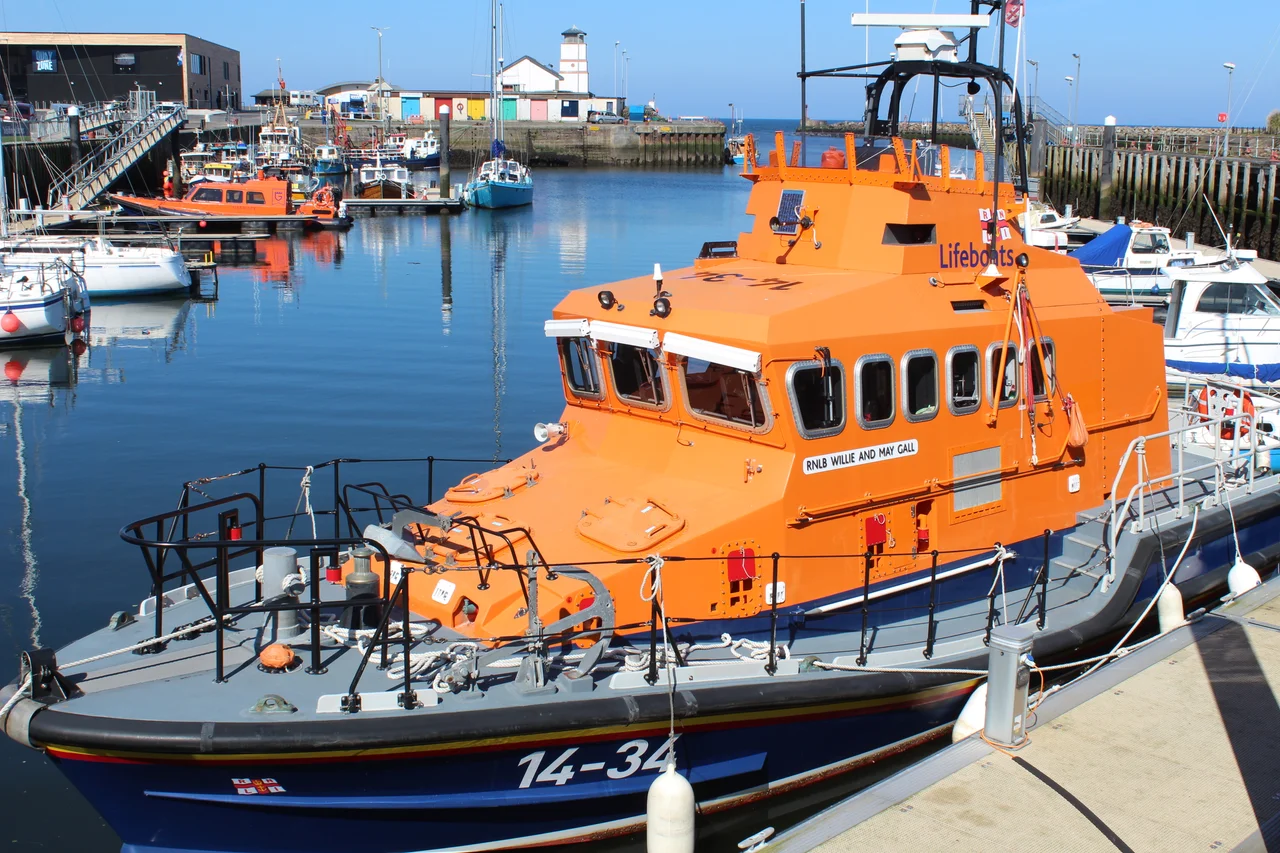

Fraserburgh Lifeboat Station
The figures are quiet but they tell a hard story. In April 1953 the Fraserburgh lifeboat John and Charles Kennedy went out to a herring drifter in trouble and was capsized by a wave on the harbour bar; six of her seven crewmen drowned, only the mechanic surviving. In January 1970 the lifeboat Duchess of Kent went out to a Danish fishing boat in a force 9 gale forty miles offshore and was thrown end over end by a sea; five of her six men were lost, again with only the mechanic recovered alive. Two disasters, eleven dead. And yet the station - first established in 1805, made the first Scottish station of the RNLI in 1858 - kept going. It is still working today.
Henry Greathead's Boat
The story begins in 1805 with a boatbuilder named Henry Greathead, the man who had built one of the earliest dedicated lifeboats in Britain twenty years before. The Fraserburgh Harbour Commissioners commissioned a boat from him, paid for by the local landowner Sir William Forbes. We know almost nothing else about her - probably a thirty-foot non-self-righting design - but she was here, on this exposed corner of the Aberdeenshire coast where the North Sea meets the Moray Firth at almost a right angle. A second boat arrived in 1831; by 1851 she was recorded as unfit for purpose. The RNLI did not yet exist in Scotland. The men of Fraserburgh handled their own rescues with whatever boat they could keep in working order.
The First Scottish Station
In November 1857 Lewis Chalmers, the Chief Magistrate of Fraserburgh, wrote to the RNLI listing thirteen shipwrecks on this coast in the previous ten years. Captain Ward, Inspector of Lifeboats, came north to assess. In March 1858 the RNLI agreed to establish a station - Scotland's first under the institution's own banner. They ordered a thirty-foot self-righting pulling-and-sailing boat from Forrestt of Limehouse in London. Cost: 182 pounds, 1 shilling, 2 pence. A fire at the workshop delayed delivery. The boat finally arrived on 26 October 1858 and was named Havelock. Chalmers became the station's first Honorary Secretary. The pattern that defined Fraserburgh - paid for locally, crewed locally, watched over by men who knew exactly which waters had killed which ships - was set.
9 February 1953
The first disaster came on a Wednesday afternoon. The Fraserburgh lifeboat John and Charles Kennedy launched at about 1:25 PM to help the herring drifter Princess Marie Jose make harbour through a strong easterly gale. She reached the drifter, escorted her in, and was returning across the harbour bar when a heavy sea reared up and overturned her without warning. She was upside-down before her crew could brace. The boat was self-righting in theory; in the conditions, with her keel taken by another wave before she could come back up, she capsized again. Of the seven men aboard, six drowned: coxswain Andrew Ritchie, mechanic George Flett Duthie, bowman Charles Tait senior, assistant mechanic James Noble, and crewmen John Crawford and John Buchan. Second coxswain Charles Tait junior - whose father died in the disaster - was the only survivor, washed up alive on the rocks south of the harbour. Fraserburgh - a town small enough that the men were known to almost everyone - went into mourning.
21 January 1970
Seventeen years later it happened again. At 6:30 AM on 21 January 1970 the lifeboat Duchess of Kent was launched into a force 8 to 9 gale to help the Danish fishing boat Opal, which was taking on water forty miles offshore. She arrived at 11:00 to find the Opal already in tow from a Russian trawler, with other vessels standing by, including the large Russian ship Victor Kingisepp. As the lifeboat held station near the casualty a great wave lifted her bow. She was thrown stern over bow. The crew of the Victor Kingisepp worked desperately to right her. They succeeded at 2:31 PM - but too late for five of the six men aboard. Coxswain John Stephen, second coxswain William Hadden, bowman James R. S. Buchan, assistant mechanic James Buchan, and crewman Frederick A. Kirkness all died. Only the mechanic John Jackson Buchan survived, thrown clear and pulled from the upturned hull. Once again it was a small town's losses, distributed across families that had crewed boats for generations. Fraserburgh did not get another lifeboat until 1978.
Willie and May Gall
On 8 May 2002 the new lifeboat 14-34 Willie and May Gall (ON 1259) arrived at Fraserburgh - a fibre-reinforced-composite hull fitted out by Souters of Cowes, twin MAN diesels developing 800 brake horsepower, top speed 25 knots, cost 1,240,452 pounds. She was named in a ceremony on 7 September 2002. She is still on station today, the latest in a line of boats running back through Henry Greathead's first vessel of 1805. Three generations of Fraserburgh families have served as coxswains, mechanics and crew on the boats from this station. RNLI medals in the station's history - gold to Bowen in 1827 and Turner in 1831, silver and bronze to many more over the years - mark services that succeeded. The roll of honour marks the services that did not. The boat goes out anyway.
From the Air
Fraserburgh Lifeboat Station lies in Fraserburgh harbour at 57.6936 N, 2.0028 W, on the north-east corner of Aberdeenshire where the coast turns from east-facing to south-facing. From altitude Fraserburgh appears as a substantial harbour town at the tip of the Buchan coast, with the lighthouse at Kinnaird Head immediately to the north. Nearest major airport is Aberdeen (EGPD) about 35 nm to the south. The station houses the Tamar-class all-weather lifeboat 14-34 Willie and May Gall (ON 1259), on service since 2002.
Nearby Stories
- Tarlair Swimming Pool 8.2 km away
- New Slains Castle 9.4 km away
- Battle of Slioch 17 km away
- German submarine U-58 (1938) 32 km away
- HMS Exmouth (H02) 33 km away
- Piper Alpha 109 km away
- German submarine U-1274 209 km away
- Jarlshof 236 km away