.jpg)
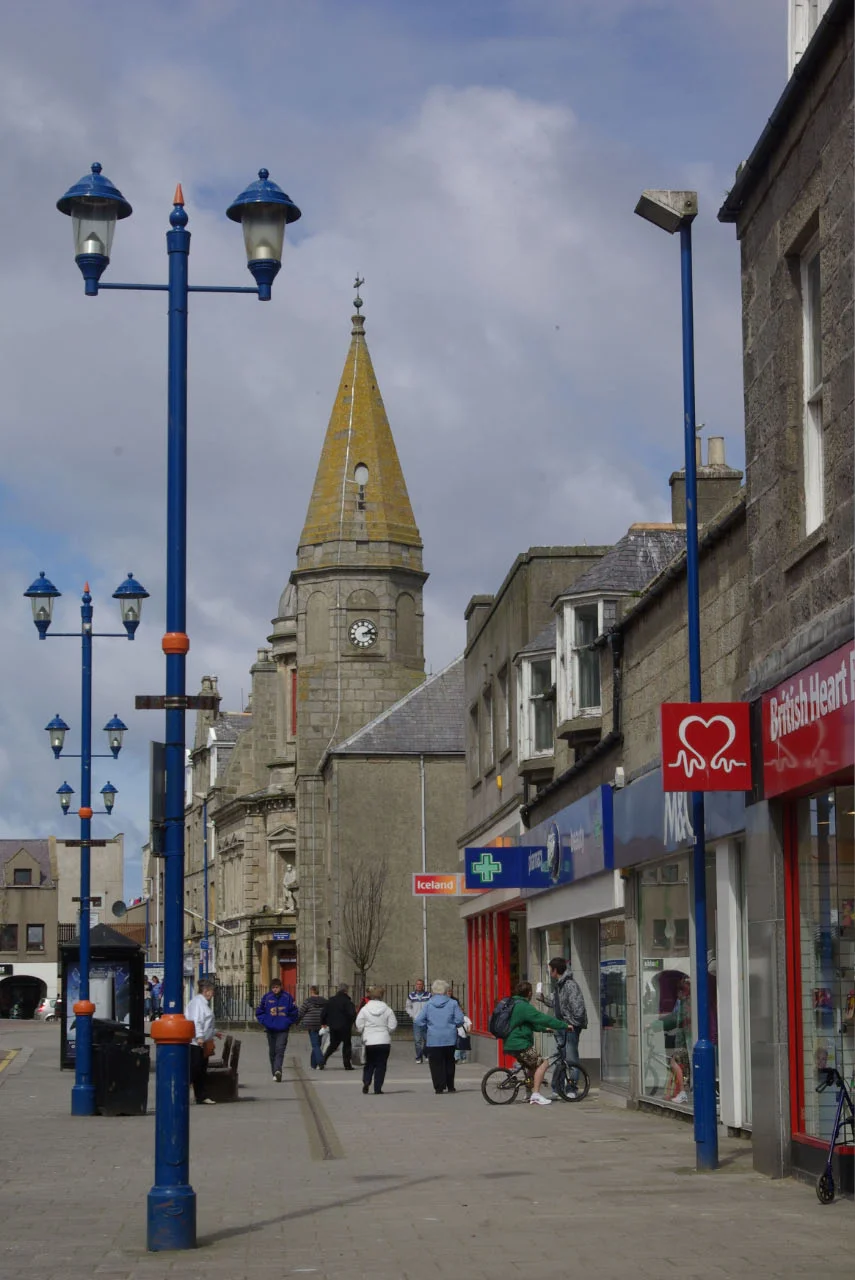
Fraserburgh Old Parish Church
Before there was a town of Fraserburgh there was a village called Faithlie - a small fishing community on a wind-scoured corner of the Aberdeenshire coast. In 1546 the local laird Sir Alexander Fraser obtained a charter to develop it. The first structure he raised was the castle at Kinnaird Head. The second was the Kirk - founded in 1571, on a rise at the head of what would become the High Street. For four hundred and fifty-five years that church anchored the town it had helped create. In early 2026 the Church of Scotland listed the building for offers over 120,000 pounds.
The Reverend Who Said No to a King
The Kirk's earliest controversy came not long after its founding. In 1599 the Reverend Charles Ferm was appointed minister - a young man, thirty-four years old, devout Presbyterian, friend and ally of Andrew Melville. The next year King James VI changed the official religion of Scotland to Episcopacy. Ferm refused to accept the change. On 2 July 1605 he was one of fourteen ministers who attended an unauthorised General Assembly at Aberdeen. The King's response was to imprison him - first at Doune Castle for a year, then on the Isle of Bute for nearly three more. He was restored to Fraserburgh in 1609 and died in his parish in 1617. Melville famously called James VI God's silly vassal. Ferm paid the price for the company he kept.
1803 - The Present Building
By the start of the 19th century the 1571 church was failing and the parish demolished it. The replacement - the building that stands today - was completed in 1803 at the same site, the rise at the head of the High Street where the original Kirk had stood. It is built in plain Georgian-Scottish style, harled and white, with a small bell tower. The interior was renovated in stages through the 19th century under successive ministers. In 1898 a new pipe organ was installed. In 1906 the Anderson Memorial Stained-Glass Window was dedicated - a major work by Douglas Strachan, one of the most important Scottish stained-glass artists of the early 20th century. The church was eventually granted Category B listed status.
Hitler's Mark
The church survived a near miss in the Second World War. Fraserburgh - a working harbour with shipbuilding capacity - was bombed repeatedly by the Luftwaffe between 1940 and 1943. On one raid a sheet of metal from an exploding aircraft or building fell through the church roof and sliced a small chip out of the wooden pulpit. The chip is still there. The congregation calls it Hitler's mark. It is one of the small, specific scars that wartime left scattered around the small towns of Britain - not large enough to record in any national history, but central to the inner life of one church that very nearly lost everything that night.
Ministers, Schools and the Long Slow Change
Through the 19th and 20th centuries the church operated like many Scottish parish churches: large Sunday congregations, Boys' and Girls' Brigades, a Junior Choir, Covenanters, Sunday schools. The Reverend Peter McLaren in the 1860s founded three new schools in the parish. The Reverend John Cumming, who served from before 1843 until his death at 85 in 1857, refused to leave the Established Church during the Disruption of 1843 and managed to feud with most of his assistants while he was at it. The Reverend Douglas Clyne, late 20th century, oversaw the renovation of the church hall - known locally as the Penny Schoolie - and the building of a new church centre in 1990-92. He retired in 2004. The slow attrition of small-town Scottish congregations did the rest.
Closed and Listed for Sale
In the early 2020s the Presbytery of the North East and Northern Isles, working through the Church of Scotland's national Presbytery Mission Planning, decided that Fraserburgh Old Parish Church should close as a place of worship. The Old Parish would be united with Fraserburgh West, Fraserburgh South, Rosehearty, Sandhaven, Inverallochy and Rathen churches into a single Fraserburgh and District Church of Scotland. The buildings of Fraserburgh South, Rosehearty and Inverallochy would continue in use. The Old Parish - the first structure of the town after the castle, the church Charles Ferm went to prison for, the building Strachan's window lights from within - would not. By early 2026 the listing went up on the Church of Scotland website: offers over 120,000 pounds. Four hundred and fifty-five years of continuous worship, now a property transaction.
From the Air
Fraserburgh Old Parish Church stands at 57.6935 N, 2.0045 W at the head of the High Street in Fraserburgh, at the north-east corner of Aberdeenshire. From altitude the church reads as a small white harled building near the centre of the harbour town, with the Kinnaird Head lighthouse visible to the north. Nearest major airport is Aberdeen (EGPD) about 35 nm to the south. Fraserburgh harbour is one of the largest fishing ports on Scotland's east coast.
Nearby Stories
- Tarlair Swimming Pool 8.2 km away
- New Slains Castle 9.4 km away
- Battle of Slioch 17 km away
- German submarine U-58 (1938) 32 km away
- HMS Exmouth (H02) 33 km away
- Piper Alpha 109 km away
- German submarine U-1274 209 km away
- Jarlshof 236 km away