.jpg)
Fraserburgh Town House
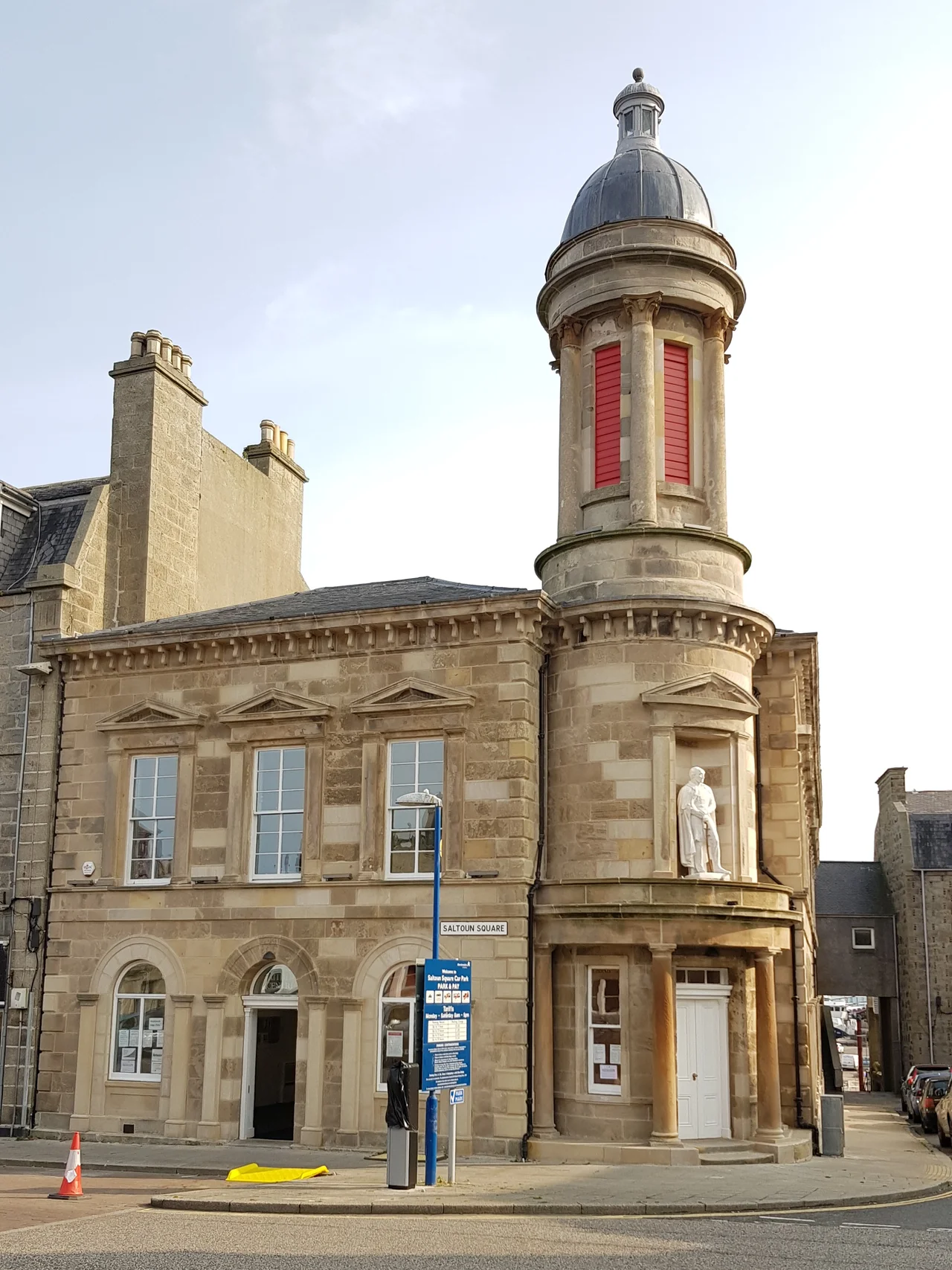
The corner of Saltoun Square and Kirk Brae carries a small architectural surprise. Out of the working harbour-town stonework of Fraserburgh rises a domed rotunda, Corinthian columns supporting the roof, a Renaissance frontage curving around the corner as though the building had been imported from a wealthier and warmer city. This is the Fraserburgh Town House. Thomas Mackenzie designed it in 1855. A statue of Lord Saltoun stands in an aedicule at first floor level, sword at his side. He had survived Waterloo, commanded in China during the First Opium War, and died as work on his town's new headquarters was just beginning.
The Tolbooth That Came Before
The site has held a municipal building since the early 17th century, when the original tolbooth was built here by the laird Sir Alexander Fraser. A tolbooth was the universal Scottish town building - prison, council chamber, tax office and meeting hall in a single structure - and Fraserburgh's served all those purposes for two and a half centuries. It had a gable and an external stair facing Saltoun Square. By the mid-19th century, after population growth driven by Fraserburgh's expansion as a herring port, the old tolbooth was crumbling. The town had become a police burgh in 1840. The new burgh commissioners demolished the tolbooth and looked for an architect who could give the rising town a building to match its ambition.
Thomas Mackenzie's Renaissance
They found him in Thomas Mackenzie, partner in the firm Matthews and MacKenzie. Mackenzie was one of Scotland's leading classical revivalists, and the building he produced for Fraserburgh is one of his clearest statements - a symmetrical rounded frontage where Saltoun Square meets Kirk Brae, completed in 1855 in cleanly cut ashlar stone. The ground floor presents a central doorway with two sash windows on either side, flanked by Doric columns supporting a rounded entablature. Above this rises a rotunda ringed in Corinthian columns supporting a small dome. The whole composition - prison-tolbooth replaced by an Italian palazzo gesture - was a deliberate civic announcement: Fraserburgh had become a town that took itself seriously.
The Lord Saltoun Statue
In December 1859 an aedicula was installed at first-floor level on the corner of the building containing a statue of Lieutenant-General Alexander Fraser, 17th Lord Saltoun. The sculptor was Edward Bowring Stephens. Saltoun was the local laird of the Fraser family that had given the town its name in the 16th century, and his life had carried him from a junior officer's commission at the Battle of Waterloo - where he commanded a company at the defence of Hougoumont - through senior command in the First Opium War in China, to his death just as construction of the new town house began. The statue marks him as much for what he was at home - the man whose family had built the place - as for what he did at war. His sword hangs at his side. He is looking out across Saltoun Square.
Extensions and Decline
In 1906 the building was extended four additional bays along Kirk Brae to accommodate a police station, designed by Reid and McRobbie. For most of the 20th century the town house held council offices and the police on different floors. Civic life passed through these doors - including a banquet here in August 1905 honouring Sir George Anderson, the locally-born banker who served as treasurer of the Bank of Scotland. By the late 1990s the police had moved to new premises on Finlayson Street. The Kirk Brae extension went vacant. The Renaissance frontage on Saltoun Square continued in council use, but the building as a whole was sliding into the kind of slow heritage decline familiar to many small Scottish towns: well-built, well-loved, expensive to keep up.
Moxon's Steel Skin
In May 2018 the building reopened after a major restoration. Moxon Architects had designed an extension to the rear - a quietly contemporary structure clad in perforated weathering steel, the rusted Cor-Ten skin folded into a single planar gesture against the back of Mackenzie's Renaissance facade. The contrast worked. The project earned design-award nominations and a feature in Dezeen. The ground floor became a modern registrar's office. The first floor was reconfigured as an enterprise hub for local businesses. The old council chamber, with its 1855 plasterwork still intact, became a venue licensed for weddings and civil partnership ceremonies. Walk past the corner today and the old building still does its job - announcing that Fraserburgh has a town worth a town hall. The statue of Lord Saltoun has watched the square through Mackenzie's hand, Reid and McRobbie's hand, Moxon's hand. The square watches back.
From the Air
Fraserburgh Town House stands at 57.6938 N, 2.0047 W in Saltoun Square at the centre of Fraserburgh, in the north-east corner of Aberdeenshire. From altitude the domed rotunda is visible as a distinctive small architectural feature near the centre of the harbour town, with the Kinnaird Head lighthouse visible to the north. Nearest major airport is Aberdeen (EGPD) about 35 nm to the south.
Nearby Stories
- Tarlair Swimming Pool 8.2 km away
- New Slains Castle 9.4 km away
- Battle of Slioch 17 km away
- German submarine U-58 (1938) 32 km away
- HMS Exmouth (H02) 33 km away
- Piper Alpha 109 km away
- German submarine U-1274 209 km away
- Jarlshof 236 km away