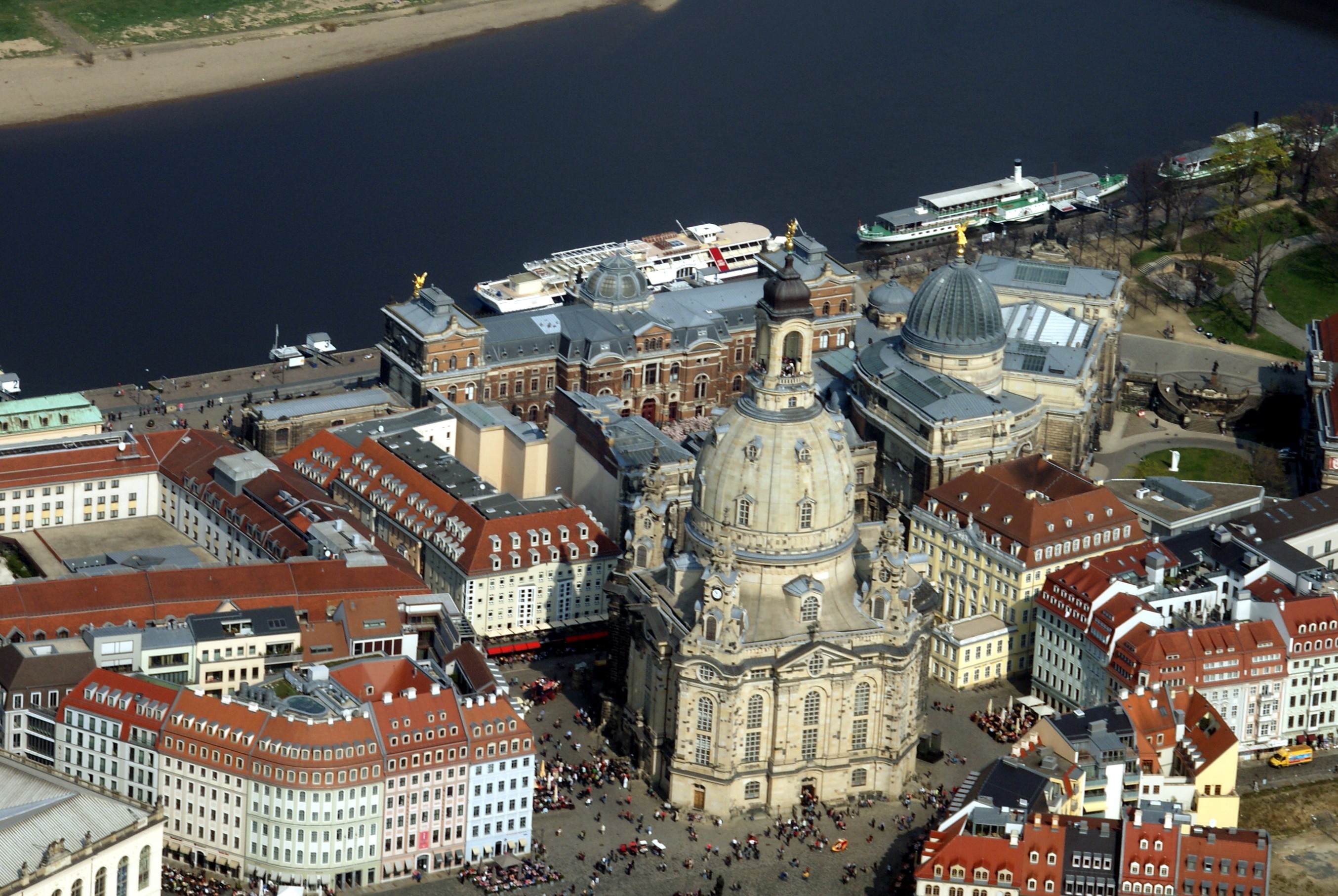
Frauenkirche, Dresden
Look closely at the sandstone of the Frauenkirche and you can read the building's biography in the color of its blocks. The dark blackened stones are the survivors. They sat in a pile in the city center for forty-five years after the firebombing of February 1945, weathering and waiting. The lighter stones are new, quarried for the reconstruction. Together they form a single church that does not pretend the destruction never happened. The patina will even out over a century or two. For now, the seam between past and present is something you can touch.
George Bahr's Stone Bell
The original Frauenkirche was the work of Dresden's city architect George Bahr, who began it in 1726 and did not live to see it finished in 1743. His most audacious move was the dome. Twelve thousand tons of sandstone, 67 meters high, resting on eight slender interior pillars. Critics insisted it would collapse. It did not. In 1760, during the Seven Years' War, Prussian artillery under Frederick II hit the dome with more than a hundred cannonballs. Witnesses said the projectiles bounced off. The Frauenkirche became the silhouette of Dresden, captured by Bernardo Bellotto in his great cityscapes and by Norwegian painter Johan Christian Dahl in his moonlit view of 1839. Johann Sebastian Bach gave a recital on the new Silbermann organ on December 1, 1736. For two centuries the dome held.
February 1945
The Allied firebombing of Dresden began on February 13, 1945. Some 650,000 incendiary bombs fell on the city in two days. Three hundred people sheltered in the church crypt while the eight sandstone pillars held against the heat. They were evacuated. The temperature inside the church reached 1,000 degrees Celsius. At 10 a.m. on February 15, the dome finally gave way. The pillars glowed red, then exploded. Six thousand tons of stone fell through the floor of the building. What remained was a charred altar, two fragments of the chancel wall, and a vast pile of blackened blocks. The death toll for the Dresden raids overall is estimated at around 25,000 people, most of them civilians. The argument over whether the bombing was militarily necessary or a war crime has not ended in the eighty years since.
The Heap That Became a Memorial
East German authorities considered clearing the rubble for a parking lot. Dresdeners refused. Within months of the war's end, residents were already pulling identifiable stones from the heap and numbering them, on the chance that a reconstruction might one day be possible. In 1966, the East German government formally declared the ruins a memorial against war. By 1982, the pile had become a gathering place for the East German peace movement, where citizens lit candles on the anniversary of the bombing in defiance of the regime. By 1989, those gatherings had grown to tens of thousands, part of the wave of protests that brought down the Berlin Wall in November of that year. The ruined dome was, for half a century, the most eloquent thing in Dresden. It said nothing and meant everything.
Stone by Numbered Stone
Reconstruction began with a citizens' initiative led by Dresden trumpeter Ludwig Guttler in 1989. Donations came from over 5,000 members in twenty countries. German-American biologist Gunter Blobel, who had seen the original church as a child refugee in 1945, donated his entire 1999 Nobel Prize money, nearly a million dollars, the largest single gift to the project. The British Dresden Trust, with the Bishop of Coventry among its curators, raised funds with the explicit framing of reconciliation. Architects sorted thousands of stones with the help of three-dimensional computer modeling, identifying the original position of each one. About 8,500 original stones were salvaged; roughly 3,800 were reused. The remaining 4,700 were sold off, fragment by fragment, in watches and medals, to fund the work. The total cost reached 180 million euros.
The Cross from the Bomber's Son
The new gilded orb and cross atop the dome was forged in London by Grant Macdonald Silversmiths. The principal craftsman was Alan Smith, whose father Frank had been a member of one of the RAF Lancaster crews that bombed Dresden. The cross was paid for by donations from the British people and the House of Windsor and exhibited for five years in cathedrals across the United Kingdom before being ceremonially handed over by Prince Edward, Duke of Kent, in February 2000. The reconsecration on October 30, 2005, was attended by representatives of the Coventry Cathedral congregation, whose own ruins, bombed by the Luftwaffe in 1940, are preserved in England as a parallel war memorial. The original Frauenkirche cross, twisted and charred, stands today inside the rebuilt church to the right of the new altar. It is not hidden. The new and the old share the same room.
From the Air
Frauenkirche stands in central Dresden at 51.05 degrees N, 13.74 degrees E, on the Neumarkt square just south of the Elbe. Dresden Airport (EDDC) lies 9 km north. The dome rises to 91 meters and is the most prominent feature of the historic skyline, easily picked out alongside the Semperoper and the Dresden Castle. Cruising approaches from the west typically pass Leipzig/Halle (EDDP), about 110 km northwest.