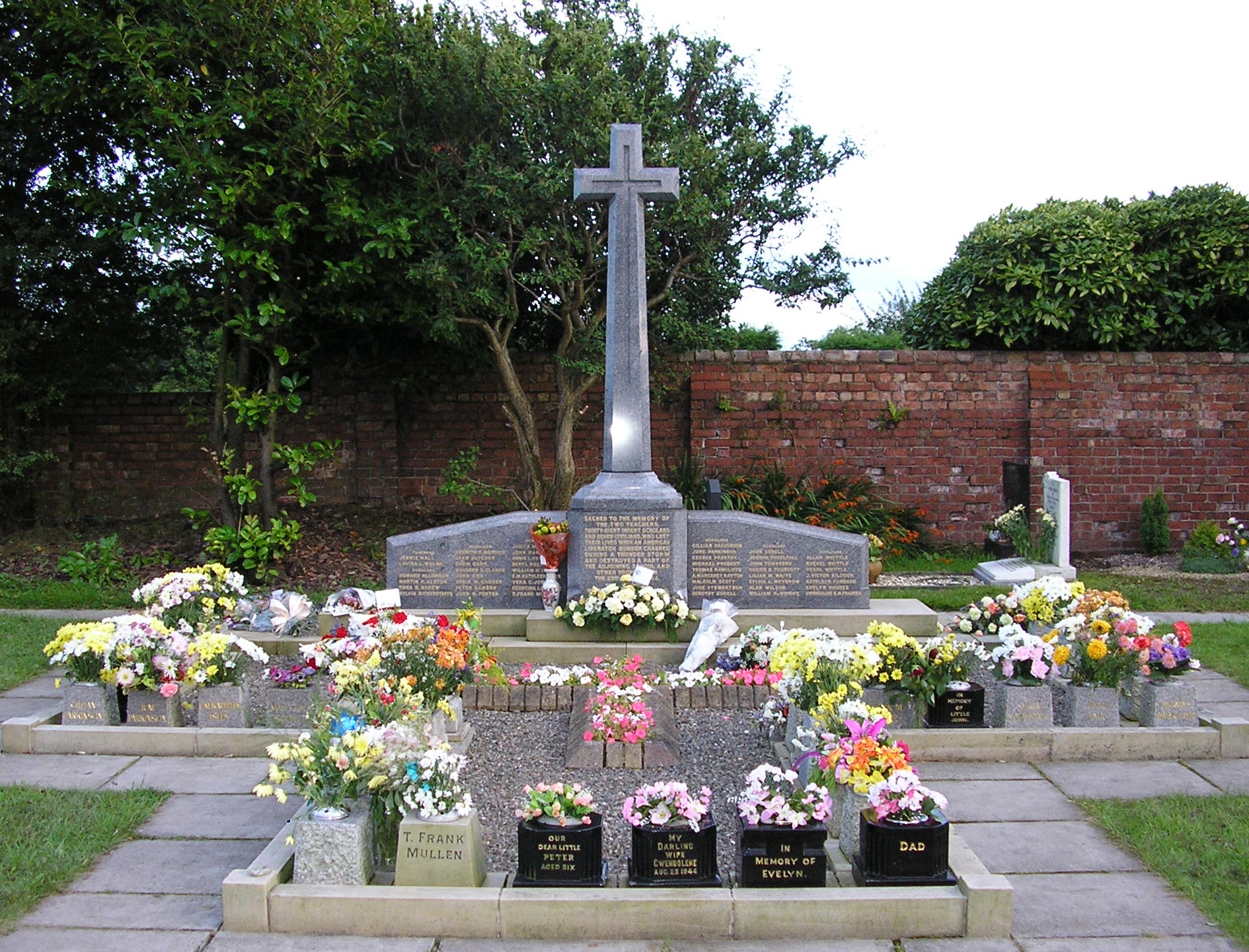
Freckleton Air Disaster
In the infants' classroom of Holy Trinity School in Freckleton, Lancashire, teacher Jennie Hall was trying to calm her young pupils as a violent storm shook the windows. A few rooms away, the headteacher had sent thirteen-year-old Jackie Nichol to check that all windows were closed. It was the morning of 23 August 1944. Outside, on the approach to nearby Warton Aerodrome, Lieutenant John Bloemendal was fighting to control a B-24 Liberator bomber through blinding rain and turbulence so severe that visibility had dropped to 500 yards. Within minutes, his aircraft would crash into the heart of the village, and 61 people -- including 38 children -- would be dead.
Ten Minutes of Fury
The storm arrived without warning. Freckleton resident Ray Cox, walking along Lytham Road, ran for shelter at a bus stop and found he could not see the buildings across the street through the downpour. Winds shifted from northeast to southwest and back in minutes, dropping the ceiling to roughly 400 feet. Two B-24 Liberators were approaching Warton Aerodrome's runway 08. Lieutenant Bloemendal radioed the control tower that he was aborting his landing and would go around. His wingman, Lieutenant Manassero, flew north, barely clearing tree canopies for nearly ten miles before reaching safe altitude. Bloemendal never made it. Fighting violent turbulence at low altitude, he ordered his co-pilot, Technical Sergeant James Parr, to increase speed. The aircraft struck the village of Freckleton northeast of the airfield.
The Infants' Classroom
The B-24 hit the Sad Sack Snack Bar -- a cafe popular with American servicemen -- before ploughing into Holy Trinity School. Fuel and debris tore through the infants' classroom where Jennie Hall and her pupils had been sheltering. Jackie Nichol, who had just reached for the classroom door, saw a blinding orange flash as a fireball rolled across the ceiling. Teacher Louisa Hulme, standing near the doorway, was engulfed in flames. The fire consumed the oxygen so rapidly that Nichol's lungs briefly collapsed. American servicemen from the nearby base scaled the school's six-foot playground wall to pull screaming children from the junior classrooms, which were largely intact. But in the infants' room and the cafe, the devastation was total. Only five people pulled from the wreckage survived -- three children and two RAF airmen. All five endured years of operations.
A Village Gutted
Almost five percent of Freckleton's population died that morning. Seven of the child victims were first or second cousins. Three were evacuees from Greater London, children sent to this quiet Lancashire village specifically to protect them from German bombing. Only one of the three survived. The dead included six American servicemen, one RAF airman, six cafe staff, a fifteen-year-old boy, four children, and two teachers who died later in hospital. It was the deadliest aviation accident involving American aircraft during the entire Second World War. Fire crews and rescuers worked until 7 p.m. before the last flames were extinguished, and American and British servicemen cleared rubble by searchlight through the night.
Bound by Grief
The disaster forged an enduring bond between Freckleton and the United States. American personnel stationed at Warton helped rebuild the school and funded a memorial garden. Each year on the anniversary, Americans still attend the remembrance service in this small village. Several survivors carried the weight of that morning for the rest of their lives. Jackie Nichol, who witnessed the fireball that killed his classmates, struggled with survivor's guilt for decades. The village memorial lists all 61 names -- a reminder that in the chaos of a world war, tragedy could find a quiet school on a rainy morning in Lancashire as easily as it found the battlefields of Europe.
From the Air
Freckleton is at 53.75N, 2.87W in the Fylde district of Lancashire, just northeast of what is now BAE Systems Warton Aerodrome (EGNO). The village sits along Lytham Road, the same road the B-24 struck. The memorial garden and rebuilt school are visible at ground level. Best viewed at low altitude approaching from the southwest along the Ribble estuary. Blackpool Airport (EGNH) is 5nm northwest. The Ribble estuary and Warton airfield are prominent landmarks.