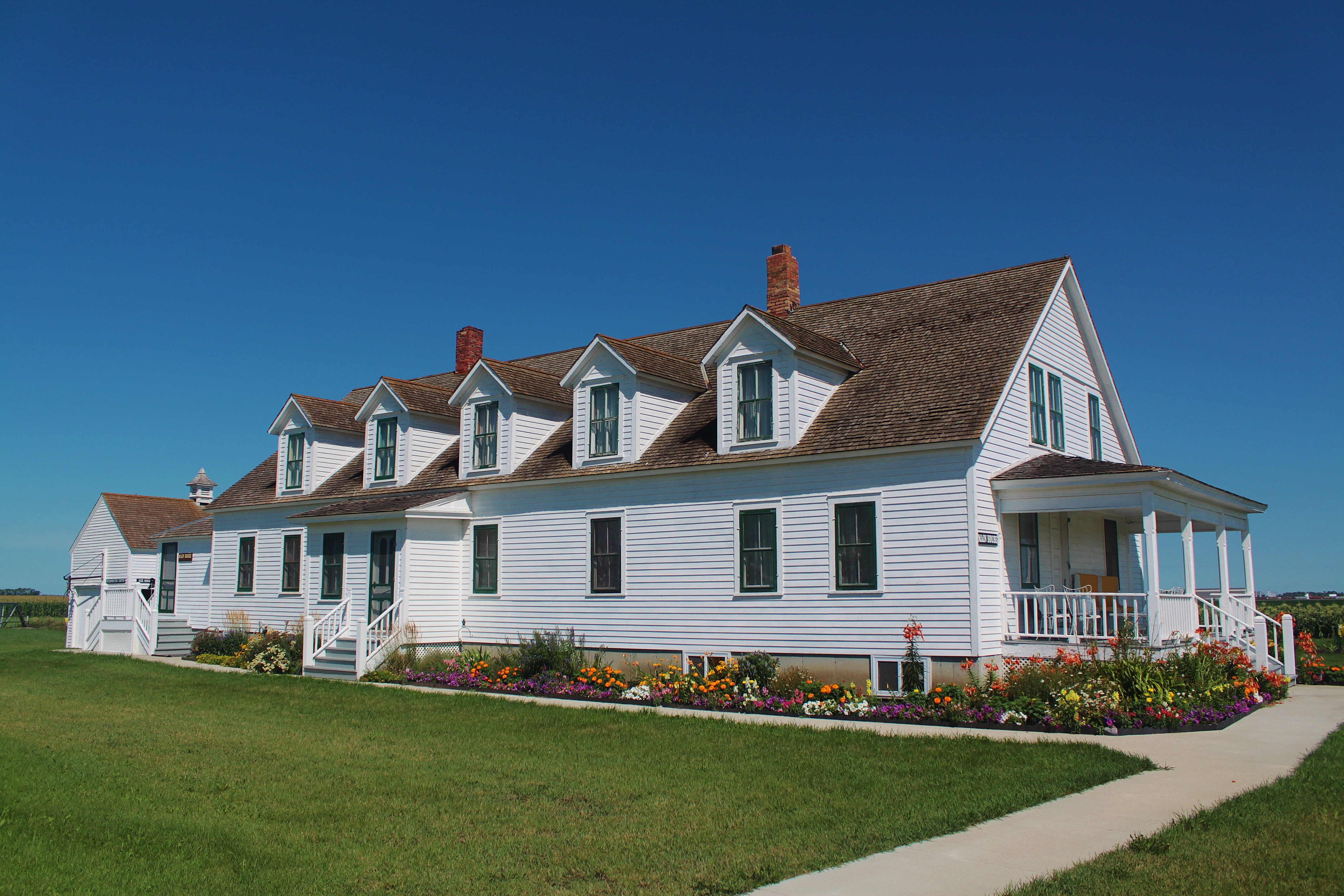
Frederick A. and Sophia Bagg Bonanza Farm
Frederick Bagg was a foreman. Sophia Bagg was a cook. They worked at the Downing Farm in Richland County, North Dakota, doing the labor that made someone else wealthy. But in the 1890s, they began quietly acquiring land of their own in the flat, fertile country east and south of Mooreton. By 1915, they had launched what Frederick described, without apology, as a factory operation -- not a factory that made steel or automobiles, but one that produced wheat, corn, and clover on a scale that dwarfed anything a traditional family farm could achieve. The Bagg Bonanza Farm grew to encompass thousands of acres, applying industrial management techniques -- labor division, cost accounting, systematic logistics -- to the ancient practice of growing things from soil. In 2005, the National Park Service declared it a National Historic Landmark, one of the best-preserved bonanza farm complexes in the nation.
From Hired Hands to Industrial Farmers
The trajectory of Frederick and Sophia Bagg reads like a Great Plains parable. They learned the business of large-scale farming from the inside, working at the Downing Farm where Frederick managed workers and Sophia fed them. The knowledge they gained was not theoretical. They understood crop cycles, labor management, equipment logistics, and the relentless economics of turning vast acreage into marketable grain. When they struck out on their own, they carried that practical education with them. The farm they built starting in 1915 was not a homesteader's modest claim but a deliberate commercial enterprise, operated between roughly 1915 and 1935 at its peak. Frederick explicitly modeled his operation on industrial business practices, treating each task as a link in a chain of production. The main house itself tells the story: it originally served as a bunkhouse at the Downing Farm, then was physically relocated and adapted to house the Bagg family alongside the transient laborers who powered the operation.
The Bonanza Era
The term 'bonanza farm' entered the American vocabulary in the late nineteenth century, describing the massive wheat operations that transformed the Northern Great Plains. These were not family farms but corporate-scale enterprises, made possible by three converging forces: the availability of vast tracts of cheap land, advances in mechanized agriculture, and the completion of railroad networks that could carry enormous harvests to distant markets. The Soo Line and Northern Pacific railroads turned Richland County into a corridor of commerce, connecting remote fields to the grain elevators and flour mills of Minneapolis and beyond. The Bagg farm fluctuated in size over the years, reaching a documented maximum extent of thousands of acres. It produced primarily wheat, corn, and clover -- the staple crops of the northern prairies -- and required a workforce that arrived seasonally, slept in bunkhouses, and moved on when the harvest was done.
What the Buildings Remember
The farm complex still sits on both sides of 169th Avenue Southeast, surrounded by the agricultural fields that were once part of its holdings. What survives is a remarkable collection of residential buildings and outbuildings -- structures for housing farm animals, storing feed, and sheltering the equipment that worked the land. The buildings are laid out in a roughly rectilinear grid, their walls oriented north-south and east-west with the practical geometry of people who had no time for architectural flourish. Stylistically, everything is vernacular: unornamented, functional, built to withstand the weather and serve a purpose. Today the complex operates as a museum, maintained by a local nonprofit organization. Walking between the buildings, you can trace the logic of an industrial farm -- the flow from bunkhouse to barn to field and back, the spatial relationship between where people slept, where animals were kept, and where machinery waited for the next season's work.
A Legacy Divided
Frederick Bagg eventually divided the farm among his five children and two key personnel -- a decision that simultaneously ended the bonanza era for this particular property and ensured that the people who had built it would benefit from it. The division reflects both the personal and the economic realities of bonanza farming: these operations depended on a core of trusted managers, and Bagg recognized that loyalty with land. The farm's designation as a National Historic Landmark in 2005 acknowledged something larger than one family's achievement. It preserved a physical record of an entire economic system -- the brief, intense period when industrial capitalism came to the prairie and transformed the landscape, the labor, and the meaning of farming itself. The Bagg Bonanza Farm stands today as testimony that the Great Plains were not simply settled; they were engineered.
From the Air
Located at 46.253°N, 96.866°W in rural Richland County, North Dakota, east and south of Mooreton. The terrain is extremely flat Red River Valley agricultural land. The farm complex is visible on either side of 169th Avenue Southeast, identifiable by its cluster of historic buildings amid open fields. The nearest airports include Wahpeton's Harry Stern Field (KBWP) approximately 15 nm to the south and Fargo's Hector International Airport (KFAR) approximately 45 nm to the north. Best viewed at 1,500-2,500 feet AGL where the rectilinear layout of buildings contrasts with surrounding cropland.