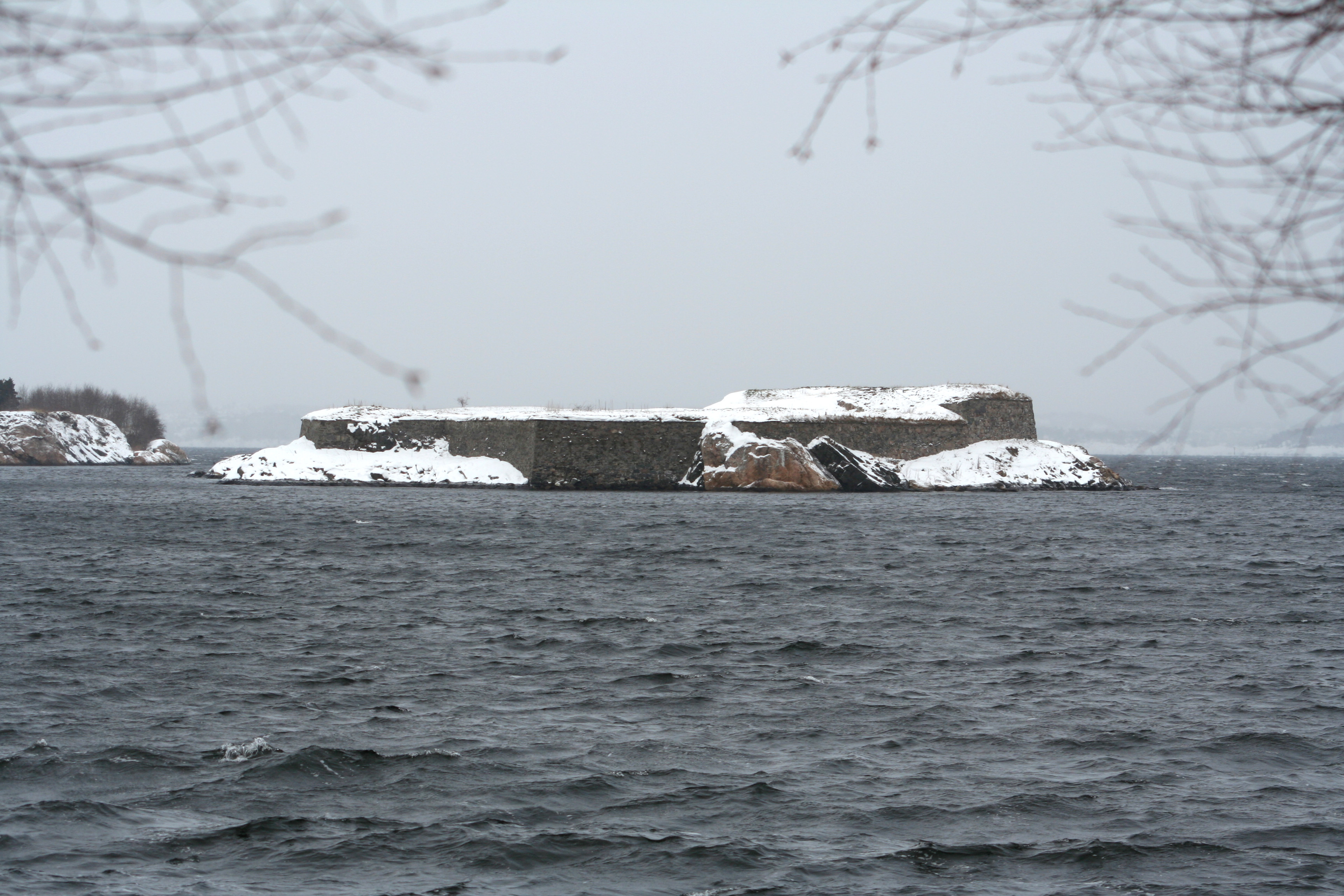
Fredriksholm Fortress
Ninety-eight Greenland dogs arrived at the ruined fortress on 4 July 1910, delivered by the steamer Hans Egede from Greenland. They would spend a month on this small islet off Kristiansand, their health checked by the state veterinarian, before boarding the Fram and sailing south with Roald Amundsen on one of the most famous expeditions in history. That an abandoned, half-destroyed military fortress became a kennel for polar sled dogs captures the strange second life of Fredriksholm -- a place built for war, destroyed in war, and then repurposed in ways its builders could never have imagined.
Built from the Bones of Another Fort
Construction of Fredriksholm began in 1655, one kilometer north of the older Christianso Fortress on Gammeloya. Both fortresses guarded Flekkeroy port, a strategic harbor on Norway's southern coast. When Christianso was abandoned on 1 May 1658, its stones, building materials, and anything useful were stripped and carried to the new site -- a literal recycling of military architecture. By 1662, Fredriksholm was complete, named after Frederick III of Denmark. The fortress was divided into lower and upper sections: the lower walls traced the shoreline, while the upper level featured a tower with a cupola and two artillery batteries. The tower served as both the commander's residence and the royal chambers. When fully armed, the fortress bristled with cannons -- 24 guns at completion, expanding to 50 by 1700.
Garrison Life on the Edge
The garrison at Fredriksholm fluctuated with the threat of war and the rhythm of the seasons. In 1658, just 24 men occupied the fortress. During summer months, when the shipping lanes were busy and the risk of attack higher, the garrison could swell to 110. In winter, it shrank to about 30. The fortress was designed to accommodate up to 300 men in an emergency, though it rarely came to that. Fortress walls were stone, covered on the exterior with turf and palisade work. In a detail that speaks to the pragmatism of military construction, the peat for the walls was taken from a nearby cemetery in such quantities that coffins were nearly exposed. The dead, it seemed, served the defense of the living.
Blown to Rubble by the British
By 1804, Fredriksholm had outlived its strategic value. Kristiansand itself had grown more important, and newer fortifications -- particularly Christiansholm Fortress, four kilometers up the fjord -- had taken over the city's defense. The old fortress was abandoned. Three years later, during the English Wars that followed the Battle of Copenhagen, a British squadron led by HMS Spencer arrived off Kristiansand, demanding the surrender of the warship Prinds Christian Frederik. When Christiansholm Fortress drove them back with heavy fire, the frustrated British sailed to the disused Fredriksholm and blew it up in an act of slighting. Four British servicemen were killed when they returned prematurely to check on the powder fuses. The fortress was partially repaired in 1808 and finally closed for good in 1874.
Amundsen's Dog Pound
The most improbable chapter in Fredriksholm's history came in the summer of 1910. Roald Amundsen was preparing his expedition to the South Pole, and he needed his sled dogs -- nearly 100 Greenland dogs -- inspected and quarantined before they could board the Fram. The ruined fortress, surrounded by water and largely deserted, made an ideal holding pen. The 98 surviving dogs (two had died in transit) arrived on the Hans Egede on 4 July. State veterinarian Christopher Juell examined them at Fredriksholm, and for a little over a month, the islet echoed with barking instead of cannon fire. On 9 August, the dogs were loaded aboard the Fram, and Amundsen's expedition departed. Today the fortress remains in ruins, a popular spot for sightseers drawn to the crumbling walls and the overlapping stories they contain -- military ambition, naval warfare, and the unlikely staging ground for a race to the bottom of the world.
From the Air
Fredriksholm Fortress ruins are located at 58.10N, 7.98E on a small islet near Flekkeroy, south of Kristiansand, Norway. The ruins are visible as low stone walls on the islet. Best viewed below 2,000 feet. Kristiansand Airport Kjevik (ENCN) is approximately 15 km to the northeast. The Flekkeroy harbor area and the nearby Batteriodden on the mainland provide visual references.