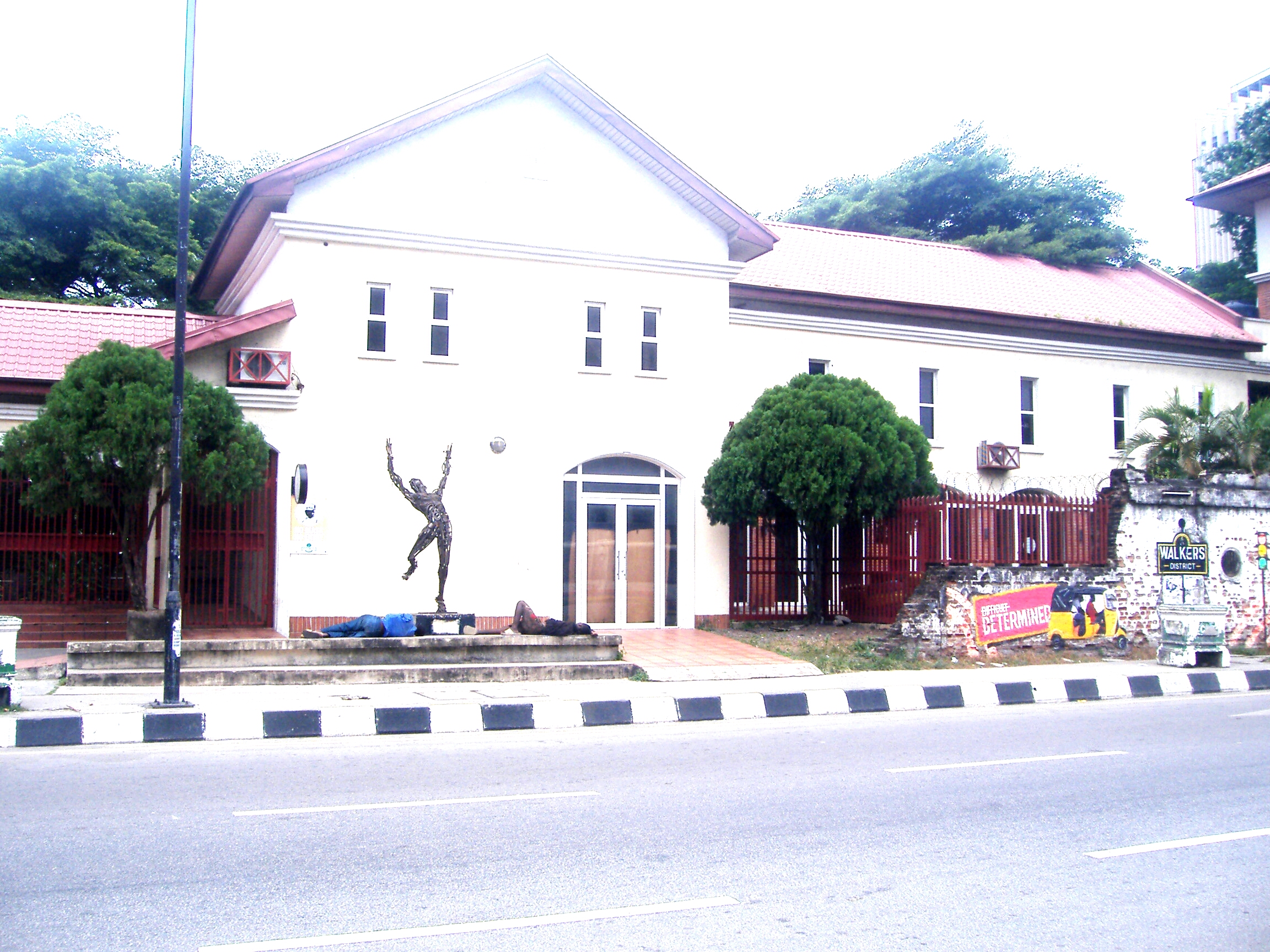
Freedom Park (Lagos)
The walls are original. They were built with bricks imported from England in 1885, after opponents of British colonial rule in Lagos kept setting the prison on fire. Her Majesty's Broad Street Prison -- established after Britain made Lagos a colony in 1861 -- stood on this ground for over a century, holding everyone from petty criminals to the political activists who would eventually win Nigeria its independence. Today those same brick walls serve as the perimeter of Freedom Park, a memorial and leisure space in the heart of downtown Lagos Island where the cells once stood.
Bricks, Fire, and Colonial Priorities
The first prison on Broad Street was built in 1882 with mud walls and grass thatch. It did not last long. According to architect Theo Lawson, who later designed Freedom Park, opponents of British colonialism in Lagos "kept throwing fire into it and setting it ablaze." The colonial government responded by importing bricks from England and rebuilding the structure in 1885 -- a more permanent solution to a recurring problem. The government's spending priorities told their own story: in 1882, the colonial administration spent 16,000 pounds on the prison, compared to just 700 pounds on education. A colonial report from 1898 recorded 676 men, 26 women, and 11 juveniles imprisoned at Broad Street that year. The prison was a statement of control, and the government made sure it would not burn down again.
The Prisoners Who Changed a Nation
Broad Street Prison held more than ordinary inmates. Among its most notable prisoners were some of the architects of Nigerian independence. Herbert Macaulay, widely regarded as the father of Nigerian nationalism, spent time behind these walls. So did Anthony Enahoro, who in 1953 moved the first motion for Nigerian independence in the House of Representatives. Obafemi Awolowo, the premier of Western Nigeria and a towering figure in the country's political history, was also imprisoned here. Michael Imoudu, the pioneer of Nigeria's labor movement and its first recognized national labor leader, joined them. These men entered Broad Street as prisoners of the British Crown. The nation they helped create would eventually turn the place where they were confined into a monument to their cause.
From Dumping Ground to Creative Space
Broad Street Prison was demolished in 1979, nearly two decades after Nigerian independence. What replaced it was not a park or a memorial but neglect -- the site deteriorated into a dumping ground. It remained that way through the 1980s and into the 1990s, when architect Theo Lawson began developing plans to transform the space under the Creative Intelligence Agency (later renamed the Cultural Intellectual Association, or CIA-Lagos). The vision was ambitious: turn a site associated with colonial oppression into a place of creative freedom. The project finally materialized when the park was built to commemorate Nigeria's 50th anniversary of independence in October 2010. Monuments throughout the grounds preserve the history of the prison and Lagos's colonial heritage, while the park itself functions as a national memorial, historical landmark, and cultural arts center.
Where Lagos Comes to Breathe
In a city of over twenty million people where open public space is scarce, Freedom Park has become something rare: a place to slow down. The original prison walls enclose lawns, performance stages, gallery spaces, and shaded walkways. The park is open daily and hosts a rotating calendar of social events, live music, art exhibitions, and recreational entertainment. It serves simultaneously as a site of contemplation and celebration -- a place where visitors can stand in the shadow of the old cells and then walk a few meters to hear live Afrobeat on a weekend evening. For a city built on constant motion, Freedom Park offers both memory and reprieve, anchored by the imported English bricks that a colonial government once used to build a cage.
From the Air
Located at 6.449N, 3.397E on Lagos Island, in the heart of downtown Lagos. Freedom Park sits in the dense urban grid near Broad Street, one of the oldest thoroughfares in the city. From 1,500-2,500 feet AGL, the green space is visible as a break in the surrounding rooftops. The Lagos Lagoon and Marina waterfront are nearby to the south. Nearest airport: Murtala Muhammed International Airport (DNMM), approximately 14 nm to the north.