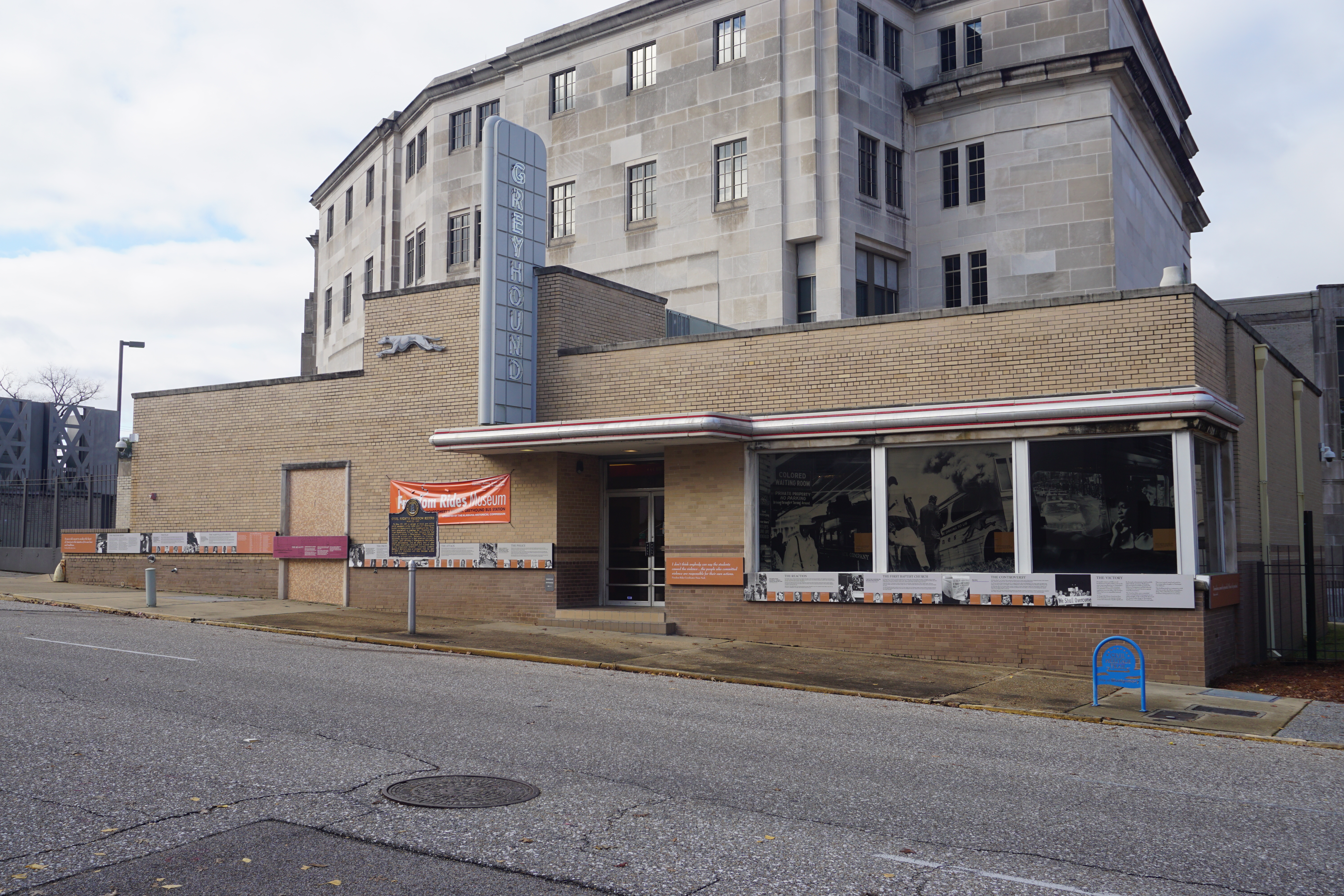
Freedom Rides Museum
At 10:23 AM on May 20, 1961, a Greyhound bus pulled into the station at 210 South Court Street in Montgomery, Alabama. The Freedom Riders aboard had already survived a firebombed bus in Anniston and beatings by Ku Klux Klan members in Birmingham. The state troopers who escorted them from Birmingham had melted away at the Montgomery city limits. What waited at the station was a crowd of white men, women, and children armed with pipes, bats, and fists. Among those beaten was John Seigenthaler, an assistant to U.S. Attorney General Robert F. Kennedy, who was struck over the head with a metal pipe while trying to rescue two female riders. He lay unconscious on the pavement for half an hour. That morning at a bus station in Alabama's capital forced the federal government to stop watching the civil rights movement from the sidelines.
A Door Marked 'Colored Entrance'
The Montgomery Greyhound Bus Station opened in August 1951 with segregation built into its architecture. A door labeled 'Colored Entrance' directed African Americans through a separate passage into the bus bay, accessing the interior of the terminal from the rear. The station sat directly behind the U.S. District Courthouse on Lee Street, where Judge Frank M. Johnson would later issue the court order against the Klan that resulted from the very violence that occurred at the station's front door. The building's design was not incidental - it was a physical expression of the Jim Crow system that the Freedom Riders set out to challenge. They were testing the Supreme Court's rulings that segregated public buses were unconstitutional, rulings that Southern states simply ignored.
The Road to Montgomery
The Freedom Riders were civil rights activists who boarded interstate buses into the segregated South to force compliance with federal law. Their route through Alabama became a gauntlet. In Anniston, a mob firebombed a Greyhound bus and beat the riders as they escaped. An hour later, Klan members boarded a Trailways bus in the same city. In Birmingham, riders including James Peck were beaten in front of the press. CORE, the organizing group, halted the rides in Birmingham on May 14. But students from Fisk University and the Nashville Student Movement refused to let the rides die. Greyhound would not provide a driver until Robert Kennedy personally intervened. Alabama's Director of Public Safety, Floyd Mann, arranged a state trooper escort. The bus left Birmingham on May 20 - and the troopers vanished at the Montgomery city line.
The Night at First Baptist
The violence at the bus station was only the beginning of that week in Montgomery. The next evening, May 21, Martin Luther King Jr. held a rally at First Baptist Church with some 1,500 people inside. Outside, approximately 3,000 angry white protesters surrounded the building, burning a car and threatening to set the church on fire. Federal marshals, along with Floyd Mann and his state troopers, held the mob back through the night. On May 24, the Freedom Rides resumed. Riders boarded buses from Montgomery bound for Jackson, Mississippi, where Nashville Student Movement activists Bernard Lafayette, James Bevel, and others were arrested for attempting to desegregate the bus terminal's waiting rooms. The confrontations generated nationwide publicity that Robert Kennedy leveraged to petition the Interstate Commerce Commission to adopt stronger regulations and finally desegregate interstate transportation.
From Ruin to Remembrance
Greyhound closed the station in 1995. A historical marker went up in 1996, but the building deteriorated. Plans for a museum stalled for years. In 2008, fifteen descriptive panels illustrating the events of May 1961 were installed across the exterior, though the interior remained locked. Finally, in May 2011 - the fiftieth anniversary of the attack - the Freedom Rides Museum opened inside the restored station. Jim Zwerg, one of the original riders who was severely beaten in Montgomery, attended the ceremony. The building was listed on the National Register of Historic Places on May 16, 2011. Previous owners had bricked over the 'Colored Entrance' and torn down the segregation sign. The museum chose not to restore those features but highlighted the building's segregated design in its exhibitions. In May 2021, a restored 1957 Greyhound bus - the same model in service during the Freedom Rides - was unveiled for the sixtieth anniversary.
Still Contested Ground
The Freedom Rides Museum sits on the U.S. Civil Rights Trail, part of a network of sites across Montgomery that includes the Rosa Parks Library, the Dexter Avenue King Memorial Baptist Church, and EJI's Legacy Museum. The station at 210 South Court Street remains a working piece of history - not a relic sealed behind glass, but a building whose significance is still being debated. In early March 2025, the federal government's DOGE initiative recommended the General Services Administration sell the museum property as one of hundreds of 'non-core' federal holdings. Alabama congresspeople pushed back forcefully. The fact that a civil rights landmark could be classified as 'non-core' only proves why the museum exists: to remind the country what happens when rights are treated as optional.
From the Air
Located at 32.37°N, 86.31°W in downtown Montgomery, Alabama, at 210 South Court Street. The former Greyhound station sits directly behind the federal courthouse. From the air, the site is in the dense urban core of Montgomery, identifiable by its position along Court Street south of the Alabama State Capitol dome on Goat Hill. Nearest airport: Montgomery Regional Airport (KMGM) approximately 7 nm southwest. The Alabama River bends around downtown Montgomery to the west and south, providing a primary navigational reference.
Sources
- Freedom Rides Museum - Wikipedia
- Freedom Rides Museum - Alabama Historical Commission
- Freedom Rides Museum - Encyclopedia of Alabama
- Freedom Rides Museum - Wikipedia
- First Baptist Church siege - U.S. Marshals Service
- John Seigenthaler beaten at Montgomery - multiple sources
- DOGE Freedom Rides Museum sale controversy - Alabama Public Radio