Freeport of Monrovia
On September 9, 1990, Liberian President Samuel Doe drove through the gates of the Freeport of Monrovia to meet peacekeeping commanders at their newly established headquarters. He never left under his own power. Rebels from Prince Johnson's INPFL faction stormed the port, overwhelmed the lightly armed presidential convoy, and seized Doe -- an event that would become one of the most notorious moments of West Africa's bloodiest decade. But the port on Bushrod Island had already lived several lives before that dark day, and it would survive to live several more.
An Artificial Harbor in a Natural World
The Freeport of Monrovia did not exist as nature intended. As early as 1850, seagoing ships were exporting palm oil from Monrovia's natural anchorage, but the harbor that serves Liberia today was engineered from scratch. During World War II, the United States military landed in Liberia to secure the flow of rubber -- a wartime essential -- and in the process built an artificial harbor with two massive rock breakwaters, approximately 2,300 and 2,200 meters long, enclosing a protected basin of 300 hectares. The new facility opened in 1948, giving Liberia its first modern deep-water port. Four piers and a main wharf with four berths rose from the engineered shoreline, transforming Bushrod Island from a marginal piece of coastal land into the commercial heart of a nation.
Wars Fought at the Water's Edge
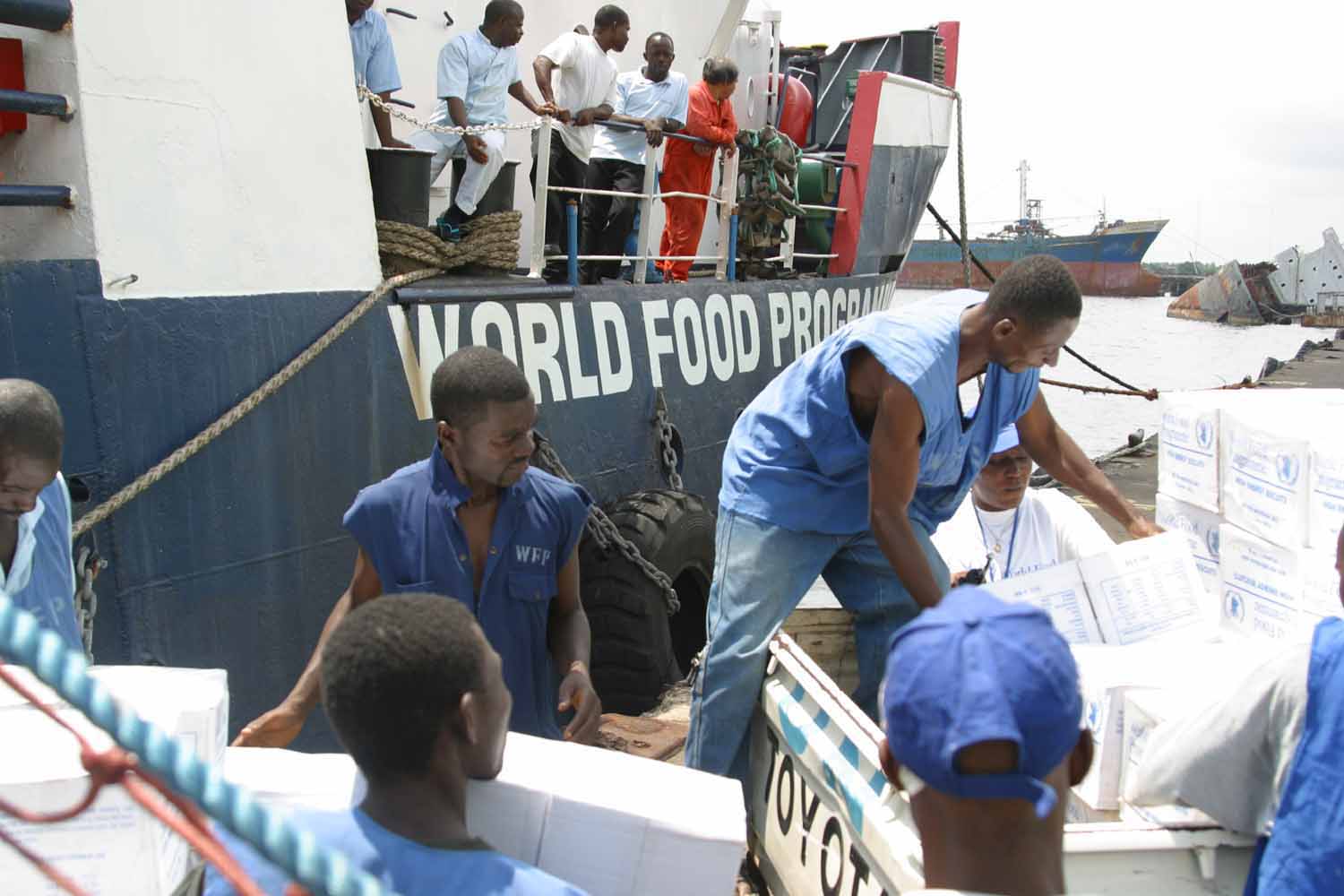
The port's strategic importance made it a flashpoint during both of Liberia's civil wars. In 1990, as Charles Taylor's forces swept through the countryside, the Freeport became the setting for Doe's capture -- an act that signaled the collapse of central authority. The Second Liberian Civil War brought its own violence to the docks. On August 15, 2003, U.S. Marines from the 26th Marine Expeditionary Unit conducted a helicopter-borne landing to secure the port, while a World Food Programme ship unloaded pallets of high-energy biscuits for a starving population. Aid and ammunition arrived at the same berths; the distance between war and relief measured in meters.
Sunken Ships and Blocked Berths
Even after the fighting subsided, the port bore physical scars that took years to heal. In 1995, the overloaded M/V Mush sank and obstructed traffic for three years before it could be removed. In 2001, the M/V Torm Alexandra went down at the port, blocking an entire berth. Repeated salvage attempts failed until 2009, when a U.S.-financed operation finally raised and removed the vessel. The pattern told a broader story: Liberia's infrastructure could be damaged in a moment but took years of international cooperation to repair. Meanwhile, in 2002, the port authority completed dredging the harbor entrance to accommodate larger modern vessels -- a quiet milestone that signaled progress even as wrecks still cluttered the waterway.
Rebuilding on Borrowed Strength
Liberia's postwar recovery leaned heavily on foreign partnership, and the port was no exception. In 2010, the government signed a $120 million concession agreement with APM Terminals, the global port operator owned by the Maersk Group, establishing a public-private partnership with the National Port Authority. The deal promised modernization: new equipment, trained staff, and compliance with international shipping standards. Two years later, Western Cluster Limited signed a lease to rehabilitate former mining company piers for iron ore exports, earmarking over 43 acres of port land for development. The Freeport was reinventing itself once more -- not as a wartime staging ground but as a gateway for Liberia's mineral wealth, the latest chapter in a port that has been built, fought over, sunk, and rebuilt across eight turbulent decades.
From the Air
Located at 6.34N, 10.79W on Bushrod Island, just north of central Monrovia. From the air, the two long breakwaters enclosing the artificial harbor basin are clearly visible against the Atlantic coastline. Nearest major airport is Roberts International Airport (GLRB), approximately 35 miles southeast. Spriggs Payne Airport (GLSP) sits closer, about 3 miles south in downtown Monrovia. Best viewed at 3,000-5,000 feet for port detail, or 10,000+ feet to see the full breakwater geometry.