French Cameroon
On 13 September 1958, a French commando unit tracked Ruben Um Nyobe through the forest and killed him. He had been hiding in the maquis for three years, leading a guerrilla war against the colonial administration that had outlawed his political party. His crime was demanding independence for Cameroon. The territory he fought to liberate -- French Cameroon -- had already passed through German, British, and French hands in less than half a century, each transfer reshaping the land and its people in ways that would echo long after the flags came down.
From Kamerun to Cameroun
Germany's claim to Cameroon began in 1884 with a treaty signed with local chiefs near Douala, particularly Ndumbe Lobe Bell. The German protectorate expanded steadily inland, and by 1911 France had ceded additional territory to Germany following the Agadir Crisis, creating what the Germans called Neukamerun. But World War I ended German rule. British and French troops occupied the colony, and in 1922 the League of Nations formally divided it: Britain received the western strip along the Nigerian border, and France took the larger eastern portion. French Cameroon was not folded into French Equatorial Africa. Instead, it became a standalone entity, a Commissariat de la Republique autonome, governed directly under the French mandate. Paris wasted no time erasing Germany's footprint. French became the mandatory language across the territory. French law replaced German codes. Local chiefs who had cooperated with the Germans, like the paramount chief Charles Atangana, were courted and co-opted by the new administration. Atangana visited the 1931 Paris Colonial Exhibition and attended the 1935 French Colonial Conference -- gestures of loyalty that helped France consolidate its grip.
A Colony at War with Itself
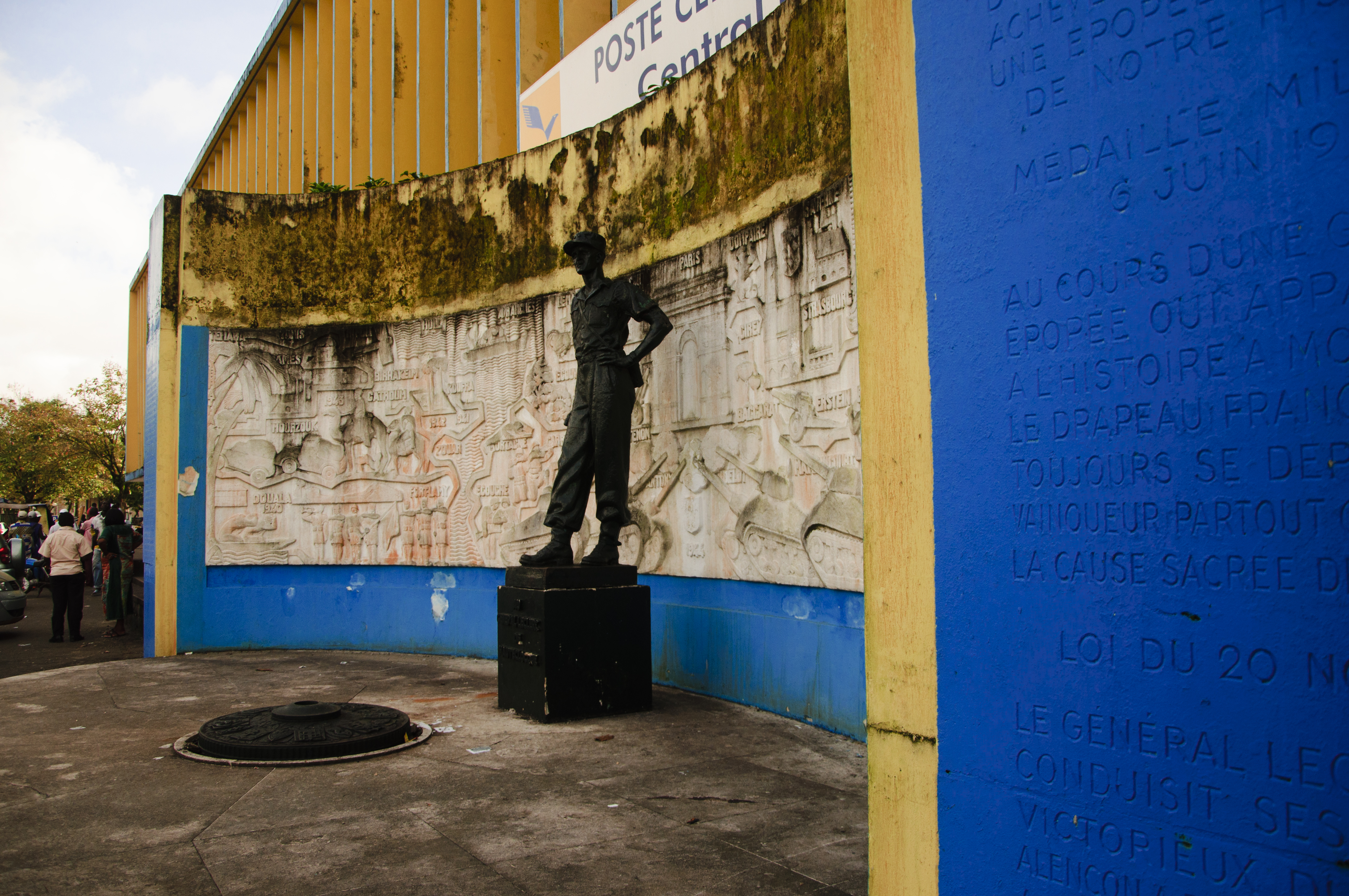
When France fell in 1940, French Cameroon faced a choice. Troops under General Philippe Leclerc landed at Douala on 27 August, captured the city, and moved on Yaounde, where the pro-Vichy governor surrendered without a major fight. The territory rallied to Free France. After the war, the mandate became a United Nations Trust Territory, theoretically on a path toward self-governance. In practice, the colonial administration tightened its economic control, pushing monoculture crops -- coffee in the west, cotton in the north, cocoa in the south -- while building roads primarily to extract timber. Of the territory's three million inhabitants, roughly 15,000 people staffed the colonial apparatus: civil servants, missionaries, private agents. A Representative Assembly was constituted in 1946, and Cameroonians like Paul Ajoulat and Alexandre Douala Manga Bell won seats in the French National Assembly. Schools opened, but the best students were sent to Dakar or Paris rather than educated locally.
The Forgotten War
The Union of the Peoples of Cameroon, or UPC, was founded in 1948 as an anti-colonialist party demanding both independence and the reunification of British and French Cameroon. Ruben Um Nyobe led the movement, drawing support from urban trade unionists frustrated by settler dominance. By 1955, tensions had reached a breaking point. Governor Roland Pre outlawed the UPC on 13 July of that year, and Nyobe went underground. What followed was a war that France would prefer to forget. The Fourth Republic, already mired in Algeria, unleashed harsh repression in Cameroon. Nyobe was killed in the maquis in 1958. His successor, Felix-Roland Moumie, was assassinated in Geneva in 1960 by agents of the SDECE, the French secret services. The conflict did not end with independence in January 1960. Ahmadou Ahidjo, who became prime minister in 1958 and later president, continued the fight against what remained of the UPC, now fractured and radicalized. The rebellion persisted until the early 1970s, its last significant leaders killed or executed: Ossende Afana died in the maquis in 1966, and Ernest Ouandie was publicly executed in January 1971.
The Cost of Silence
Estimates of the war's death toll reach into the tens of thousands, with most casualties occurring after independence. Both sides committed abuses: UPC militants and the combined Cameroonian-French forces alike. Yet this conflict remains remarkably obscure. Writer Mongo Beti spent years trying to bring attention to it, largely without success. The war was overshadowed by the far larger Algerian conflict, which consumed French public attention and political energy. France used professional soldiers rather than conscripts in Cameroon, which meant fewer French families had a personal stake in the fighting. The small Cameroonian diaspora in France lacked the political weight to demand historical reckoning, and the fall of communism removed what ideological interest foreign observers might have had in the UPC's story. The people who fought and died in this war -- on all sides -- deserved more from history than they received.
Two Cameroons Become One
French Cameroon became the Republic of Cameroon on 1 January 1960. The following year, the question of British Cameroon was resolved by plebiscite. The Muslim northern portion voted to join Nigeria in May 1961. The southern portion chose union with the Republic of Cameroon, forming the Federal Republic of Cameroon on 1 October 1961. The territory that Germany had claimed, that France and Britain had divided, that the UPC had fought to unify, was at last -- imperfectly, incompletely -- one country. The scars of its colonial past and its war for independence remain part of Cameroon's national fabric, even when the wider world has moved on.
From the Air
Centered on Yaounde at 3.87°N, 11.52°E, the former administrative capital of French Cameroon. At altitude, the green hills and river valleys of central Cameroon spread in every direction. Yaounde Nsimalen International Airport (ICAO: FKYS) lies to the south. Douala, the economic capital and site of Leclerc's 1940 landing, is roughly 200 km to the west near the coast (ICAO: FKKD). The landscape transitions from dense equatorial forest in the south to savanna in the north toward Ngaoundere.