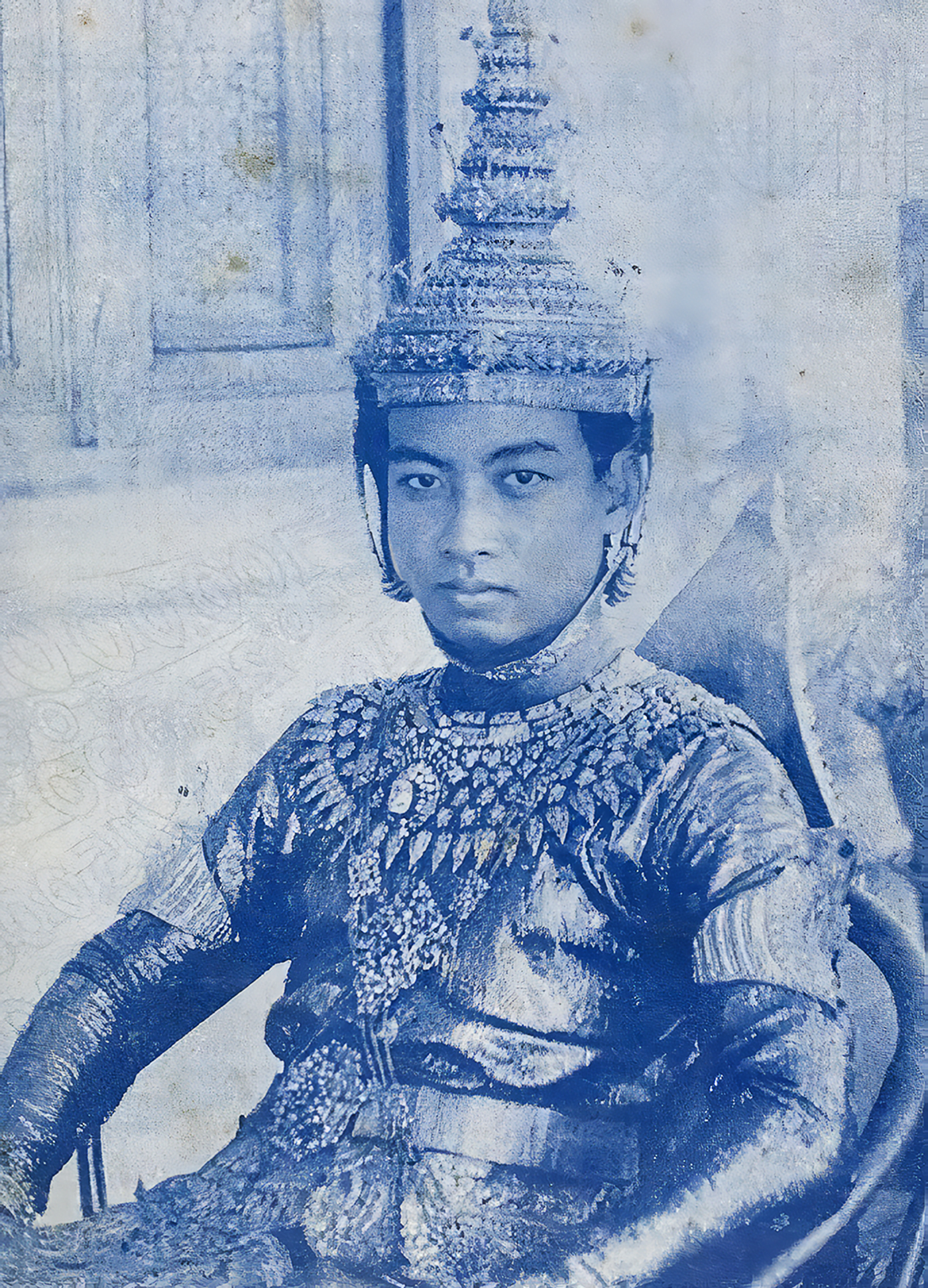
French Protectorate of Cambodia
On August 11, 1863, King Norodom signed away his kingdom's sovereignty with a pen stroke. It was, by his calculation, the least terrible option available. To the west, the Kingdom of Siam had already swallowed Cambodia's provinces, including Angkor itself. To the east, Vietnam's Nguyen dynasty was pressing inward. Squeezed between two expansionist neighbors, Norodom turned to a third power -- France -- and requested a protectorate over Cambodia. The French, who had just established a colony in Cochinchina to the south, saw Cambodia as a useful buffer between Siam and their Vietnamese possessions. Both sides got what they wanted, though neither got quite what they expected. What followed was ninety years of colonial rule that would transform Cambodia in ways Norodom could not have imagined.
The Bargain and Its Price
The 1863 treaty allowed the Cambodian monarchy to remain, but real power shifted to a French resident-general installed in Phnom Penh. France controlled foreign affairs, trade relations, and military protection. Siam recognized the arrangement only after France ceded the province of Battambang and acknowledged Thai control over Angkor -- a concession that stung. Cambodia had traded one form of subjugation for another, but the French version came with a resident bureaucracy and systematic extraction of resources. The arrangement's true nature became clear in 1897, when the resident-general complained to Paris that King Norodom was unfit to rule and requested permission to assume the king's powers: collecting taxes, issuing decrees, appointing officials, even choosing crown princes. Permission was granted. From that point forward, Cambodian kings were figureheads, patrons of Buddhism and symbols of continuity, revered as god-kings by the peasant population but emptied of political authority. The colonial bureaucracy, staffed almost entirely by French officials, held every lever of governance.
Rebellions and Royal Pawns
Cambodians did not accept French rule quietly. In 1885, Si Votha, Norodom's half-brother and rival for the throne, returned from exile in Siam to lead a rebellion. The fighting concentrated in Cambodia's jungles and around the coastal city of Kampot, where a resistance leader known as Oknha Kralahom Kong organized opposition. French forces helped Norodom crush the revolt, but the price was steep: Cambodia's population was disarmed, and the resident-general's supremacy was formally acknowledged as absolute. When Norodom died in 1904, the French bypassed his sons entirely and placed his brother Sisowath on the throne. The reasoning was blunt: Norodom's line had proven too rebellious. His favored son, Prince Yukanthor, had embarrassed France by traveling to Europe and publicizing French colonial brutalities in Cambodia. Sisowath's branch, while nationalistic, was more cooperative. The pattern was set: the French would choose Cambodia's kings based on pliability, not bloodline. Through treaties with Siam in 1902 and 1904, France expanded Cambodia's territory, adding Preah Vihear Province and gaining control over the Bassac River, while the 1904 exchanges reshuffled borders between Cambodia and French Laos.
Rubber, Rails, and Resentment
The colonial economy reshaped Cambodia's landscape. As the French automobile industry boomed, rubber plantations spread across the countryside, echoing those already established in Cochinchina and Annam. Cotton and corn crops diversified the agricultural base through the 1920s. A railway connected Phnom Penh with Battambang on the Thai border, knitting the country together for the purposes of commerce and control. But the benefits flowed upward and outward. Cambodians were barred from holding important economic positions. Vietnamese workers were recruited for the rubber plantations, and Vietnamese immigrants came to dominate key roles in the colonial economy as fishermen and businessmen. Chinese Cambodians remained active in commerce, but the highest positions were reserved for the French. Despite economic expansion, Cambodians bore heavy taxes. In 1916, frustration boiled over into protests demanding relief. Industry developed, but it was designed to process raw materials for export rather than build local capacity. The infrastructure was real -- the roads, the railways, the plantations -- but it served the colony's masters more than its people.
The Slow Awakening
Cambodian nationalism stirred more slowly than in neighboring Vietnam, partly because French colonial policy kept literacy rates low and educational opportunities scarce. But among the French-educated Cambodian elite, a paradox emerged: the same colonial power that suppressed Cambodian self-governance also restored monuments like Angkor Wat, inadvertently rekindling pride in the Khmer Empire's former greatness. The gap between past glory and present subjugation was hard to ignore. In 1936, Son Ngoc Thanh and Pach Choeun launched Nagaravatta, a French-language newspaper that channeled anti-colonial and anti-Vietnamese sentiment. Minor independence movements, particularly the Khmer Issarak, took shape among Cambodian exiles in Thailand beginning in 1940. When the Japanese occupied Southeast Asia during World War II, their rhetoric of "Asia for the Asiatics" resonated with Cambodian nationalists. But Tokyo's willingness to support them proved shallow. In July 1942, after French authorities arrested and defrocked a politically active Buddhist monk named Hem Chieu, Nagaravatta's editors organized a protest demanding his release. The Vichy colonial government crushed it swiftly. Pach Choeun received a life sentence. Son Ngoc Thanh fled to Tokyo.
The Long Road to Independence
The fate of European colonies in Asia occupied the Allied leaders during the war. At the Tehran, Cairo, and Yalta conferences, Roosevelt and Stalin agreed that France and the Netherlands should not return to their Asian possessions. But Roosevelt's death before the war's end changed the calculus. Britain backed the restoration of French and Dutch colonial rule, dispatching Indian soldiers under British command to enforce the return. Cambodia was granted limited self-rule within the French Union in 1947, and the protectorate status was formally removed in 1949. Full independence arrived on November 9, 1953, under King Norodom Sihanouk, ninety years after his ancestor had signed the original treaty. The celebration was genuine, but what followed was far from the peace Cambodians hoped for. Sihanouk was overthrown in a 1970 coup, the Khmer Rouge seized Phnom Penh on April 17, 1975, and the genocide that followed would kill an estimated 1.5 to 2 million people. The French protectorate had ended, but the instability it helped create -- the hollowed-out institutions, the suppressed national identity, the unresolved tensions -- echoed through the decades that came after.
From the Air
Located at 11.570°N, 104.921°E in Phnom Penh, Cambodia -- the administrative center of the former French protectorate. Phnom Penh International Airport (ICAO: VDPP) lies immediately to the west of the city. The Royal Palace, residence of the figurehead kings during the protectorate era, is visible along the Tonle Sap and Mekong river confluence in central Phnom Penh. Best viewed at 3,000-5,000 feet for city layout. The former rubber plantation regions extend to the east toward Vietnam. Battambang, connected to Phnom Penh by the colonial-era railway, lies approximately 290 km to the northwest. Flat terrain with river systems dominating the landscape. Tropical monsoon climate; dry season (November-April) provides best visibility.