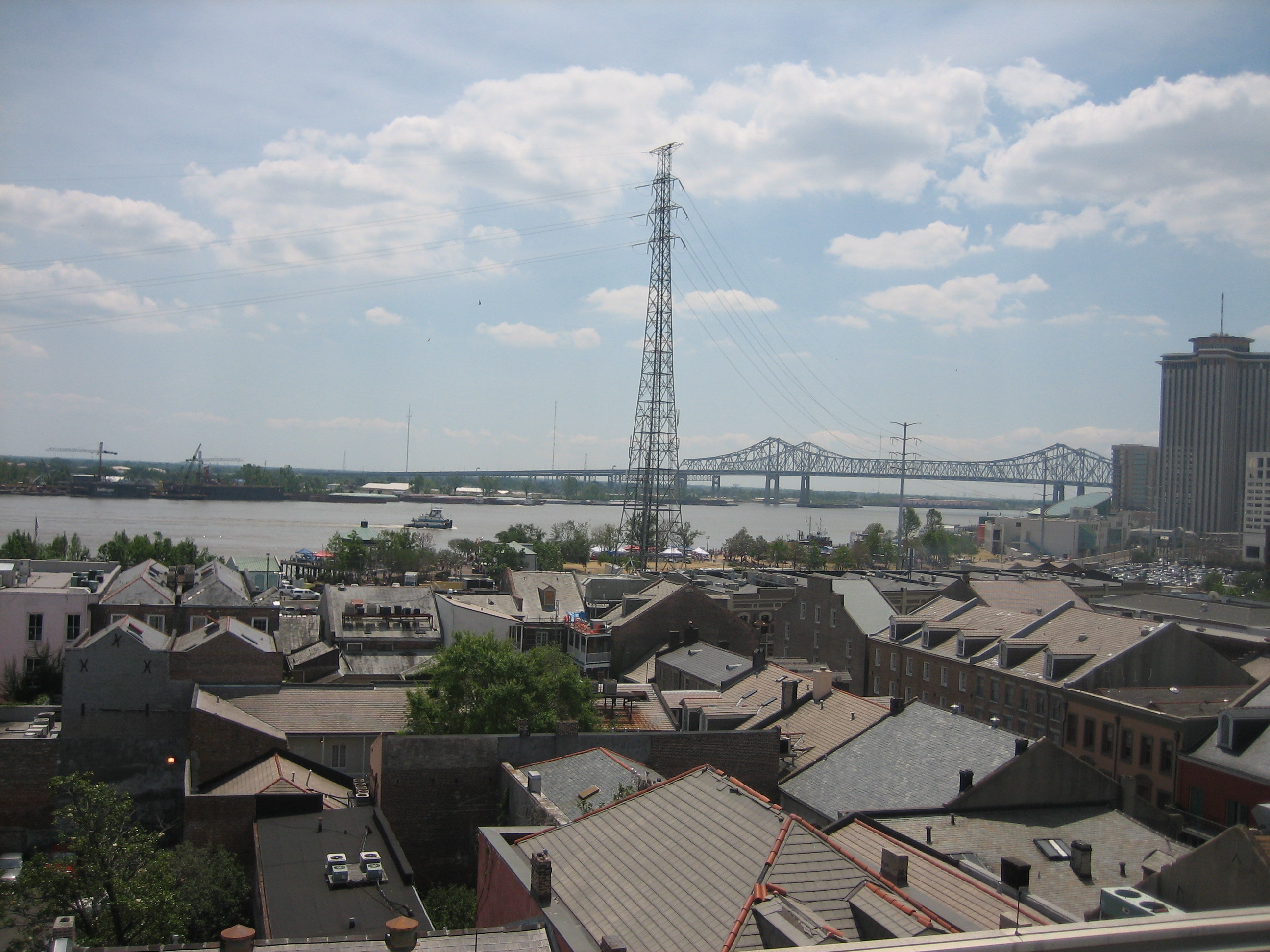
French Quarter
Two catastrophic fires, in 1788 and 1794, destroyed eighty percent of everything the French had built. What rose from the ashes was something stranger and more beautiful than anyone planned. The Spanish colonial government imposed strict fire codes, banning wooden siding in favor of brick covered in pastel stucco, replacing peaked roofs with flat tiled ones. Yet the largely French population kept building in their own style, blending Caribbean timber balconies with Spanish masonry. The result is one of North America's most distinctive urban landscapes: a neighborhood called the French Quarter that is, in its bones, overwhelmingly Spanish. Founded in 1718 by Jean-Baptiste Le Moyne de Bienville, this 78-square-block district along the Mississippi River has served as the cultural crucible of New Orleans for three centuries.
The Neutral Ground
When the Americans arrived after the Louisiana Purchase of 1803, they encountered a world that was thoroughly not their own. Rather than push into the Creole heart of the Vieux Carre, the English-speaking newcomers built upriver across Canal Street. That wide boulevard became the boundary between two cultures, one Francophone Creole and the other Anglophone American. The median where the two groups met to conduct business in both languages became known as the "neutral ground" -- a term New Orleanians still use for every median in the city. By 1840, wealth from sugar, tobacco, and cotton had made New Orleans the nation's third-largest city, with the second-busiest port after New York. The Pontalba Buildings rose on Jackson Square between 1849 and 1851, their ornate cast iron galleries setting a fashion that became the neighborhood's visual signature.
Little Palermo and the Bohemians
Even before the Civil War, French Creoles had become a minority in their own quarter. The late nineteenth century brought waves of immigrants, particularly from Sicily and Ireland, and the neighborhood acquired the nickname "Little Palermo." By 1905, the Italian consul estimated that one-third to one-half of the Quarter's population was Italian-born or second-generation Italian-American. When the closure of Storyville in 1917 pushed vice back into the Quarter, most of the remaining French Creole families finally left for uptown. The loss of the French Opera House two years later marked the end of an era. But decay proved to be a kind of preservation. In the 1920s, cheap rents attracted a bohemian artistic community, and many of these new residents became the Quarter's fiercest defenders. Elizabeth Werlein spearheaded the creation of the Vieux Carre Commission in 1925, beginning a fight for architectural preservation that would define the district's modern identity.
Where Bourbon Meets History
Bourbon Street, named not for whiskey but for France's ruling dynasty, the House of Bourbon, is the Quarter's most famous artery. Behind the neon and the Hurricane cocktails lie some of America's most storied drinking establishments. Lafitte's Blacksmith Shop, built sometime before 1772, is one of the oldest surviving structures in the city and the oldest bar in America still operating as a bar. According to legend, it was a front for the Lafitte brothers' smuggling operations at Barataria Bay. The Napoleon House occupies the former home of Mayor Nicholas Girod, named for an unrealized plot to rescue Napoleon Bonaparte from exile on Saint Helena. Pat O'Brien's invented the Hurricane cocktail and pioneered the dueling piano bar. And diagonally across Jackson Square from the Cabildo, where the Louisiana Purchase transfer papers were signed, sits Cafe du Monde, serving beignets and chicory coffee continuously since 1862.
Surviving the Storm
The French Quarter sits on the natural high ground that first attracted Bienville in 1718, elevated five feet above sea level on the natural levee of the Mississippi River. When Hurricane Katrina struck in 2005, the Quarter's geography saved it. While much of New Orleans drowned when the levees breached, the French Quarter remained substantially dry. Nearly all of its antique shops and art galleries were untouched by looting. Johnny White's Hole in the Wall and Molly's at the Market became famous as the only businesses in the entire city to stay open throughout the hurricane and its aftermath. Mayor Ray Nagin officially reopened the Quarter on September 26, 2005, less than a month after the storm, and within weeks a large selection of businesses had resumed operations. The district's survival was not just architectural luck but a testament to the wisdom of building where the land had always been highest.
A Living Stage
On December 21, 1965, the Vieux Carre Historic District was designated a National Historic Landmark. Preservationists then fought a decade-long battle against an elevated expressway that would have severed the Quarter from the river, winning in 1969 -- the same year a municipal ordinance banned new hotels within the district. Today, the Quarter still functions as what it has always been: a place where people live, eat, drink, create, and celebrate. Painters and tarot card readers share Jackson Square. Street musicians play on every corner. The St. Louis Cathedral, flanked by the Cabildo and the Presbytere, anchors the square as it has since colonial times. The Quarter is not a museum in amber but a neighborhood that has absorbed French, Spanish, Creole, African, Italian, Irish, and American influences across three centuries, each layer visible in the iron lacework overhead.
From the Air
Located at 29.959N, 90.065W on the inside of the Mississippi River's crescent bend. The French Quarter's tight street grid and low-rise buildings are clearly visible from the air, bounded by Canal Street to the southwest and Esplanade Avenue to the northeast. The river levee runs along the southeast edge. Nearest airports: KMSY (Louis Armstrong New Orleans International, 11nm west), KNEW (Lakefront Airport, 5nm north). Best viewed at 2,000-3,000 ft AGL for the full grid pattern. The Quarter sits noticeably higher than surrounding neighborhoods.