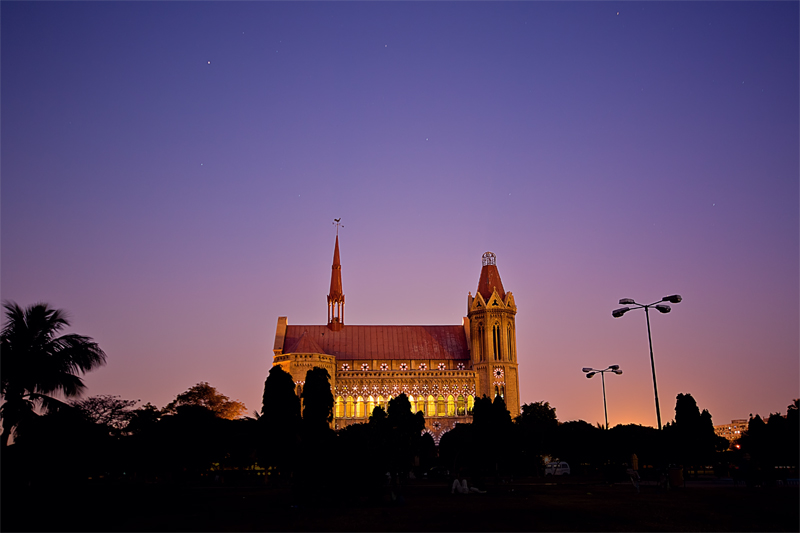
Frere Hall
One mural on the ceiling of Frere Hall will never be finished. The Pakistani artist Sadequain was partway through painting it when he died in 1987, leaving brushstrokes that simply stop mid-composition. That unfinished work captures something essential about this building: Frere Hall has always been in the process of becoming something new. Built in 1865 as Karachi's town hall, it has reinvented itself across three centuries, surviving the end of empire, the birth of a nation, and the relentless growth of one of the world's largest cities.
Venetian Arches on the Arabian Sea
Construction began in August 1863, and the building was not entirely complete when it was inaugurated in October 1865. The architects chose Venetian-Gothic as their style, an unlikely transplant to the Sindh coast. Pointed arches and ribbed vaults rise from yellow-toned local limestone, with white oolite details quarried from the nearby town of Bholari. Red and grey sandstone from Jungshahi adds further color. A tall octagonal tower anchors one corner, crowned by an iron cage, while the roof gleams with Muntz metal, a copper-zinc alloy designed to resist corrosion at sea. The result is a building that looks as if it drifted from the Grand Canal to the shores of the Arabian Sea and decided to stay.
A Name Earned After Death
The hall was not originally named for anyone. It became Frere Hall only after the death of Sir Henry Bartle Edward Frere in 1884. Frere was a British administrator who championed economic development in Sindh and made a consequential linguistic decision: he replaced Persian, the language favored by the Mughals, with Sindhi as the language of administration. The building's land had been purchased for just 2,000 British Indian rupees. After independence in 1947, the hall's library was rechristened the Liaquat National Library, and it grew into one of Karachi's largest, housing more than 70,000 books, including rare hand-written manuscripts. The surrounding lawns, once called Queen's Lawn and King's Lawn, became Bagh-e-Jinnah, Jinnah Gardens.
The Galerie Sadequain
In the 1980s, Sadequain, considered one of Pakistan's greatest artists and calligraphers, transformed the hall's ceilings into sweeping murals. His work inside Frere Hall became known as the Galerie Sadequain, a collection of paintings that fill the interior with flowing Arabic script and figurative compositions. When Sadequain died in 1987, one ceiling mural was left incomplete. The hall also houses stone busts, including one of King Edward VII donated by the Parsi philanthropist Seth Edulji Dinshaw, and oil paintings by Sir Charles Pritchard, a former Commissioner of Sindh. Today the building hosts festivals, exhibitions, and cultural events, drawing visitors who come as much for the art inside as for the architecture outside.
Where Empires Meet Gardens
Frere Hall sits between Abdullah Haroon Road and Fatima Jinnah Road, adjacent to the colonial-era Sind Club. The building anchors Bagh-e-Jinnah, a green oasis in the dense urban fabric of modern Karachi. Families spread blankets on the grass. Book vendors set up stalls along the pathways. The flying buttresses and quatrefoils of the Victorian structure look down on a city that has grown from a colonial port town into a megacity of more than fifteen million people. The hall remains one of Karachi's most important tourist attractions, a place where British colonial architecture, Pakistani art, and the everyday life of the city coexist in a single compound.
From the Air
Located at 24.85N, 67.03E in central Karachi. Frere Hall sits within the green expanse of Bagh-e-Jinnah gardens, which provides a visible contrast to the surrounding dense urban area. The nearest major airport is Jinnah International Airport (OPKC), approximately 14 km to the east. Best viewed at altitudes between 2,000 and 5,000 feet. The Arabian Sea coastline lies roughly 5 km to the south.