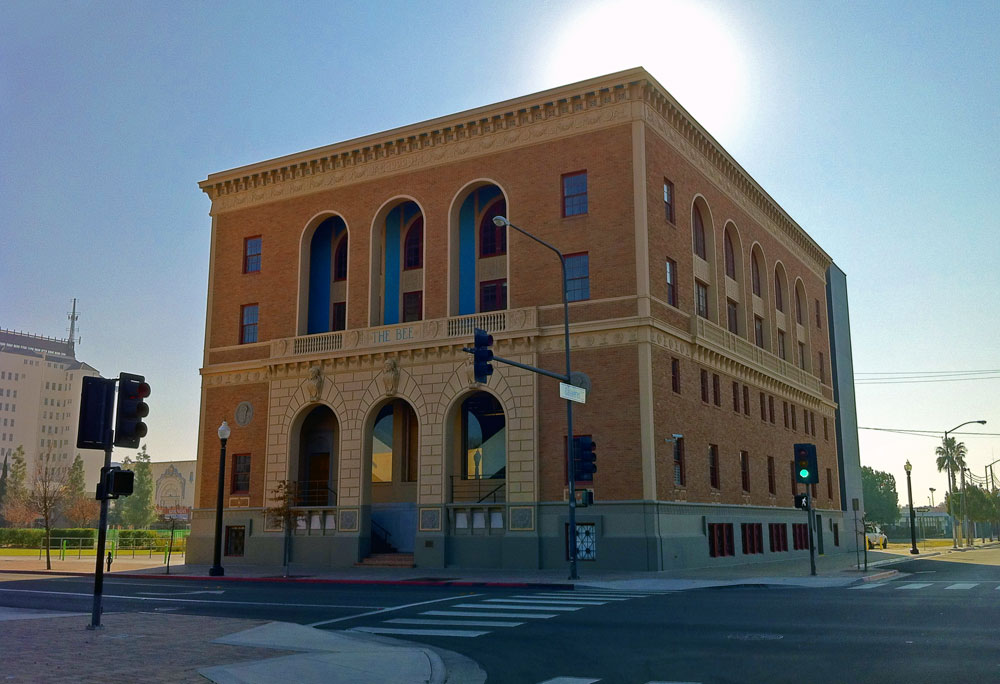
The Fresno Bee Building
Every morning for more than fifty years, the rumble of printing presses shook the floors of the five-story building at the corner of Van Ness and Calaveras in downtown Fresno. The Fresno Bee rolled off those presses by the tens of thousands, carrying crop reports, war headlines, and classified ads out into the San Joaquin Valley. Architect Leonard F. Starks designed the building in 1922 to be a monument to the printed word -- neoclassical in style, solid in construction, a building that announced the permanence of the newspaper it housed. A century later, the presses are gone. The newspaper is gone. But the building remains, having cycled through identities the way Fresno itself has, adapting to each era's needs while its original bones hold firm.
Ink and Airwaves
For its first fourteen years, the Fresno Bee Building stood essentially as Starks had drawn it -- a neoclassical block housing the offices, editorial rooms, and printery of one of Central California's most important newspapers. That changed in 1936, when the Fresno architectural firm Franklin and Kump designed a four-floor addition on the south side to accommodate an enlarged engraving department and, notably, studio space for radio station KMJ. The newspaper business was evolving, and the building evolved with it. The most significant transformation came in 1951, when engineers Lockwood Greene and architect Dunbar Beck added a new entrance wing and pressroom. Each modification layered new purpose onto the original structure, but the core of Starks's 1922 design held. The building became a palimpsest of Fresno's media history, one addition stacked upon another.
The Museum Gamble
When The Fresno Bee relocated to new facilities in 1975, the building fell silent. For six years it sat empty, its printing halls collecting dust while downtown Fresno wrestled with the same urban decline that plagued cities across America. Then a group of civic leaders proposed something ambitious: transform the old newspaper building into a regional museum for the San Joaquin Valley. Between 1981 and 1984, community members raised more than $5.5 million to bring the vision to life. The Fresno Metropolitan Museum opened its doors on April 8, 1984, filling the former printery with art galleries and science exhibits. For a quarter century, the building thrived in its second life. More than two million visitors walked its halls. But in 2005, the museum undertook a $28 million interior renovation -- new elevators, accessible gallery space, structural enhancements from the basement footings to the fifth floor. The renovated museum reopened in November 2008, gleaming and modern. Fourteen months later, on January 5, 2010, it closed for good, crushed by the debt that renovation had created.
Vacant Again
The museum's closure hit downtown Fresno hard. The City of Fresno took ownership of the building, but for two years the five-story landmark sat dark on Van Ness Avenue, its newly renovated interior gathering the same dust that had accumulated after the newspaper left decades earlier. The pattern felt almost cyclical -- a building designed to serve one purpose, abandoned when that purpose moved on, then reinvented for another, then abandoned again. Fresno had poured millions into the structure twice over, and twice the investment had evaporated. The building's neoclassical facade, unchanged since the 1920s, gazed out at a downtown that was itself struggling to find a new identity.
A Third Life, Partially
On April 13, 2012, the Community Media Access Collaborative -- CMAC -- moved its public, educational, and government access television station onto the building's second floor. They constructed a 900-square-foot television studio in what had been the museum's main exhibit space, a room that extends up into the third floor, and built out classroom and office space around it. It was a modest reoccupation of a building designed for much grander things, but it fit a certain symmetry: the building that once housed a newspaper and a radio station was now home to community television. The first, fourth, and fifth floors remain unoccupied. The Fresno Bee Building endures the way certain buildings do -- not by fulfilling a single grand purpose but by outlasting every purpose imposed upon it, waiting patiently for the next one.
From the Air
Located at 36.74N, 119.79W in downtown Fresno, at the corner of Van Ness Avenue and Calaveras Street. The five-story building is part of Fresno's downtown core, visible amid the grid of low-rise buildings in the city center. Best viewed from 2,000-3,000 feet AGL. Nearest airports: Fresno Yosemite International (KFAT) approximately 5 nm northeast, Fresno Chandler Executive (KFCH) approximately 3 nm south. The building sits along the Mariposa Mall civic corridor.