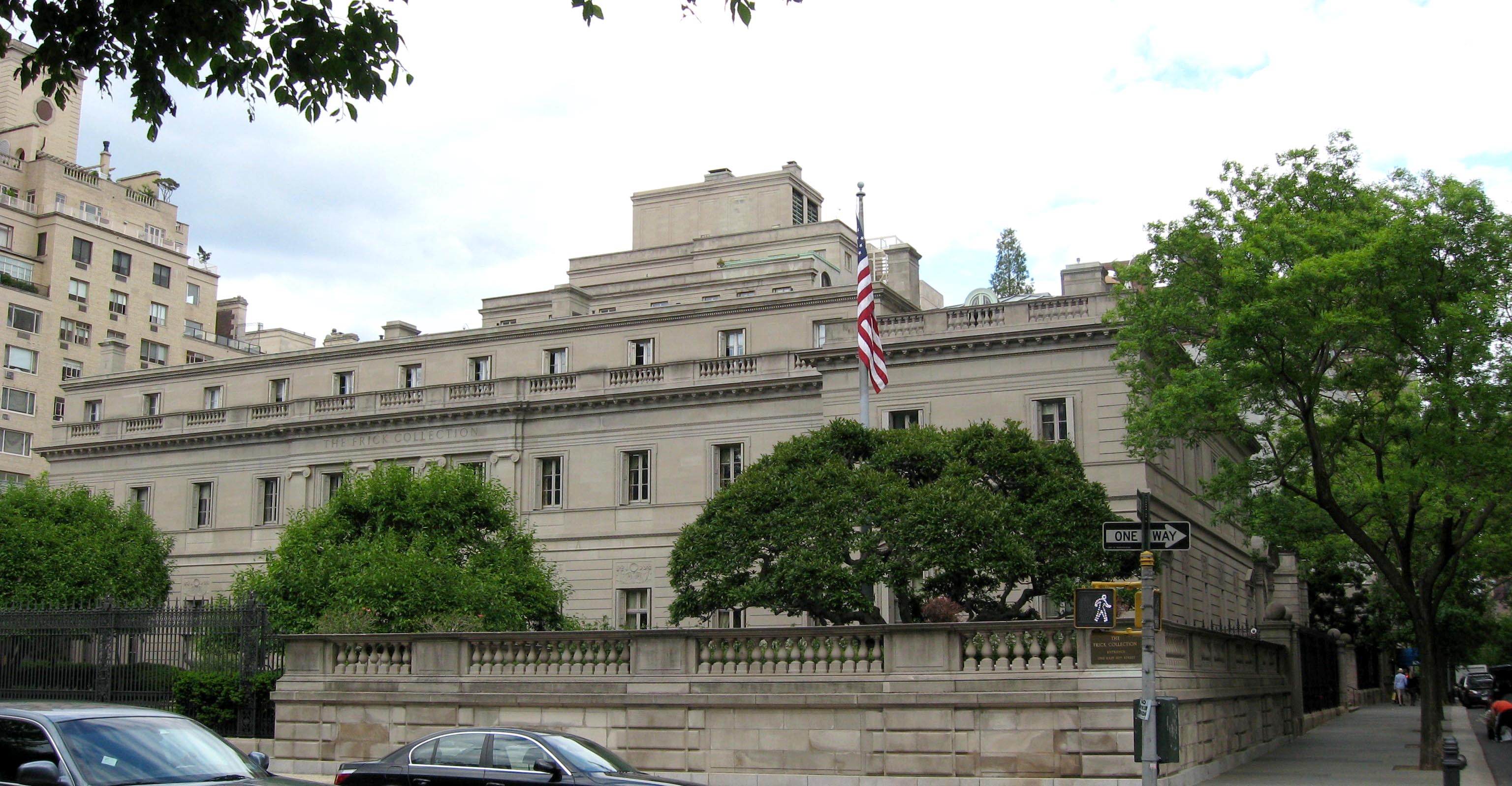
Frick Collection
"I can make money. I cannot make pictures." Henry Clay Frick offered that explanation for why one of America's most ruthless industrialists spent his fortune acquiring Vermeers, Bellinis, and Holbeins instead of more coke ovens. When he died in 1919, he bequeathed his Beaux-Arts mansion at 1 East 70th Street and everything inside it to the public. The resulting museum, which opened in 1935, is unlike any other in New York City. There are no crowds jostling before blockbuster exhibitions. No cafeteria din. For decades, the Frick did not even admit children under ten. Walking its rooms feels less like visiting a museum and more like being a guest in an impossibly refined home where Vermeer's Mistress and Maid hangs on the wall and a Fragonard fills an entire room -- because that is exactly what it was.
The Collector's Eye
Frick began collecting art as early as 1870, hanging pictures in his house in Broadford, Pennsylvania. He bought his first significant painting, Luis Jimenez's In the Louvre, in 1880 after moving to Pittsburgh. As his fortune in coke and steel grew, so did his ambition for art. He was not alone among Gilded Age tycoons in this pursuit -- Henry Havemeyer and J.P. Morgan were contemporaries building their own collections -- but Frick was exceptionally particular. He spent an estimated $10 million during his lifetime acquiring pieces and opened four purchasing accounts with the dealer Joseph Duveen, including two specifically earmarked for works from Morgan's estate. When the Frick family relocated from Pittsburgh to New York in 1905, they leased the William H. Vanderbilt House on Fifth Avenue while their permanent home was being designed. Thomas Hastings of Carrere and Hastings completed the mansion at 1 East 70th Street in 1914, designing it from the start to accommodate the collection.
A Mansion Becomes a Museum
Frick's will stipulated that after his wife Adelaide died or moved out, the mansion would become a public museum. Adelaide remained until her death in 1931. John Russell Pope was hired to convert the residence, and the Frick Collection opened to the public on December 16, 1935. The collection was then valued at $30 million, and Frick had left a $15 million endowment for its upkeep. At its soft opening five days earlier, the event was considered so noteworthy that the New York Herald Tribune published the names of all 700 attendees. Initially, admission was free and timed-entry tickets were distributed to prevent crowding, but demand was so intense that visitors had to book weeks in advance. The library wing, rebuilt on 71st Street, opened in January 1935 with 200,000 photographs, 18,000 art-sale catalogs, and 45,000 books. The Frick Art Research Library, established by Frick's daughter Helen Clay Frick in 1920, remains one of the most important art-history reference centers in the world.
Helen's Vigil
If Henry Clay Frick created the collection, his daughter Helen spent decades guarding it against change. She catalogued most of the works over the 1920s and 1930s, and when John D. Rockefeller Jr. offered to donate artwork in 1948, Helen objected, arguing the museum should only accept gifts from family members. A New York Supreme Court judge ruled against her, and the appellate division upheld the decision. Rockefeller resigned from the board of trustees. Helen opposed any expansion of the collection, insisting her father would not have wanted additions. She resigned from the board in 1961 but continued to exercise influence until her death in 1984. Her resistance gave the Frick its distinctive character: a small, intensely curated collection displayed in domestic rooms rather than institutional galleries. By the mid-1960s, the museum held 160 portraits, 80 sculptures, and various decorative objects across 16 rooms -- a fraction of what the nearby Metropolitan Museum of Art displayed.
The Intimate Alternative
The Frick's intimacy is its defining quality. Visitors encounter Vermeer's Officer and Laughing Girl, Rembrandt's Self-Portrait, Goya's The Forge, and Holbein's portraits of Thomas More and Thomas Cromwell not in museum galleries but in wood-paneled rooms with period furniture, Oriental rugs, and natural light. The Boucher Room and Fragonard Room display entire decorative ensembles as Frick arranged them. Chamber music performances in the garden courtyard have been a tradition for decades. The museum began charging admission in 1976, and through the 1990s maintained its policy of excluding unaccompanied minors and children under ten. When New York City passed an age-discrimination law in 1993 that would have forced the museum to admit children, officials requested and received a waiver, arguing they would need to install protective barriers. The Frick has about 1,500 pieces in its collection and typically receives up to 300,000 visitors annually.
Renovation and Return
By the early 2000s, the mansion's facilities had grown dated, and the basement exhibition space was no longer adequate. Annexes were proposed in 2001, 2005, and 2008 but were canceled because each would have required an extended closure. During the 2010s, the museum raised $220 million for a comprehensive renovation (with total project costs including the temporary relocation reaching $330 million). The Frick House closed in 2021, and the collection temporarily relocated to Frick Madison at 945 Madison Avenue. The mansion reopened in April 2025, its rooms restored and its infrastructure modernized while preserving the domestic character that has distinguished the collection since Frick's day. From the air, the Beaux-Arts facade on Fifth Avenue is dwarfed by the surrounding Upper East Side towers. But step inside, and the scale shifts. The rooms are human-sized. The art is close enough to study without binoculars. Henry Clay Frick could make money, and he proved it. But his legacy is the pictures.
From the Air
Coordinates: 40.7711°N, 73.9672°W. Located at 1 East 70th Street on the Upper East Side of Manhattan, facing Fifth Avenue and Central Park. Visible from altitude as part of the Museum Mile along the eastern edge of Central Park. Nearest airports: KLGA (LaGuardia, 10 km NE), KJFK (JFK International, 22 km SE). Best viewed at 2,000-4,000 ft AGL following Fifth Avenue north from Midtown, with Central Park to the west.