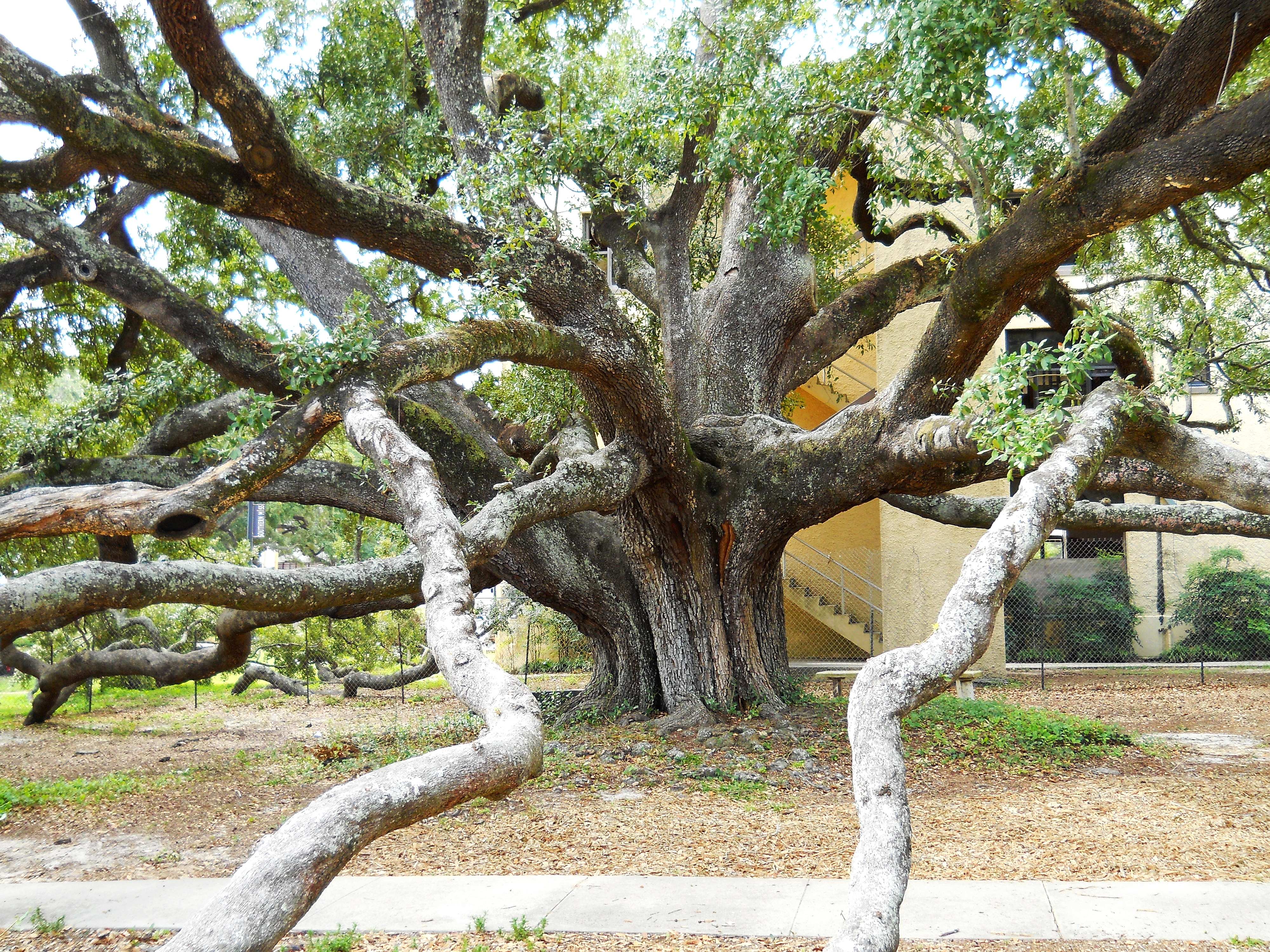
Friendship Oak
The legend is simple: step beneath the branches of this tree and you will remain friends for life with everyone who shares its shade. It sounds like the kind of story printed on a souvenir postcard, except that Friendship Oak has been collecting believers since before the United States existed. Planted around 1487 -- five years before Columbus reached the New World -- this southern live oak has stood on what is now the Gulf Park campus of the University of Southern Mississippi in Long Beach, Mississippi, through more than five centuries of hurricanes, wars, and the steady accumulation of human devotion. Its crown spreads approximately 155 feet across, sheltering nearly 16,000 square feet of ground, and its lateral roots reach 150 feet from the trunk in every direction.
Older Than the Nation
Friendship Oak dates to a time when the Pascagoula and Biloxi peoples were the only humans who knew this coastline. By the time French explorers arrived in the late 1600s, the tree was already two centuries old. When the campus was established as Gulf Park College for Women in 1921, the oak became the emotional center of student life. In the 1920s, the poet Vachel Lindsay taught at the college and read poetry to students gathered beneath its branches. By 1940, the tree had earned a formal distinction: it was registered as the 110th member of the Live Oak Society, a Louisiana-based organization whose members are all trees, each with a trunk circumference of at least 17 feet. At the time of registration, Friendship Oak measured 14 feet around.
Under the Canopy
In 1950, Life magazine featured Gulf Park College with photographs of students attending classes in the open air beneath Friendship Oak. The image captured something essential about the tree: it is not merely old, it is used. Weddings have been held under its canopy for generations, most celebrated by former students of Gulf Park College or the University of Southern Mississippi, which absorbed the campus in 1971. The Mississippi Forestry Commission measured the tree in August 2011 and recorded a height of 59 feet, a trunk diameter of 5.75 feet, and a trunk circumference that had grown to 19.8 feet -- nearly six feet more than when it was first registered seven decades earlier. The main lateral limbs average 60 feet in length, with circumferences of 7.5 feet where they meet the trunk. A certified arborist assessed the tree's health after a limb failure, and remediation work in October 2017 included pruning and the installation of bracing to support other limbs.
Weathering the Gulf
Living a few hundred yards from the Gulf of Mexico for five centuries means surviving what the Gulf throws at you. Hurricane winds have repeatedly stripped the Friendship Oak bare of leaves, and storm surges have pushed saltwater inland over its root system. Hurricane Camille in 1969 and Hurricane Katrina in 2005 each devastated the Mississippi Coast, toppling hundreds of live oaks along the shoreline. Friendship Oak survived both. After each catastrophe, acorns were gathered from the tree to grow seedlings for replanting along the coast, replacing the oaks that had fallen. The tree's offspring now line stretches of the Mississippi Gulf Coast, a quiet legacy of resilience rooted in the genetics of a single survivor.
Still Growing
In 2024, the coast campus was approved for a sidewalk grant from the Mississippi Department of Transportation, creating a dedicated parking space and walkway to the tree along with a natural boundary designed to attract pollinators. It is a small, careful gesture -- the kind of attention a 500-year-old living landmark requires. Friendship Oak is not a museum piece behind glass. It is a working tree on a working campus, still providing shade for students, still hosting weddings, still dropping acorns that carry five centuries of genetic memory into Mississippi soil. The legend may or may not be true. But generations of students, poets, and married couples have chosen to believe it, and the tree keeps growing, indifferent to whether friendship is magic or simply the product of standing in the right shade at the right time.
From the Air
Located at 30.35N, 89.14W on the Gulf Park campus of the University of Southern Mississippi in Long Beach, Mississippi. The tree's 155-foot crown spread makes it visible as a distinctive canopy on the campus grounds near the Gulf shoreline. Nearest airport: Gulfport-Biloxi International (KGPT), approximately 6nm east. Stennis International (KHSA) is 25nm west. Best viewed at 1,000-2,000 ft AGL while following the coast. The campus sits between US Highway 90 and the beach, with the tree's canopy standing out among the surrounding buildings.