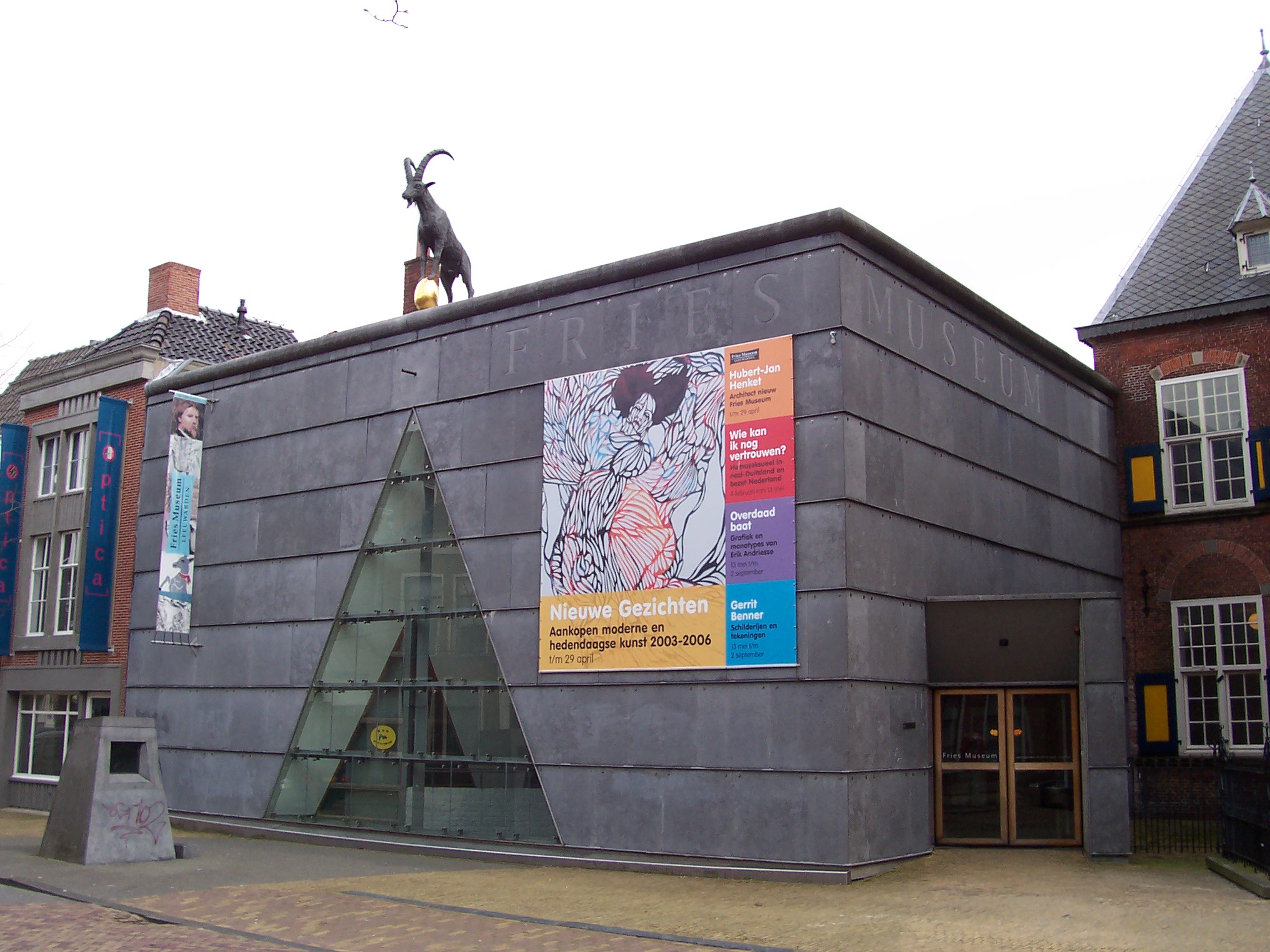
Fries Museum
When the Frisian architect Abe Bonnema died in 2001, his will left eighteen million euros to a museum he loved. The bequest paid for the long, low building on the Wilhelminaplein that Queen Maxima opened on a September day in 2013. Inside it, on a million-object scale, is the answer to a question Friesland has been asking itself for two centuries: what is it that makes us a separate people? The Fries Museum is the curated reply, and the reply contains a dancer-spy, a giant's sword, a painted room from Hindeloopen, and a fibula of Wijnaldum that may be the most precious piece of gold in the Netherlands.
The Society That Bought a House
The museum was founded on 13 April 1881, but really it began earlier - in 1827, when a group of Frisian-minded citizens formed the Provincial Friesch Genootschap, a society devoted to Frisian history, antiquities and language. For half a century they collected artifacts faster than they had anywhere to put them. The local preacher and writer Joost Hiddes Halbertsma brought in Hindelooper goods and other Frisian curiosities. In 1877 the society staged a single historical exhibition with more than fifteen hundred items on loan; it drew so many visitors it returned a profit of seventeen thousand guilders. With that money the society bought a property on the Koningstraat called the Eysinga house, and four years later the Fries Museum opened in its rooms. King William III bequeathed portraits from the stadhouder's collection. A wing went up in 1892 with a skylit gallery. The museum has been growing ever since.
Margaretha From the Korreweg
She was born on 7 August 1876 in a tall narrow house on the Kelders, the daughter of a hat merchant named Adam Zelle. Her name was Margaretha Geertruida Zelle. Leeuwarden knew her then as Greetje. The world would later know her as Mata Hari, the half-invented exotic dancer of pre-war Paris, executed by French firing squad in October 1917 for espionage. The Fries Museum reclaims her. Its Mata Hari hall holds her scrapbooks, her letters, her photographs - the artifacts of a Frisian girl who built herself a new identity at the price of her life. The museum tells her story as a hometown daughter who became someone else, not as a Belle Epoque caricature.
A Sword, A Room, A Fibula
Three objects sit at the museum's iconic heart. The first is the legendary sword of Grote Pier - Pier Gerlofs Donia, the giant Frisian rebel of the 1510s whose mercenary band, the Arumer Zwarte Hoop, fought the Habsburgs to keep Frisian freedom alive a little longer than history allowed. The sword is over two metres long; tradition says he wielded it two-handed. The second is the Hindelooper Room, an entire painted interior moved into the museum, every surface covered in the brilliant red and green folk paintwork that the fishing town of Hindeloopen produced in the eighteenth century. The third is the Great Fibula of Wijnaldum, a seventh-century gold cloak-pin found in a Frisian terp mound - one of the most spectacular pieces of early medieval goldsmithing surviving anywhere in Europe.
Painters of the Province
The museum holds the largest collection anywhere of works by Adriaen van Cronenburg, a late-sixteenth-century portraitist who recorded the Frisian gentry in cool, dark tones. Beside him hang Wigerus Vitringa's marines, Wybrand de Geest's Golden Age portraits, the floral still lifes of Eelke Jelles Eelkema, the modernist landscapes of Gerrit Benner, and the strange, dreamlike interiors of Jan Mankes, who painted in Friesland until tuberculosis killed him in 1920 at thirty. There is one outlier of international stature: Lourens Alma-Tadema, born in nearby Dronryp in 1836, who became the Victorian world's most celebrated painter of ancient Rome. His luminous Roman scenes hang here in his home province, an exhibition of his work in 2017 won the museum the Global Fine Art Award - the prize sometimes called the Museum-Oscar.
Finding the Building
Hubert-Jan Henket's design is unmistakable from above: a sharp, angular volume of pale stone and glass anchoring the south side of the Wilhelminaplein, between the railway station and the old centre of Leeuwarden. From cruising altitude the building does not stand out - Leeuwarden is a compact provincial capital, not a metropolis - but the square it dominates is one of the few clean rectangular open spaces in the city centre, easy to pick out among the dense brickwork and the canals that loop around the old town. The Oldehove, the leaning unfinished church tower, sits a few hundred metres northwest. The Fries Museum sits at the heart of the place its collection comes from.
From the Air
Located at 53.20 N, 5.79 E in central Leeuwarden, capital of Friesland, Netherlands. The museum sits on the Wilhelminaplein, a large open square just south of the historic core. Nearest airfields: Leeuwarden Air Base (EHLW) 3 km west, Groningen Airport Eelde (EHGG) 50 km east, Amsterdam Schiphol (EHAM) 105 km south-southwest. Best altitude for picking out Leeuwarden from the air is 3,000 to 5,000 feet - look for the leaning Oldehove tower north of centre, and the rectangular Wilhelminaplein with the angular pale Fries Museum building on its south side. The city's canal grid wraps around the old town in a clear ring shape.