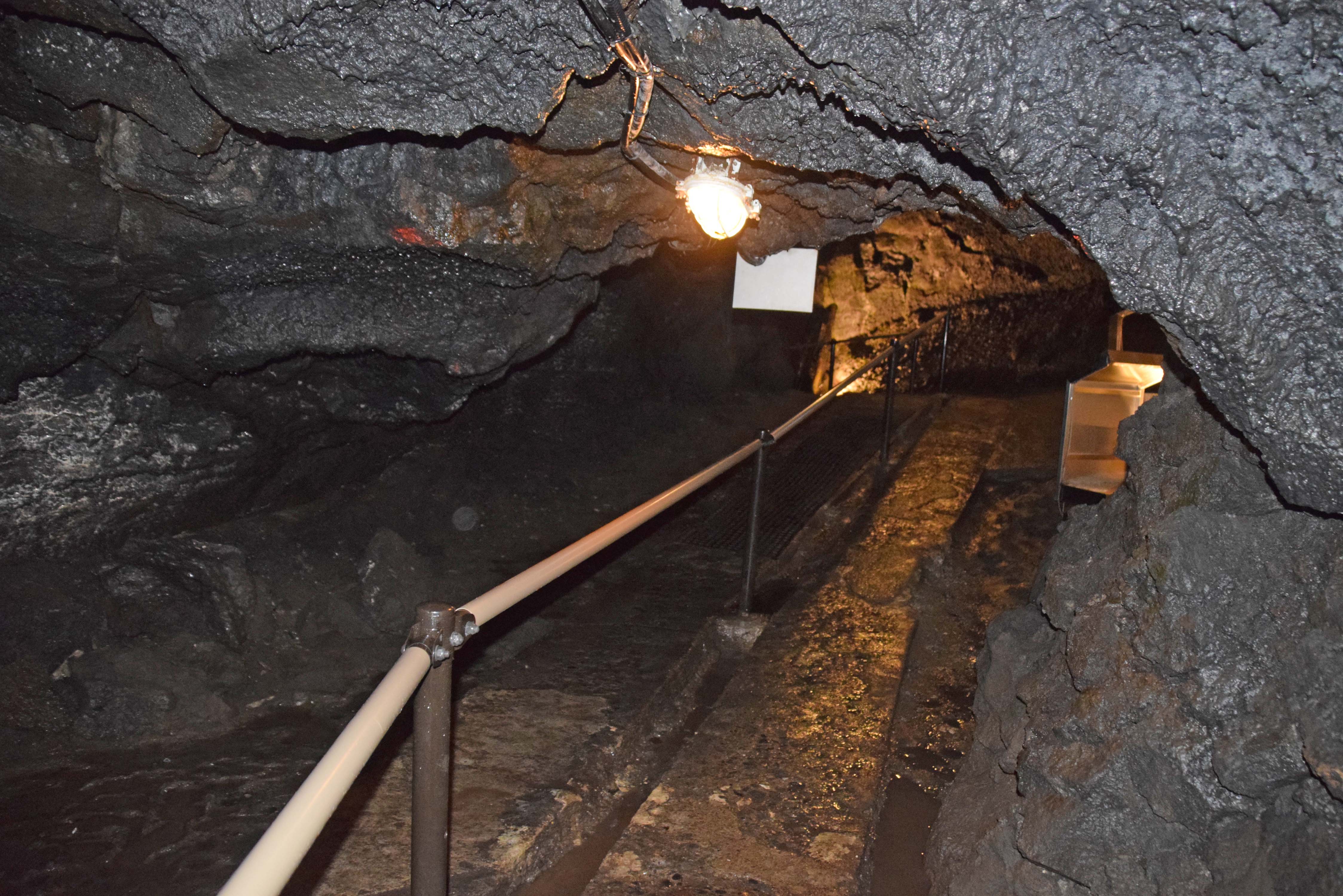
Fugaku Wind Cave
Even in the dead of August, when humidity blankets the forests around Mount Fuji and cicadas scream from every tree, the temperature inside Fugaku Wind Cave hovers near freezing. Icicles cling to basalt walls that have not seen sunlight in over a thousand years. This is Mount Fuji turned inside out -- a tunnel of frozen lava stretching 201 meters beneath the dense canopy of the Aokigahara forest, where the same volcanic violence that built Japan's most iconic peak also hollowed out chambers of permanent cold. The cave's name says it plainly: Fugaku is a literary name for Mount Fuji itself, and Fūketsu means wind cave, for the steady circulation of air that keeps temperatures locked at a constant chill year-round.
Born from the Mountain's Rage
Fugaku Wind Cave owes its existence to a catastrophic night in 864 AD, the sixth year of the Jōgan era, when Mount Fuji's northeast flank ripped open and poured lava downslope for ten straight days. The eruption ejected immense quantities of cinders and ash while rivers of molten basalt flowed west, splitting the ancient lake known as Se-no-umi into two separate bodies -- Lake Saiko and Lake Shōji, both now counted among the famous Fuji Five Lakes. The lava also raised cinder cones like Ōmuro and Nagao mountains and smothered a vast area that would eventually grow into the Aokigahara forest. As these lava flows cooled unevenly, the outer crust hardened while molten rock continued to drain beneath, leaving behind hollow tubes like veins through solid stone. Fugaku Wind Cave is the largest of these tubes -- a geological receipt for a volcanic transaction completed over a millennium ago.
The Silkworm Refrigerator
For roughly three centuries, from the Edo period through the Meiji era, the people of the Fuji foothills put Fugaku Wind Cave to practical use that no modern engineer could have designed better. Silkworm farmers needed to store their delicate eggs at cold, stable temperatures to control hatching cycles -- and here was a ready-made refrigerator buried in the forest floor. They carried their egg trays deep into the basalt chambers, where the constant chill preserved them perfectly. The cave's natural air circulation prevented moisture buildup while maintaining temperatures that kept the eggs dormant until the farmers were ready. It was an elegant solution from a people who understood their landscape intimately: the same volcanic forces that threatened their homes with destruction also provided, in the aftermath, a tool for sustaining one of Japan's most important industries.
A Walk Through Frozen Stone
Today, visitors descend a staircase into the cave and find themselves surrounded by formations that look like they belong on another planet. Lava terraces step down through the chamber like a frozen amphitheater. Rope-like lava forms twist across the floor and walls, preserving the exact texture of molten rock caught mid-flow. And then there are the icicles -- crystalline spears hanging from the ceiling even when summer temperatures above ground push well past thirty degrees Celsius. The basalt walls, eight and a half meters high on average, absorb what little warmth drifts in and give nothing back. Fugaku Wind Cave, along with the neighboring Narusawa Ice Cave and Lake Sai Bat Cave, was designated a Natural Monument of Japan in 1929 -- recognition that these formations represent something irreplaceable. All three caves are managed by the Fuji Sightseeing Industry Company, part of the Fuji Express Group, and the entrance facility was renovated and reopened in 2012 as "Wood Station Wind Cave."
The Forest Above
Part of what makes Fugaku Wind Cave remarkable is what sits above it. The Aokigahara forest, sometimes called the Sea of Trees, is one of the densest woodlands in Japan -- a thick carpet of vegetation rooted directly in the porous lava flows of 864 AD. The trees here grow on rock, not soil, sending roots into cracks in hardened basalt. The forest floor is so uneven with cooled lava formations that straying from marked paths is genuinely dangerous. Beneath this tangled canopy, the cave system runs like a hidden circulatory network, channeling air through passages that have remained essentially unchanged since the lava stopped flowing. Standing at the entrance, you can feel the cave breathing -- a faint, cold draft pushing outward against the warm forest air, a reminder that the Jōgan eruption is not truly over. Its consequences are still shaping the temperature, the forest, and the landscape of Fuji's northern foot.
From the Air
Located at 35.4775N, 138.6575E on the northern foot of Mount Fuji, within the dense Aokigahara forest. The cave entrance itself is not visible from the air, but the Aokigahara forest is identifiable as a distinctly dark, flat expanse of dense tree cover on the lava plateau between Lake Saiko and Lake Shōji. Best observed at 3,000-5,000 feet AGL. The Fuji Five Lakes are excellent visual landmarks. Nearest airports: Mt. Fuji Shizuoka Airport (RJNS) approximately 40nm south, Tokyo Haneda (RJTT) approximately 60nm east. Mount Fuji itself dominates the skyline and serves as the primary navigation reference.