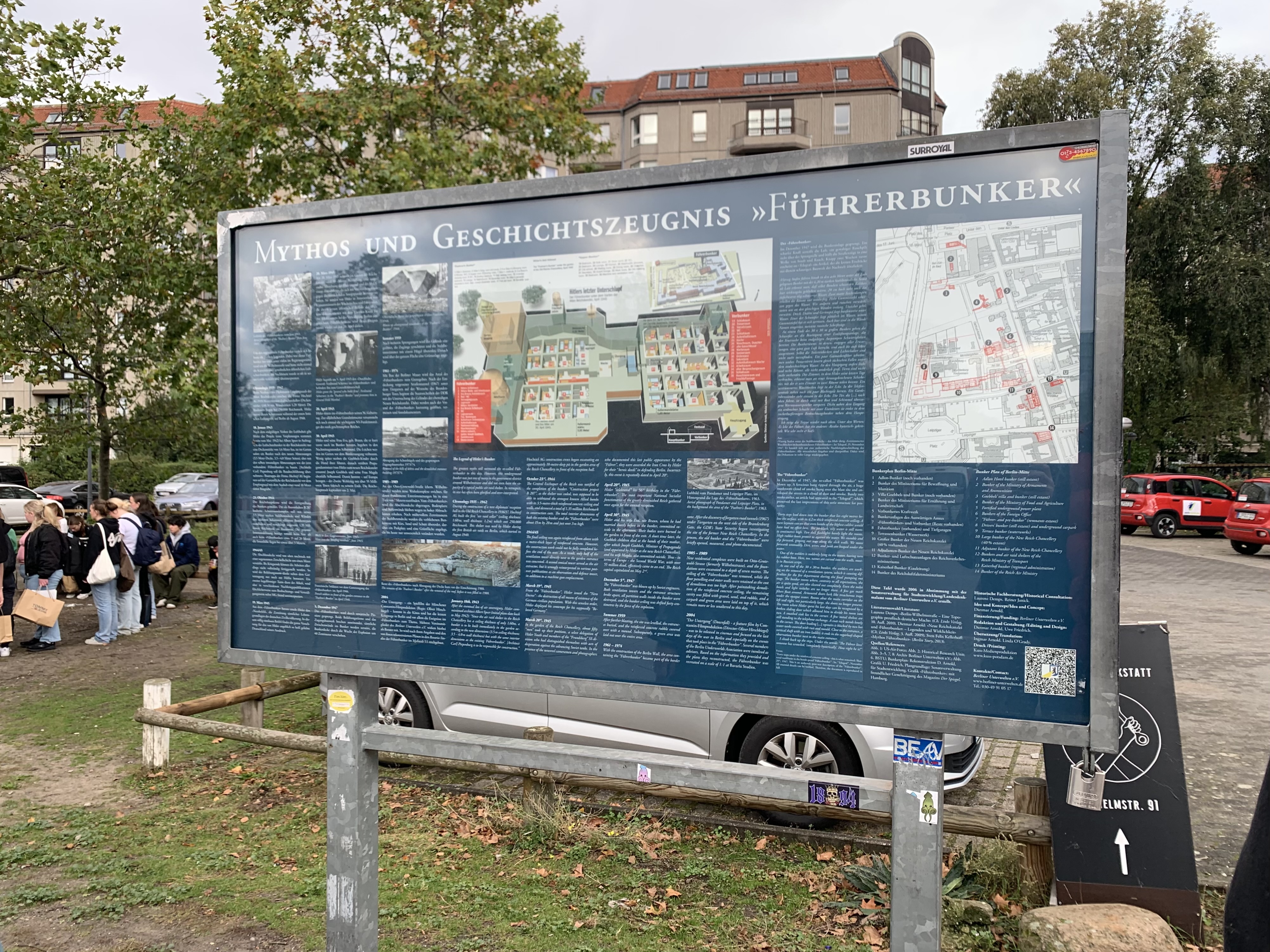
Fuhrerbunker
The site is between two streets named for victims of the Holocaust: In den Ministergarten and Gertrud-Kolmar-Strasse. There is a parking lot. There is an apartment block on one side and a small grass strip on the other. There is a single laminated information board with a schematic diagram of the bunker that lies sealed beneath. There is no statue, no flame, no flag. The deliberate ordinariness is the memorial. Berlin decided, after long debate, that the place where Adolf Hitler shot himself in April 1945 should not be allowed to become a pilgrimage site for those who would venerate him.
An Air Raid Shelter Beneath the Garden
The bunker complex sat 120 meters north of the New Reich Chancellery, beneath the garden of the older one. The upper Vorbunker was finished in 1936 as a temporary air-raid shelter; the deeper Fuhrerbunker was completed in 1944 as the Allied bombing of Berlin intensified. The lower bunker had walls of reinforced concrete four meters thick and a roof almost three meters thick, holding about thirty small rooms. Construction was carried out by the Hochtief firm and cost 1,349,899 Reichsmarks, a precise figure preserved in the records. The complex sat below the Berlin water table, so pumps ran continuously to keep the rooms dry. A diesel generator provided electricity. Hitler took up residence on January 16, 1945, and would never again leave Berlin alive.
The Last Hundred Days
Hitler's senior staff joined him in April. Joseph and Magda Goebbels brought their six children, who took rooms in the upper Vorbunker. Eva Braun arrived to be with him. So did Martin Bormann, a handful of secretaries including Traudl Junge, the SS bodyguard and switchboard operator Rochus Misch, and a nurse named Erna Flegel. Hitler made his last trip above ground on April 20, his fifty-sixth birthday, to award the Iron Cross to boy soldiers of the Hitler Youth in the wrecked Chancellery garden. Soviet artillery began shelling the city center that same afternoon. Inside the bunker, Hitler spent the next ten days issuing orders to armies that no longer existed, raging at generals who had failed him, and finally accepting that the war was lost. He had blamed everyone but himself for years. He continued.
April 30
Hitler married Eva Braun in a small civil ceremony just after midnight on April 29. He dictated his last will and testament to Traudl Junge in the early hours, then went to bed. The next afternoon, with Soviet troops one city block from the bunker, he and Eva Braun killed themselves in his study. He was 56; she was 33. Their bodies were carried up the stairs to the Chancellery garden, doused with gasoline, and burned, in accordance with his instructions. Goebbels became chancellor for a single day. On the evening of May 1, his wife Magda poisoned their six children with cyanide; she was 43, the children were aged twelve to four. Their parents then killed themselves. On May 2, the master electrician Johannes Hentschel, who had stayed behind to keep power and water flowing for the field hospital above, surrendered the bunker to the Red Army at 9 a.m. The bodies of the children were found in their beds the next day.
Forty Years of Indecision
The Soviets levelled the Reich Chancellery between 1945 and 1949 and tried to demolish the bunker in December 1947. The reinforced concrete largely held. East Germany had another go at demolition in 1959, with similar results. Through the Cold War the site sat a few meters from the Berlin Wall, a derelict grass strip that nobody developed. When Berlin began rebuilding the area in 1988-89, construction crews uncovered surviving sections of the bunker complex and destroyed most of what they found. The deliberate strategy, agreed by city authorities and historians, was to make the surroundings as anonymous as possible. The emergency exit, which had opened into the Chancellery garden where Hitler's body was burned, ended up beneath a parking lot. A residential building covers the rest.
What the Sign Says
The information board appeared on June 8, 2006, just before the World Cup brought tourists to Berlin in numbers. The text is restrained and factual. It describes the bunker, names the people who died there, places the events in the context of the Battle of Berlin, and lists relevant scholarship. There is no commemoration of Hitler, no naming of him as anything other than the chief perpetrator of the war the bunker had been built to escape. Rochus Misch, the former bodyguard who had been there in the final days, attended the unveiling. He died in 2013, the last living survivor of the bunker. In 2025, researchers led by Turi King at the University of Bath used DNA from blood preserved on the sofa in Hitler's study, compared to a relative's DNA, to confirm the identity of the man who had died in that room. The science was not really in doubt; the test settled the last conspiracy theory. The bunker, sealed and inaccessible, lies five meters beneath the asphalt where you stand.
From the Air
Located in central Berlin at 52.51 degrees N, 13.38 degrees E, just south of the Brandenburg Gate and three minutes' walk from Potsdamer Platz. Berlin Brandenburg Airport (EDDB) lies about 23 km southeast. The Reichstag, Brandenburg Gate, and the new Holocaust Memorial are all within about 500 meters. From altitude the unmissable landmark is the Tiergarten, the large green rectangle immediately west of the bunker site.