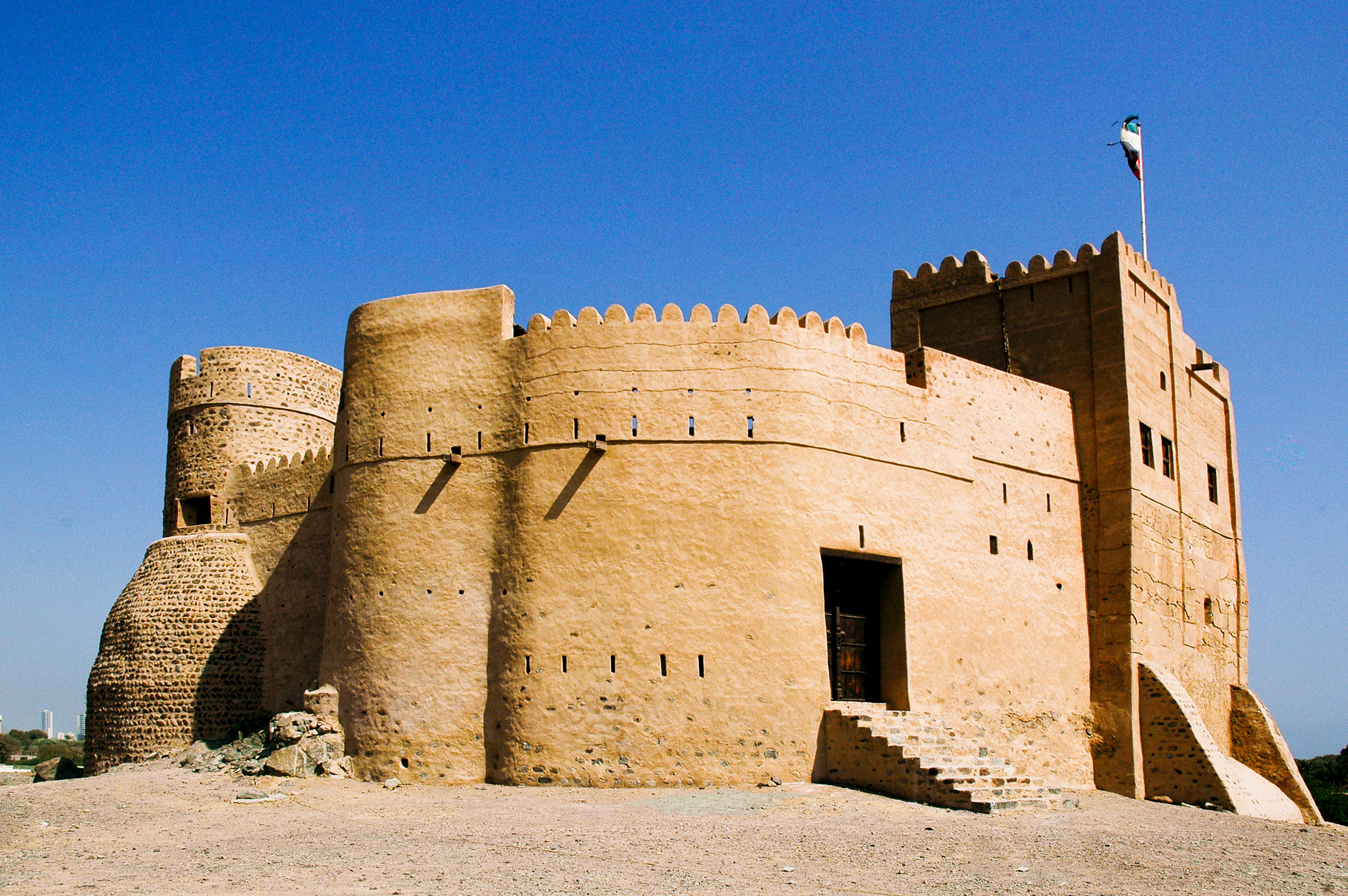
Fujairah Fort
Radiocarbon dating places the construction of Fujairah Fort at around 1500 to 1550, making it one of the oldest standing structures in the United Arab Emirates. It sits on a small rocky hill that rises 20 meters above the surrounding landscape, about a kilometer from the coast and two kilometers from the center of modern Fujairah. The hill's uneven surface gives the fort its irregular shape -- a feature that, far from being a flaw, forced the builders to adapt their design to the rock itself.
Built on Bedrock
The fort is constructed from local materials: rocks, gravel, mud, hay, and plaster. It forms part of a complex that includes several old houses and a mosque. Three round watchtowers and one square watchtower guard the perimeter, connected by walls that create a central hall. The design is characteristic of the Portuguese fortifications that dotted this coast in the 16th century -- Fujairah Fort was one of many such structures built by the Portuguese to control the eastern seaboard of the Arabian Peninsula. The fort was renovated between 1650 and 1700, a period that coincided with the Omani expulsion of the Portuguese from the region.
The Bombardment
In the 20th century, Fujairah Fort suffered a blow that neither the Portuguese nor regional rivals had managed to deliver. HMIS Lawrence, a vessel of the Royal Indian Marine, bombarded the fort in 1925. The attack reflected the British Empire's enforcement of its authority over the Trucial States, the collection of sheikhdoms along this coast that Britain considered within its sphere of influence. The bombardment damaged the fort severely enough that it was subsequently abandoned and neglected for decades. The structure that had withstood centuries of regional warfare could not withstand imperial firepower.
Rebuilding With the Same Mud
In 1997, the Fujairah Administration of Antiquity and Heritage began restoring the fort, a project completed by 2000. The restoration used the same materials with which the fort was originally built -- rocks, mud, and plaster sourced locally. This decision was deliberate: the restored fort is not a modern replica dressed in old clothing but an attempt to continue the building traditions of the original constructors. The watchtowers were rebuilt, the central courtyard cleared, and the complex reopened to visitors as one of Fujairah's primary tourist attractions.
Old Fujairah
The fort's location in "old Fujairah" places it at the historical heart of the emirate. Nearby stands the Fujairah Museum, and to the north the Sakamkam Fort marks another point in the chain of defensive structures that once protected this coast. The Wahhabists occupied Fujairah Fort at one point, adding yet another layer to a building that has served Portuguese colonizers, local rulers, religious movements, and British imperialists across five centuries. Today, the rocky hill offers views across the coastal plain toward the Gulf of Oman. The mosque within the complex still stands. The watchtowers still watch, though what they guard has changed beyond recognition.
From the Air
Located at 25.14N, 56.34E in old Fujairah, UAE, on a small rocky hill about 1 km from the Gulf of Oman coast. The fort complex is visible from lower altitudes as a cluster of stone structures on elevated ground. Nearest airport is Fujairah International (OMFJ), approximately 5 km south. The Hajar Mountains rise immediately to the west.