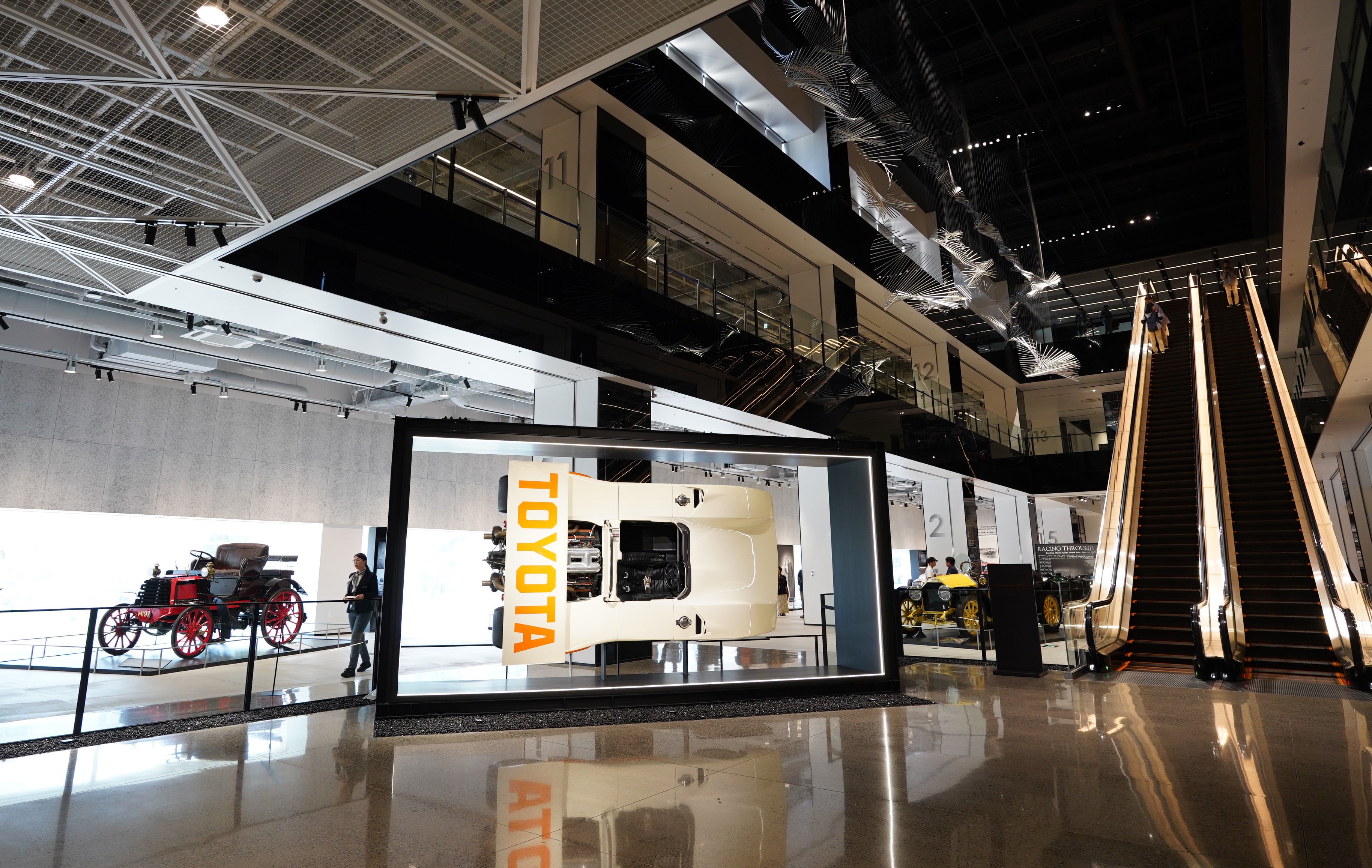
Fuji Motorsports Museum: Racing in Fuji's Shadow
The Fuji Speedway was supposed to be Japan's Daytona. When the track opened in December 1965, one end sported a towering 30-degree banking modeled on NASCAR's famous superspeedway, designed with advice from NASCAR founder Bill France Sr. and Formula One driver Stirling Moss. Money ran out before the other three bankings could be built, and the circuit evolved into something entirely its own -- a road course that hosted Japan's first Formula One Grand Prix in 1976 and became one of the country's most storied racing venues. Now, fifty-seven years after the first engines fired on that incomplete oval, the Fuji Motorsports Museum opens on the grounds of the same circuit to tell the whole story. Housed inside the Fuji Speedway Hotel, the museum that opened on October 7, 2022, is perhaps the world's first attempt at a permanent motorsport exhibition built through the cooperation of 10 competing automobile manufacturers.
Where the Engines Sleep
The museum occupies the first and second floors of the Fuji Speedway Hotel, a luxury property operated by Hyatt Hotels and Resorts as part of The Unbound Collection. The building sits on the west side of Fuji Speedway in Oyama, Shizuoka Prefecture, with Mount Fuji filling the sky to the northwest. Together with the circuit and hotel, the museum forms part of Fuji Motorsports Forest, a regional development project promoted by Toyota Motor Company and Fuji Speedway that aims to turn the racing complex into a destination beyond race weekends. Roughly 40 vehicles are on display at any time, arranged to trace 130 years of motorsport history -- from the earliest racing machines to modern prototypes -- and the exhibits rotate irregularly, giving the collection a living, changing character.
Rivals Under One Roof
What makes the Fuji Motorsports Museum unusual is not its size but its philosophy. Although funded by the Toyota Group and supervised by the Toyota Automobile Museum, the collection deliberately refuses to favor its patron. Honda, Nissan, Mazda, Porsche, Mercedes-Benz, Subaru, Mitsubishi Motors, Hino Motors, and Yamaha Motor Company all contribute vehicles, alongside organizations like The Henry Ford museum in Dearborn, Michigan. The approach mirrors that of Volkswagen's ZeitHaus in the Autostadt in Wolfsburg, Germany -- a corporate museum that tells the industry's story rather than one brand's glory. The second floor focuses on how racing technology transfers to commercial vehicles, featuring legendary Japanese machines like the 1966 Toyota 2000GT Speed Trial car and the 1969 Nissan R382, which dominated the Japanese Grand Prix. These are cars that competed against each other on the circuit just outside the window, now resting side by side.
The Circuit That Shaped a Nation's Racing
The museum's location is inseparable from its meaning. Fuji Speedway opened in 1965 as the Japan NASCAR Corporation's bid to bring American-style oval racing to Japan. The original 6-kilometer layout featured a 1.6-kilometer straight leading into that single completed 30-degree banking -- a startling feature that made the track both thrilling and dangerous. The circuit hosted Japan's first Formula One World Championship race in 1976, a rain-soaked event won by Mario Andretti while James Hunt clinched the drivers' title. A devastating crash in 1977 involving Gilles Villeneuve and Ronnie Peterson, which killed a photographer and a marshal, drove Formula One away until 2007. Toyota acquired the circuit in 2000 and undertook a major renovation, reopening the modernized track in 2005. Today, the museum sits at the heart of a venue that carries six decades of racing history in its asphalt.
Machines and Their Makers
The museum's first floor greets visitors with a collection arranged chronologically, walking the history of speed from horseless carriages to Le Mans prototypes. But the exhibits go beyond the machines themselves. Display materials explore the thinking of the engineers and designers who built them -- the decisions behind an aerodynamic curve, the calculations that determined a gear ratio, the obsessions that drove teams to shave fractions of a second. Some vehicles on display are originals; others are highly detailed replicas built by the manufacturers themselves, each one faithful enough to satisfy the engineers who designed the real thing. The collection is not static. Vehicles rotate in and out, ensuring that repeat visitors encounter different chapters of the same long story -- a story that began with internal combustion and ambition, and that still plays out on the track just beyond the hotel walls, where the sound of engines on practice days drifts through the museum's glass.
From the Air
Located at 35.368N, 138.918E on the west side of Fuji Speedway in Oyama, Shizuoka Prefecture. The circuit's distinctive oval-influenced layout is clearly visible from altitude, with the long main straight and grandstands marking the eastern side. Mount Fuji rises dramatically to the northwest. Best viewed at 3,000-6,000 feet AGL. The museum is within the hotel complex on the circuit's western perimeter. Shizuoka Airport (RJNS) lies approximately 55 nautical miles to the southwest. The area sits at approximately 600 meters MSL in hilly terrain at the base of the Fuji volcanic zone.