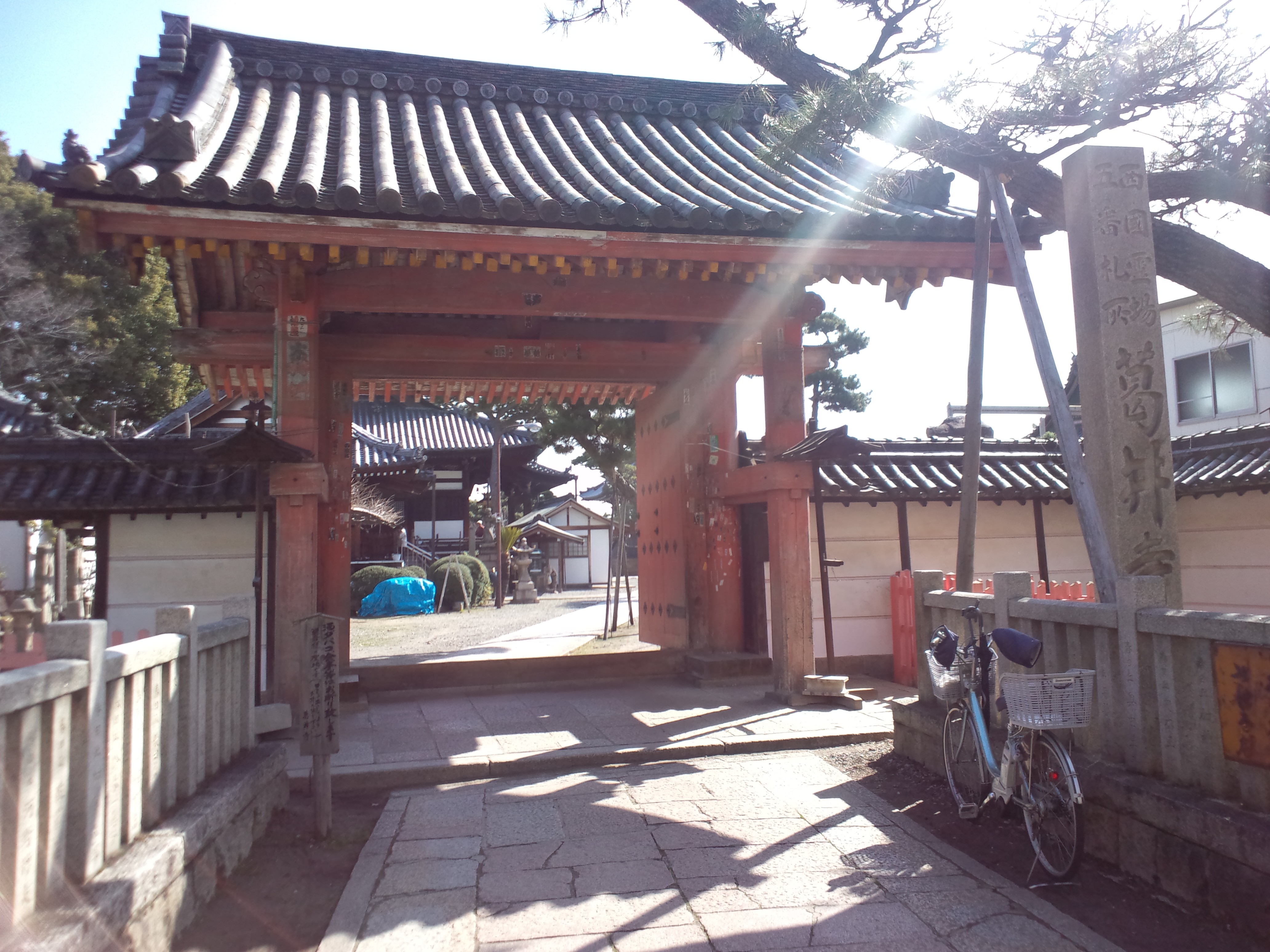
Fujii-dera: The Temple with More Than a Thousand Arms
Count the arms and you run out of patience before you run out of arms. The seated Kannon at Fujii-dera holds 1,041 of them -- large and small, fanning outward in a radiant circle from two supports behind the figure, each one crafted from dry lacquer over wood. Most Thousand-Armed Kannon statues in Japan take the symbolic shortcut: forty-two arms, each said to save twenty-five worlds. Fujii-dera's sculptors took the name literally. Commissioned around 725 during the Nara period, this is Japan's oldest Thousand-Armed Kannon and the only Tenpyo-era Buddha in all of Osaka Prefecture. It has been a designated National Treasure since 1938, and it sits in a quiet temple compound that most travelers to the Osaka region never visit -- the fourth stop on the ancient Saigoku Kannon Pilgrimage, a 1,300-kilometer circuit of thirty-three temples that has drawn Buddhist pilgrims for over a thousand years.
A Clan Temple at the Edge of Two Kingdoms
The origins of Fujii-dera lie not with monks but with a powerful immigrant family. The Shirai clan were toraijin -- people who had crossed from the Korean kingdom of Baekje to serve the ancient Yamato court. In 720, the clan changed their name to Fujii, and the temple that bears their name is believed to have been their family worship hall. Temple legend credits the wandering monk Gyoki with founding it in 725, and says Emperor Shomu bestowed the name Kokosan Fujii-dera. Archaeological evidence complicates the legend: Nara-period roof tiles excavated from the grounds push the temple's origins back to at least the late 7th century, and Daian-ji-style and Naniwa Palace-style tiles from the early 8th century confirm a major renovation during that era. What is clear is that by the time Prince Abo rebuilt the temple in 807, and his son -- the celebrated poet Ariwara no Narihira -- constructed the inner sanctuary, Fujii-dera was already an old and storied place.
Burned, Besieged, and Rebuilt
Fujii-dera's history reads like a catalog of survival. During the Nanbokucho period of civil war in the 14th century, the warrior Kusunoki Masashige commandeered the temple as a field headquarters, and the compound suffered repeated fires and armed skirmishes. In the Muromachi period, the temple recovered as a branch of the great Kofuku-ji monastery in Nara, its grounds laid out in the grand Yakushi-ji style with twin three-story pagodas flanking the east and west sides. That grandeur ended in 1493 when a civil war within the Hatakeyama clan ignited a fire that gutted the Romon Gate, the Middle Gate, a three-story pagoda, the Chinju-sha Shrine, and the entire Oku-no-in complex. Only the Main Hall and one pagoda survived. That last pagoda fell in an earthquake in 1510. The buildings visitors see today were rebuilt by Toyotomi Hideyori in 1610, with the current Main Hall dating to 1776 and the Romon Gate to 1796.
The Statue That Took the Name Literally
The Kannon sits 130.2 centimeters tall to the topknot -- 144.2 centimeters including the Buddha face crowning the head -- on a five-tiered lotus throne atop an octagonal frame. The main body was made using the dry lacquer technique introduced from the Asian continent, a painstaking process of layering hemp cloth with lacquer to build up the form. The 1,041 arms, large and small, are separate pieces attached to two wooden supports behind the figure. Viewed from the front, they appear to grow organically from the statue's back in a radiant fan. During the Kamakura period, the Kannon was enshrined in a Hexagonal Treasure Hall. It remains one of only a handful of Senju Kannon statues anywhere in Japan to carry the full complement of arms -- and the only one known to exceed the thousand count.
The Pilgrim's Fourth Stop
Fujii-dera sits on the Saigoku Kannon Pilgrimage as stop number four, part of a route that stretches across the Kansai region linking thirty-three temples dedicated to the bodhisattva of compassion. The pilgrimage tradition dates back over a millennium, and modern-day walkers still carry pilgrim books to collect vermilion stamps at each temple. Fujii-dera's stamp is among the most prized, given the extraordinary Kannon that awaits inside. The temple belongs to the Shingon-shu Omuro-ha sect, and its formal name -- Shiun-san Fujii-dera, written with characters meaning 'Purple Cloud Mountain' -- evokes the auspicious clouds said to have appeared at its founding. A five-minute walk from Fujiidera Station on the Kintetsu Minami Osaka Line, it sits in the suburban fabric of modern Fujiidera city, surrounded by homes and shops, a quiet pocket of deep time amid the sprawl of greater Osaka.
From the Air
Located at 34.57°N, 135.60°E in the city of Fujiidera, southeast of central Osaka. The temple compound is compact and embedded within suburban development, making it difficult to identify from high altitude. Best viewed at 2,000-3,000 feet AGL. Osaka Itami Airport (RJOO) lies approximately 15 nautical miles to the north-northwest. Kansai International Airport (RJBB) is approximately 25 nautical miles to the southwest. The surrounding terrain is flat Osaka Plain with low hills to the east. The Furuichi Kofun Cluster, a UNESCO World Heritage Site of ancient burial mounds, is visible nearby to the south.
Sources
- Fujii-dera - Wikipedia
- Agency for Cultural Affairs - Dry Lacquer Senju Kannon
- Wikipedia - Fujii-dera
- Kansai Odyssey - Fujiidera Temple and the Goddess with 1,000 Arms
- Saigoku Kannon Pilgrimage - Wikipedia