Fujinoki Tomb: The Unlooted Treasure Vault of Ancient Japan
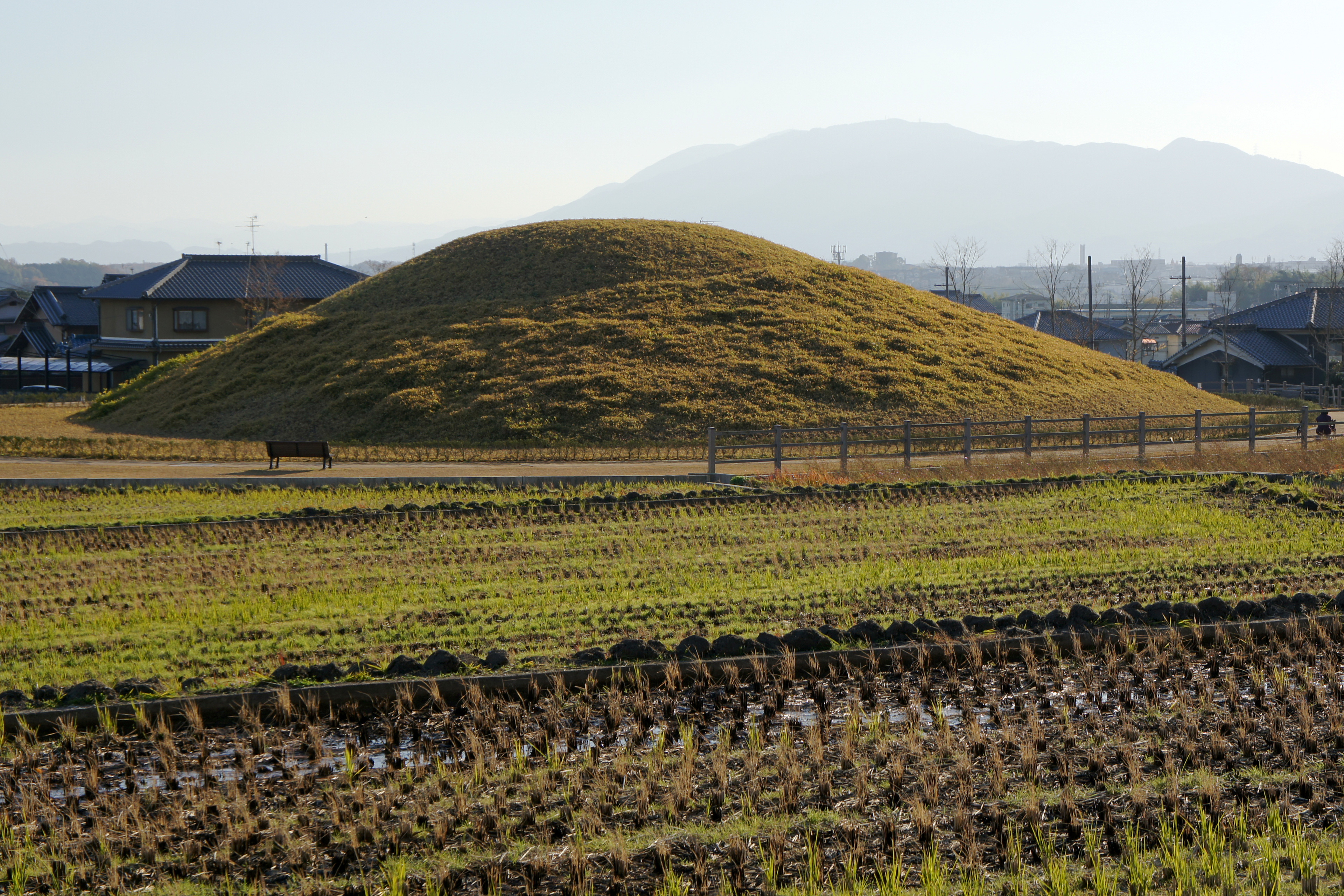
For fourteen centuries, a grassy mound sat quietly in a rice paddy 350 meters west of Horyu-ji, one of the oldest wooden structures on Earth. Farmers worked the fields around it. Buildings slowly encroached. Nobody dug. When archaeologists finally opened the Fujinoki Tomb in 1985, they found what almost never survives in Japanese burial mounds: an unlooted chamber. The horizontal-entry stone passage led to a room nearly fourteen meters long, its floor covered in gravel, a drainage ditch running beneath -- and at the back, a house-shaped stone sarcophagus painted inside and out with mercury vermilion. The white tuff stone had been quarried from Mount Nijo. Inside lay two bodies, a staggering array of gilded bronze objects, and a mystery that remains unsolved.
A Sarcophagus Sealed in Red
The burial chamber measures just under fourteen meters in total length, with walls rising over four meters high. The passage narrows from about 2.7 meters in the chamber to roughly two meters in the entry corridor, running 8.3 meters to the base of the mound. The sarcophagus itself -- about 235 by 139 by 152 centimeters -- is trapezoidal in plan, wider on its east side than its west, carved from white tuff and painted with cinnabar vermilion both inside and out. Rope-hanging protrusions on the lid suggest it was lowered into place with considerable ceremony. The tomb was not perfectly sealed against time. One corner of the sarcophagus shows chipping where, at some point, thieves attempted to pry off the lid. Unmatched pottery lids and vessels pushed to one side of the chamber hint that someone entered, rummaged, but ultimately left the richest treasures untouched. The grave goods that remained were so extraordinary that they were collectively designated a National Treasure.
Gold, Bronze, and the Question of Two Bodies
The excavation, conducted in six stages between 1985 and 2006, produced artifacts that stunned the archaeological world. Gilded bronze crowns, gilded bronze footwear, a divine beast mirror, dragon-patterned ornamental fittings, and an unprecedented collection of horse trappings emerged from the chamber. But the tomb's deepest puzzle lies in its occupants. Osteoarchaeologist Kazumichi Katayama of Kyoto University examined the remains and concluded both individuals were likely male, based on surviving ankle and heel bones. This raised immediate questions: the simultaneous burial of two men in a mound this elaborate was highly unusual for the period. Archaeologist Yoshiko Mabe of Kobe Women's University voiced skepticism. In 2009, researcher Tamaki Kazue of Nara College of Art and Design proposed the occupants were a man and a woman, arguing that certain wrist and foot ornaments matched female adornment patterns found on haniwa figurines and described in the Kojiki and Nihon Shoki. The debate continues.
More Horse Gear Than Any Known Tomb
The Fujinoki Tomb contained more horse trappings than any other known kofun in Japan. Multiple complete sets of saddle parts, stirrups, and bits lay in the chamber alongside the sarcophagus. The saddle fittings were spectacular: gilt-bronze arc-shaped ornaments adorned the wooden cantles, with a front bow that was fully and intricately decorated while the rear bow was left plainer, suggesting deliberate hierarchy in craftsmanship. The saddle bows held straps that would have looped under the horse for stability. Notably absent were the typical Japanese metal bits -- two linked mouthpiece sections. Researchers believe the Fujinoki riders may have used rawhide rope bits instead, reflecting the cost and scarcity of metal across parts of sixth-century Asia. These horse trappings provide critical evidence for understanding equestrian culture in ancient Japan, where clear proof of horseback riding only begins to appear in the fifth century with the arrival of wooden stirrups.
From Paddy Field to Public Park
The mound that once measured fifty meters in diameter and nine meters high has been worn down by centuries of surrounding agriculture and construction to about forty meters across and 7.6 meters tall. But what remains is now protected. Designated a National Historic Site in 1991, the Fujinoki Tomb sits within a landscaped park with information boards explaining the excavation history. The Ikaruga Cultural Properties Center, about 200 meters south of the tomb, displays replicas of the major finds. The Nara Prefectural Kashihara Archaeological Institute has gone further, using 3D printing to recreate the horse equipment so visitors can handle replicas of objects that were buried with their unknown owners nearly fifteen hundred years ago. The cylindrical haniwa clay figures found lining the mound's base also rewrote scholarly understanding: it had been assumed that haniwa installation in the Yamato region ended in the early sixth century, but Fujinoki's haniwa pushed that date forward, correcting decades of established thinking.
From the Air
Located at 34.61°N, 135.73°E in the town of Ikaruga, Nara Prefecture, approximately 350 meters west of the famous Horyu-ji temple complex. The burial mound appears as a low, circular grassy rise surrounded by modern development and rice paddies. From altitude, Horyu-ji's pagoda and temple roofs are the primary visual landmark. Best viewed at 2,000-3,000 feet AGL. Nearest major airports: Osaka Itami (RJOO) approximately 20 nautical miles northwest, Kansai International (RJBB) approximately 35 nautical miles southwest.