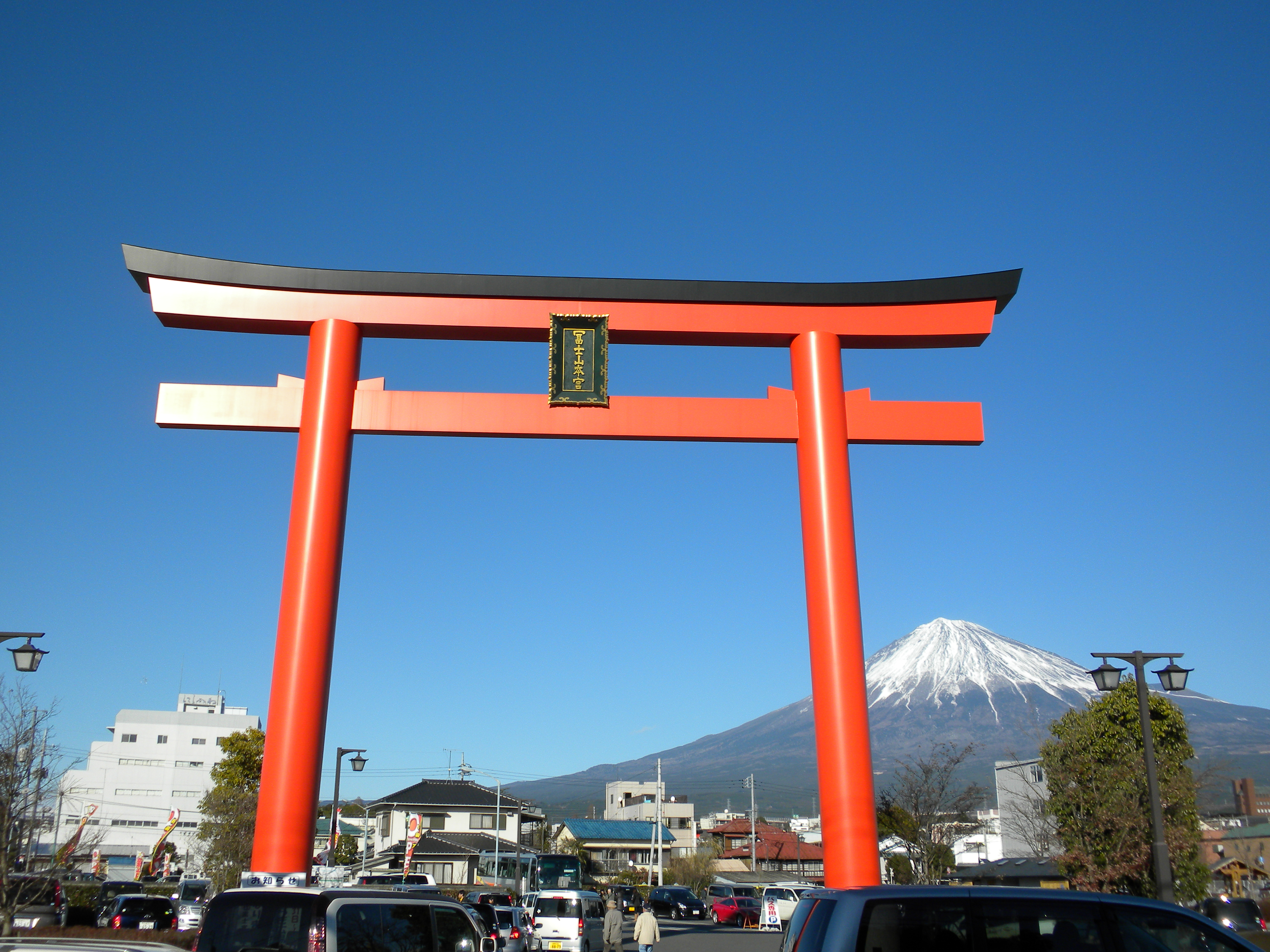
Fujisan Hongu Sengen Taisha
Most shrines own the land they sit on. Fujisan Hongu Sengen Taisha owns a mountain. Not metaphorically -- the entire summit of Mount Fuji, from the eighth station upward, is legally and spiritually part of this shrine's grounds. The arrangement dates back more than twelve hundred years, to an era when the volcano was erupting so violently that people built a shrine at its base to calm the goddess of fire who lived inside. Today, some 400,000 pilgrims climb Fuji every year, and a great many of them stop here first, at the head shrine of roughly 1,300 Asama and Sengen shrines scattered across Japan, to pray for a safe ascent.
Born from Fire and Fear
The shrine's founding predates written records. Tradition places its establishment during the reign of Emperor Suinin, with the first structure on its current site built under Emperor Keiko, during a period of intense volcanic fury on Mount Fuji. The logic was straightforward: if the mountain's kami -- Konohanasakuya-hime, the goddess of fire and daughter of Oyamatsumi -- was angry, build her a home and make offerings. Historical evidence picks up the thread in 781 CE, when the Shoku Nihongi records a major eruption, and by 853 the Nihon Montoku Tenno Jitsuroku notes the shrine had risen to third rank. The legendary hero Yamato Takeru is said to have prayed to Fuji's kami while fleeing danger in Suruga Province. During the reign of Emperor Heizei, the warrior Sakanoue no Tamuramaro was ordered to rebuild the shrine at its present location, cementing its authority over the mountain.
A Mountain Under Lock and Key
For centuries, Mount Fuji was forbidden ground. Only Shugendo monks -- ascetics known for punishing physical training -- were allowed on its slopes, and women were barred from climbing entirely. The shrine enforced this spiritual quarantine, serving as gatekeeper between the profane lowlands and the sacred peak. Pilgrimages began in earnest from the ninth century onward, but always under the shrine's authority. The designation of Fujinomiya's shrine as the 'Hongu' (main shrine) and the Shizuoka Sengen Shrine as the 'Shingu' (new shrine) reflected a careful hierarchy, even though Shizuoka sat closer to the old provincial capital. The ichinomiya -- the highest-ranking shrine of Suruga Province -- belonged here, at the foot of the mountain itself.
Tokugawa's Gift in Wood and Gold
The shrine's current Honden dates to 1604, built with funds donated by Tokugawa Ieyasu himself. Its distinctive sengen-zukuri style features a two-story gate tower unlike anything at other Shinto shrines. The Romon gate followed in 1614. Both survived the Ansei Tokai earthquake of 1854, though repairs were needed. Inside, the shrine guards treasures spanning centuries: a Kamakura-period sword inscribed with the name Kanemitsu, a noted swordsmith from Bizen active between 1306 and 1334, said to have been donated by the warlord Takeda Shingen. A Muromachi-period scroll, measuring roughly 180 by 118 centimeters, depicts an idealized Fuji in gold, with three divine summits, white-robed pilgrims snaking up the slopes, and the sun and moon flanking the peak. Armor believed donated by Takeda Katsuyori bears the four-eye diamond crest of the Takeda clan's main branch.
The World Comes Calling
In 2006, the shrine celebrated the 1,200th anniversary of its founding. Seven years later, in 2013, UNESCO inscribed it as part of the Fujisan Cultural Site, a World Heritage designation that recognized not just the mountain's natural beauty but its deep spiritual significance to Japanese culture. Every May 5, the shrine's main festival fills the grounds with the thunder of hooves and the crack of bowstrings as mounted archers perform yabusame -- horseback archery rooted in Kamakura-era warrior traditions. The shrine sits a ten-minute walk from Fujinomiya Station on JR Central's Minobu Line, placing it squarely in the modern city even as it anchors one of Japan's oldest living religious traditions.
From the Air
Located at 35.2275N, 138.6103E in Fujinomiya, Shizuoka Prefecture, at the southern base of Mount Fuji. The shrine complex is visible in downtown Fujinomiya, identifiable by its large torii gate and forested grounds amid the urban grid. Mount Fuji dominates the northern horizon. Recommended viewing altitude: 3,000-5,000 feet for shrine context with Fuji backdrop. Nearest airports: Mt. Fuji Shizuoka Airport (RJNS) approximately 30nm southeast, Chofu Airport (RJTF) approximately 55nm east. Clear weather essential for Fuji views; morning flights offer the best visibility before afternoon cloud buildup.