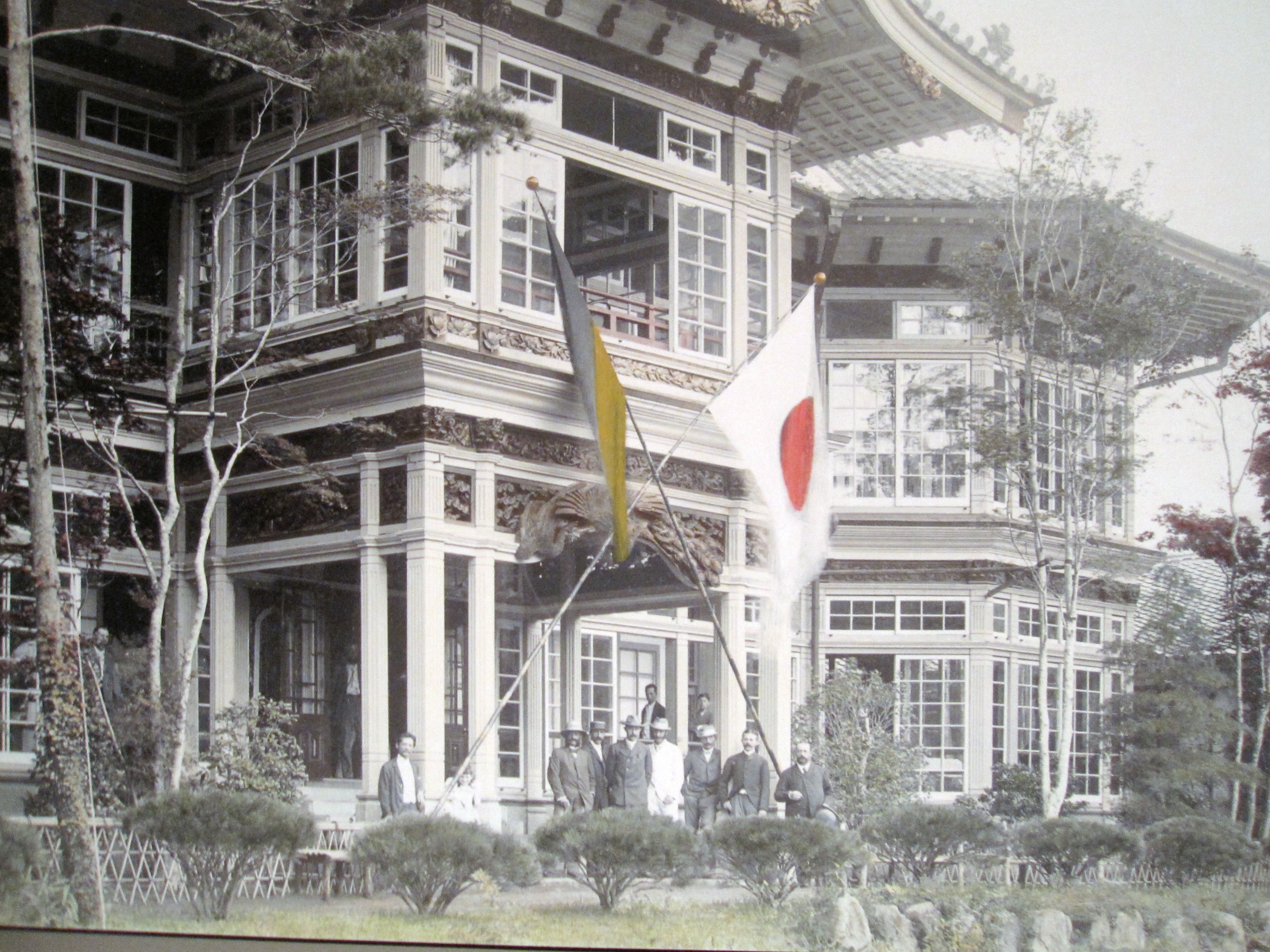
Fujiya Hotel
The guest register reads like a fever dream of the twentieth century. Archduke Franz Ferdinand signed in during his 1893 tour of Japan, twenty-one years before his assassination would ignite a world war. Charlie Chaplin stayed. So did Helen Keller, Albert Einstein, and John Lennon, who brought Yoko Ono and their son Sean in 1978. The Fujiya Hotel has been collecting these improbable signatures since 1878, when a Yokohama industrialist named Sennosuke Yamaguchi bought a 500-year-old inn in the mountain hot-spring village of Miyanoshita and reinvented it as Japan's first full-scale Western-style resort hotel. Nearly a century and a half later, its temple-roofed silhouette still presides over Hakone's steaming valley.
Where East Built West
Yamaguchi was a Keio University graduate who saw an opportunity in the Meiji era's rush to modernize. Foreign diplomats and traders flooding into Yokohama needed somewhere to escape the summer heat, and Hakone's hot springs had drawn visitors for centuries. So he took the ancient Fujiya inn and transformed it into something Japan had never seen: a hotel with Western beds, Western dining, and Western plumbing, all wrapped in unmistakably Japanese architecture. The Main Building, completed in 1891, set the tone: louvered windows and grand parlors beneath a sweeping temple-style roof. Additional wings followed over the decades, each blending Western comfort with Japanese ornament. Today, three historic buildings -- THE MAIN, the COMFY LODGE & RESTFUL COTTAGE, and the FLOWER PALACE -- are designated Tangible Cultural Properties of Japan, recognized as Industrial Heritage of Modernization.
The Archduke's Room and the Lennon Suite
The hotel's celebrity pedigree is not mere name-dropping; it reflects Japan's place at the crossroads of global history. When Archduke Franz Ferdinand visited in 1893, Japan was still a novelty for European royalty, and Hakone was becoming the gateway through which the world encountered Japanese hospitality. By the 1930s, judges of the British Supreme Court for China and the Chief Justice of Hong Kong were posing for photographs on the hotel's veranda. After the war, the hotel's associated Fuji View Hotel at Kawaguchi-ko briefly served as a refuge for German Embassy personnel, and on September 6, 1945, just four days after Japan's formal surrender, agents of the US Counter-Intelligence Corps arrested Gestapo Colonel Josef Albert Meisinger there. Through it all, the Fujiya kept its doors open, absorbing history into its walls the way its wooden beams absorb the sulfurous mountain steam.
A Hotel That Published Books
In 1934, the Fujiya Hotel embarked on an unlikely side project. In collaboration with the Yamagata Corporation, it began publishing a series of books explaining Japanese customs to its international guests. The final volume appeared in 1949, and the three were eventually bound together under the magnificently long title We Japanese: Being Descriptions of Many of the Customs, Manners, Ceremonies, Festivals, Arts and Crafts of the Japanese, Besides Numerous Other Subjects. Editions continued at least until 1950. The books were more than marketing; they were an act of cultural translation, offered by a hotel that understood its role as a bridge between worlds. Decades later, novelist J. David Simons, who stayed at the Fujiya multiple times during the seven years he lived in Japan in the 1990s, set his best-selling novel An Exquisite Sense of What is Beautiful in the hotel, spanning both the 1950s and the present day.
Shaken and Restored
The Fujiya Hotel closed in 2018 for a comprehensive seismic renovation, prompted by updated earthquake-resistance standards. For two years, engineers strengthened its century-old bones while preserving the ornate interiors and hand-carved woodwork that generations of guests had admired. It reopened on July 15, 2020, its historic character intact but its structure braced for the tremors that periodically rattle Hakone's volcanic landscape. The renovation was a statement of commitment: rather than demolish and rebuild, the owners chose the painstaking work of reinforcing what already existed. Walking the corridors today, past the same carved transoms and painted ceilings that Franz Ferdinand once passed beneath, you sense the hotel's enduring argument that hospitality is itself a form of preservation.
From the Air
The Fujiya Hotel sits at 35.244N, 139.059E in the Miyanoshita hot-spring area of Hakone, Kanagawa Prefecture. From the air, look for the distinctive temple-roofed buildings nestled in the narrow valley of Hakone's volcanic terrain, surrounded by dense forest and wisps of hot-spring steam. The hotel is southwest of Odawara along the winding Hakone mountain road. Nearest airport is RJTT (Tokyo Haneda), approximately 85 km northeast. For scenic approach, follow the Sagami Bay coastline south from Odawara and turn inland toward the Hakone caldera. Recommend viewing at 3,000-4,000 feet. Steam vents and the bright green of the surrounding forest help identify the Miyanoshita area.