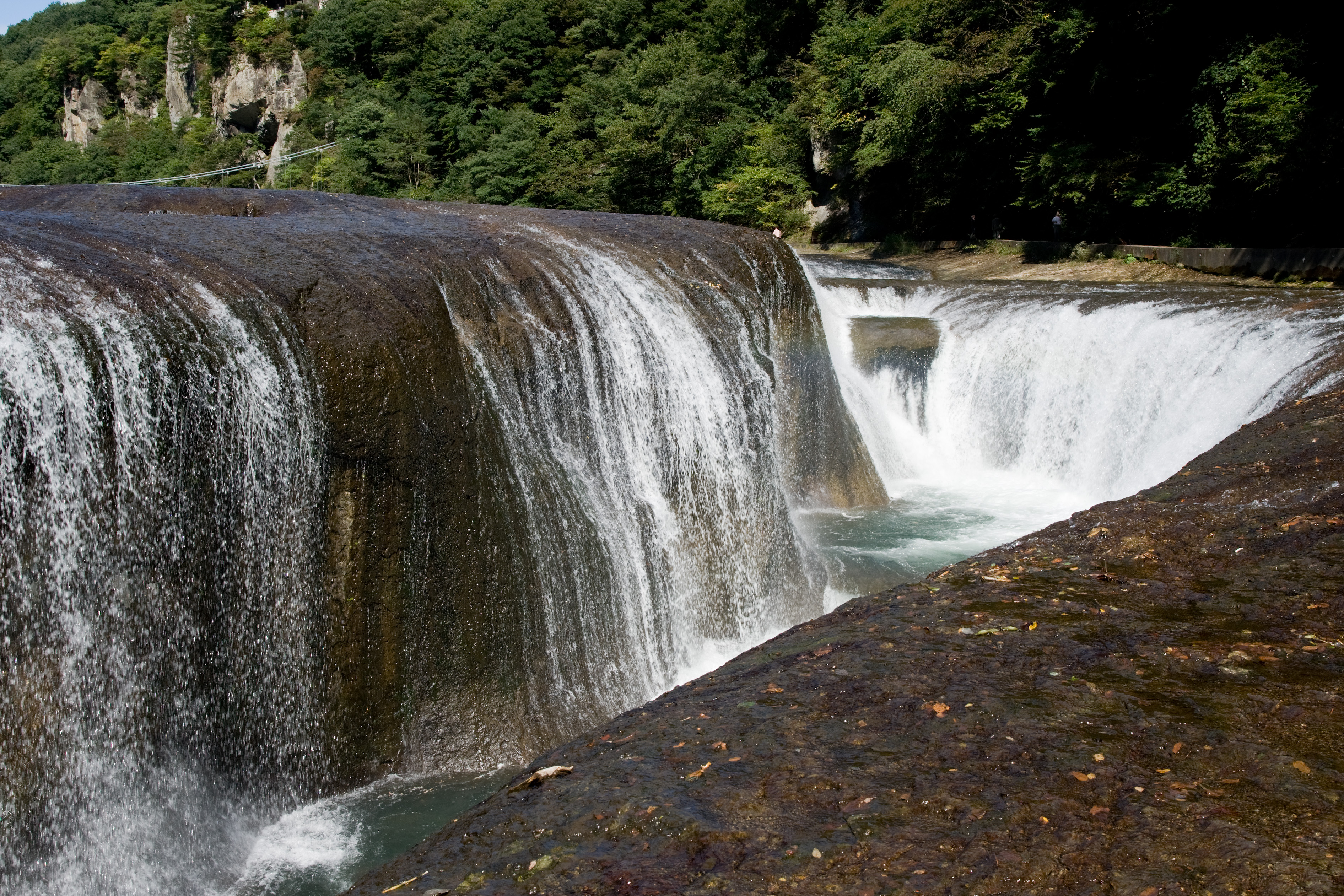
Fukiware Falls: The Oriental Niagara Carved by Ancient Fire
Every child who grows up in Gunma Prefecture learns about Fukiware Falls before they ever see it. The waterfall appears on the 'ta' card of Jomo Karuta, a card game published in 1947 that teaches Gunma's children the landmarks, heroes, and natural wonders of their home prefecture. Annual tournaments have been held since 1948, and generations of Gunma residents can recite all forty-four cards from memory. So by the time a local child finally stands on the promenade above the Katashina River and watches the wide curtain of water pour over that tuff cliff, the sight arrives already wrapped in meaning -- not just a waterfall, but a piece of identity. And the falls live up to their card.
Born in Fire, Shaped by Water
Nine million years ago, a massive volcanic eruption sent pyroclastic flows roaring through this part of northern Gunma. The superheated debris cooled and compressed into tuff -- a type of rock formed from volcanic ash that is sturdy enough to hold its shape but soft enough for water to sculpt over millennia. The Katashina River found these tuff cliffs and went to work. Today, the falls stand seven meters tall and stretch thirty meters wide, the river pouring over three sides of a broad cliff face in a display that prompted the Numata City Tourism Board to dub them the 'Oriental Niagara.' The comparison is generous in scale but apt in character: like Niagara, Fukiware's power comes from breadth rather than height, the water spreading into a wide curtain that thunders into the gorge below.
The Ravine Below
Below the main falls, the Katashina River enters the Fukiwari Ravine, a gorge carved between the confluences of the Hikawa River upstream and the Kurihara River downstream. The riverbed here is pockmarked with potholes -- smooth, rounded depressions ground into the rock by centuries of swirling water and trapped stones. The largest potholes stretch six to seven meters along their long axis, deep enough to hold standing water in their bowls. Two smaller waterfalls cascade further downstream within the ravine. A promenade follows the river through the gorge, completed in 1991 with three lookout decks offering views from different angles. At the entrance, souvenir shops cluster where visitors pause before descending into the spray.
A Cliff in Retreat
Fukiware Falls is not standing still. The constant volume of water flowing over the tuff cliff face drives severe erosion, and the falls are receding upstream at a rate of approximately seven centimeters per year. That steady retreat has been reshaping the gorge for millennia, slowly extending the ravine deeper into the landscape. The same softness that allowed water to carve this scenery in the first place means the scenery is always changing, the cliff edge inching back one season at a time. The falls earned national recognition as a Place of Scenic Beauty and a Natural Monument, twin designations from Japan's Agency for Cultural Affairs. In 1990, the Ministry of the Environment added Fukiware to its list of Japan's Top 100 Waterfalls. The falls also appeared as the backdrop for the opening credits of the 2000 NHK Taiga drama Aoi, bringing their image into living rooms across the country.
A Mountain Waterfall Within Reach
Despite their dramatic setting in the upper reaches of the Katashina River, Fukiware Falls remain accessible. The drive from the Numata Interchange on the Kan'etsu Expressway takes about thirty minutes, winding through the forested hills of northern Gunma. Numata itself sits on a river terrace high above the Tone River valley, a castle town with its own layers of history. The falls draw visitors year-round, but the contrast between seasons defines the experience: in spring, snowmelt swells the Katashina and the curtain of water roars at its fullest; in autumn, the surrounding forest lights up in red and gold maple, framing the white water against fiery hillsides. Winter brings a quieter spectacle, with ice forming along the edges of the falls while the center keeps flowing, the river refusing to freeze entirely even as the mountains around it go still.
From the Air
Located at 36.702N, 139.207E in the upper Katashina River valley, northern Gunma Prefecture. From altitude, the falls appear as a break in the forested river gorge where the Katashina widens before dropping over the tuff cliff. The Fukiwari Ravine runs downstream through dense forest. Nearest significant airport is Tokyo Haneda (RJTT), approximately 150km to the south-southeast. Niigata Airport (RJSN) lies about 140km to the north-northwest. Best viewed below 3,000 feet AGL to spot the white water against the dark gorge. The Kan'etsu Expressway is visible as a reference line running north-south through the valley.